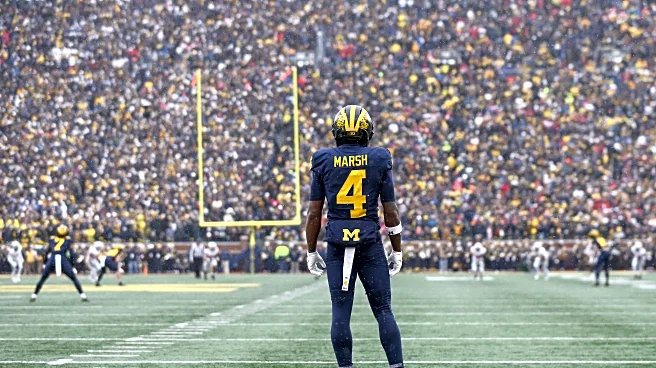




Andrew Marsh burst onto the college football scene in 2025 as a true freshman. The 6-foot, 190-pound wide receiver out of Katy, Texas hauled in 45 receptions for 651 yards and four touchdowns. In the process, he put his name in the Michigan football record book quite a few times.
Heading into his second season, what should fans expect out of Marsh as a sophomore in 2026?
Let’s start by giving some additional context on what Marsh accomplished in 2025. His 12 catch, 189 yard performance against Northwestern
at Wrigley Field vaulted him to No. 5 in Michigan history for single-game receptions and No. 6 in program history for single-game receiving yards. On the season, Marsh ranked second in the country when it came to receiving yards out of a freshman.
In recent Michigan history, there is no comparison to what Marsh did last season as a true freshman. Andrel Anthony had one big game in East Lansing in 2021, but was a non-factor outside that game. Roman Wilson appeared a decent amount in the long-forgotten 2020 season but didn’t produce much. The most we’ve seen of a freshman wide receiver at Michigan is likely Semaj Morgan as a gadget player and punt returner in 2023.
Going a little bit further back in time doesn’t bring many comparable players either. Donovan Peoples-Jones had 22 receptions for 277 yards and zero touchdowns in 2017. Even Braylon Edwards only had three catches for 38 yards in 2001.
There is only one even halfway-decent comparison: Mario Manningham. He played extensively as a true freshman in 2005, catching 27 passes for 442 yards and six touchdowns. He was also used sparingly on the ground and in the return game, just as Marsh was in 2025.
The next logical question is “how did Manningham do as a sophomore?” The answer is his production increased significantly despite an injury. Mario hauled in 38 passes for 703 yards and nine touchdowns as a sophomore in 2006 despite only playing in nine games.
That’s a 59 percent increase in yardage despite playing in fewer games. If Marsh were to increase his yardage by 59 percent, he would be well over a 1,000-yard receiver in 2026.
With only one good comparison at Michigan, let’s open up the sample size and look nationally. Keep in mind we are only comparing Marsh’s stat line with other true freshmen historically, not his play style or offensive scheme.
True Freshmen Seasons
The closest comparison to Marsh’s freshman season appears to be Arizona’s Tetairoa McMillan. Romeo Doubs also had a similar stat-line, though his was at a lower level of competition in Nevada.
Now let’s take a look at each of these players sophomore and junior campaign statistics.
Sophomore Seasons
Junior Seasons
McMillan really upped his game following his freshman season. He had 1,300 or more yards in each of his next two seasons before being drafted No. 8 overall to the Carolina Panthers. Similarly, Rashard Higgins burst onto the scene as a sophomore before falling back to reality a bit as a junior. Doubs and Elijah Moore showed solid improvement from their freshmen to sophomore seasons, but neither really popped until their junior seasons.
It’s worth noting none of these historical comparisons saw a decline in production in their second year. While anything can happen in football, it’s certainly encouraging for Marsh’s outlook heading into 2026.
Should Marsh’s stat line take the same jump as the players listed above, we would be looking at a 1,000-yard receiver with near double-digit touchdowns. For context, Michigan has only had 12 1,000-yard receiving seasons all-time, with the most recent being Jeremy Gallon in 2013 with 1,373 yards.