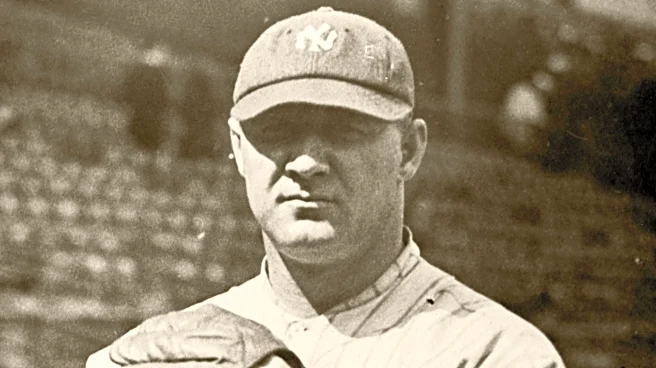



Francesco Stephano Pezzolo was born in San Francisco, California, in 1887. That man would later be known as Frank Stephen Bodie and, eventually, Ping Bodie. Bodie felt the need to change his name out of fear of being mocked and discriminated against for his Italian heritage. The Ping portion of his name came from the sound of him hitting baseballs with a legendary 52-ounce piece of lumber, and the Bodie part he adopted from a town in California that was special to him and his family.
Frank Stephen
“Ping” Bodie
Born: October 8, 1887 (San Francisco, CA)
Died: December 17, 1961 (San Francisco, CA)
Yankees Tenure: 1918-1921
There is not much recorded on Bodie’s childhood, but he came into the public eye around 1905 while playing baseball in the California State League at just 17 years old. The young ballplayer was moved all over the field and played for a variety of independent league teams before catching on with the San Francisco Seals in 1908.
With the Seals, Bodie stopped bouncing around positions and started primarily roaming the outfield grass. During the 1910 season, Bodie had a breakout season for the Seals, hitting an unheard-of 30 home runs during the deadball era. The power surge placed the young right-handed hitter on the radar of every big league club. In September of 1910, Bodie was drafted by the Chicago White Sox in the Rule 5 draft.
After that impressive season, Bodie was invited to spring training and broke camp with the White Sox in 1911 but found himself mostly riding the pine. After the team started slowly on offense, owner Charles Comiskey publicly criticized the team and called out the offense. Allegedly, the rookie Bodie, with true American-Italian bravado, walked right up to the owner the next day and told him he could be the answer to his problems if he could get him in the lineup. The rest, as they say, is history. In 145 games as a rookie, Bodie slashed .289/.348/.407 with four home runs, good for a 2.8 WAR.
In Chicago, Bodie rose to fame due to his powerful swing and big personality. A showman and entertainer at heart, the press fell in love with the humor and charisma Bodie brought to the ballpark every day. After a successful rookie year, there would be no sophomore slump. In 1912, he hit five more home runs and slashed .294/.358/.407. For the second straight season, he was tied for the team lead in home runs as the White Sox finished just above .500 for the second straight season.
The 1913 season was a weird one for Bodie as he set his career high in home runs with eight. Those eight long balls were good for third in the league. However, Bodie’s average dropped to .264, and for the first time, his slugging finished below .400 at .397. The decline did not stop for Bodie in 1914. A season-long struggle caused conflict with manager Jimmy Callahan. After Bodie finished with a .229 batting average and three home runs, the White Sox sold him back to the Seals.
Despite his big league success, Bodie accepted going back to the Pacific Coast League. Bodie completely dominated for the next two seasons. The Philadelphia Athletics needed offense and signed Bodie ahead of the 1917 season. Bodie did not disappoint, slashing .291/.356/.418 with seven home runs, good for third in the league again. The Athletics finished the season 55-98-1. Bodie would later joke that he was the only ticket in town other than the Liberty Bell that year. In March of 1918, the Athletics traded Bodie to the New York Yankees for George Burns, who was a Yankee for as long as it took the paperwork to process after being purchased from Detroit only to be flipped.

Bodie’s age-thirty season was his first in pinstripes, and he slashed .256/.319/.358 and finished seventh in the league with three home runs. Unfortunately for Bodie, the Yankees did not fare much better than any of his previous clubs, finishing the 1918 season 60-63-3. However, he started the legendary run of San Francisco Italians in the Bronx.
Both Bodie and the Yankees turned things around in 1919. The club went 80-59-2. Bodie slashed .278/.334/.406 with six home runs. The turnaround might have been due to the fact that Bodie scored a big win in an eating contest in April of that year. In a publicity stunt, Bodie competed against a Jacksonville Zoo ostrich named Percy in a spaghetti eating contest. Legend has it that Bodie won on the 11th plate as Percy could not finish his, and Bodie finished it for him.

The Yankees made a splash following the 1919 season by acquiring Babe Ruth. Bodie got the honor of being Ruth’s first roommate on the Yankees for the 1920 season, a role that he absolutely loved due to the extra attention brought his way from the presence of Ruth. The Yankees went 95-59 on the year, and Bodie had one of the best seasons of his career, slashing .295/.350/.446 with seven home runs.

As much fun as 1920 was, the 1921 season saw the good times finally run out for Bodie as his production fell off the table. In 31 games, Bodie hit .172 with no home runs. In August, the Yankees traded him to Boston. New York went on to win the American League pennant that year but fell in the World Series to the Giants. After the season was over, Bodie refused to go back to the Red Sox and returned home.
Not yet done with baseball, Bodie played in the minors for another seven years. After retiring from the game, he took up work as an electrician in Hollywood. For over thirty years, he worked on sets and got roles as a bit actor with Universal Studios. At age 74, in his hometown down by the bay, Bodie died of lung cancer.
Happy birthday, Ping!