



Not everyone who writes for Roker Report knows each other; in fact, many of us aren’t even in the North East.
A couple of years ago, two of our “silver foxes” (Lars and Kelvin) met up on the beautiful island of Lindisfarne, as it had become clear that it was a place that was close to our hearts. Last summer, I decided to join the wise men, and so I met with Lars to revisit the Lindisfarne Liturgies
.To complete the trilogy, myself and Kelvin met up last month at the new arranged venue of the brilliant
Barter Books in Alnwick, where we’d had a pre arranged subject of our favourite Sunderland teams of the 1960s, 1970s and 1980s.
I looked around the old train station and saw a very studious and distinguished-looking gentleman who was obviously making final adjustments to his lists in a waiting room/cafe area. Some of you might be aware of Kelvin as one of the voices of “On This Week” feature on the Haway the Podcast. I had a good idea of what Kelvin looked like, but if I had had to identify everyone in Barter Books by their voice, I would’ve identified him immediately!
After having a general chat, we got down to business, revealing each other’s chosen teams.
From my own point of view, it had taken me a full fun afternoon of research and going through my books and the internet to compile my squads. But as we talked, it became evident from some of our choices that “the rules” needed to be firmed up somewhat — picking a team from a particular decade isn’t so easy when some players turned out for the Black Cats from, say, 1968 to 1972.
There were many players caught in this “crossover” period so the teams that appear below are much closer to a team of 1965 to 1972, 1973 to 1982 and 1983 to 1990. We also agreed that we had to have seen the players live, and Jimmy Montgomery was allowed to be in two separate teams due to the longevity of his career.

If I encountered some inner turmoil over who to pick, I often resorted to the player who’d been credited with the most appearances for the Lads. But as we discussed, supposing Lionel Messi had played two or three games for us, would that allow him to appear in the “team of the decade” list? Maybe it would, we agreed.
Many of the choices are players whom we just happened to like — our favourites and not necessarily the most skillful or with the most appearances. The 1960’s was the most difficult period as we were both just young lads, not even teenagers, and there weren’t many entrants before 1965, when we would’ve seen our first games.
The formation was also a problem, but we tried to not let this get in the way too much, with the old fashioned line up of right back, centre half, left back, right half, left half, inside left, inside right, right winger, left winger and centre forward being loosely adopted — in modern parlance, it would be 3-2-2-3.
John’s Sunderland team of the 1960s: The Ian McColl and Alan Brown eras
Montgomery, Irwin, Hurley, Todd, Ashurst, Herd, Baxter, McNab, Suggett, Clough, Mulhall
Subs: Harvey, Suggett
I have to admit that I never saw Clough play but in all seriousness, I couldn’t leave out one of the greatest goal scorers in our history — and a big debate here was whether to go for Dick Malone or Cec Irwin. Choices!
Kelvin’s team of the 1960s
Montgomery, Malone, McNab, Todd, Hurley, Harvey, Herd, Suggett, Martin, Baxter, Mulhall
Subs: Ashurst, O’Hara

We were in much more comfortable territory when we moved into the 1970’s.
By then, we were both teenagers and going to games on our own. Memories were starting to be more vividly formed — some that would stay with us for the rest of our lives — and the 1973 FA Cup win (as things stand at the moment) was perhaps the best Sunderland experience in our life times.
Our 1970’s teams are quite similar — except I couldn’t remember Docherty. We also disagreed on the era into which we should place the recently-departed Gary Rowell, with Kelvin opting to put him in his 1980s squad.
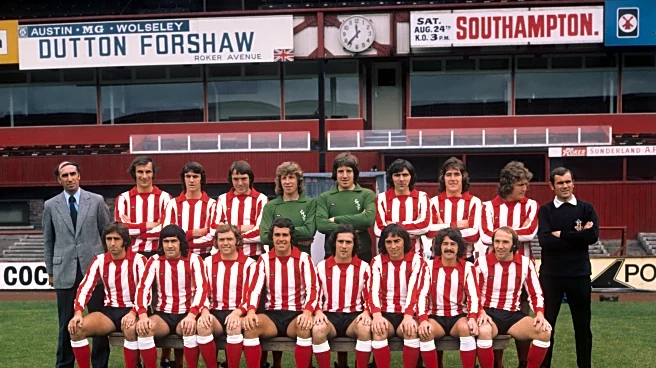
John’s team of the 1970’s: The Bob Stokoe, Jimmy Adamson and Billy Elliott eras
Montgomery, Chisholm, Watson, Clarke, Bolton, Robson, Hughes, Arnott, Kerr, Rowell, Tueart
Subs: Halom, Towers
Kelvin’s team of the 1970s
Montgomery, Docherty, Watson, Clarke, Bolton, Kerr, Towers, Porterfield, Hughes, Halom, Tueart
Subs: Arnott, Robson

By this time, we were getting funny looks from some other customers who were queuing up outside to get a seat in the cafe — especially as us “big spenders” had only bought one coffee each — so we decided to move into the main body of the library, onto one of the comfy seats.
Typical of the free-flowing conversation we’d had all morning, we happened to sit right in front of the sports section in the library.
A Chris Waddle autobiography stared us in the face, so cue a Waddle chat. There was also a Geoff Hurst autobiography, so cue Hurst chat, the 1966 World Cup, etc! It was that kind of morning.
The 1980s are almost up to date in my head, so it’s even less of a problem.
John’s Sunderland team of the 1980s: The Ken Knighton, Alan Durban, Lawrie McMenemy and Denis Smith eras
Turner, Burley, Bennett, Elliott, Agboola, Armstrong, Gates, Bracewell, Cummins, Gabbiadini, Owers
Subs: Venison, Pascoe, MacPhail
Kelvin’s team of the 1980s
Turner, Venison, Bennett, Elliott, Atkins, Pickering, Bracewell, Proctor, Cummins, Gabbiadini, Rowell
Subs: Gates, Hindmarch

As you can see, there were many crossovers, differing memories and favourites, but generally similar teams. We sometimes dabbled with formations to fit our favourite players in, but it was just a bit of fun!
Sometimes it was like choosing your favourite child; so much so that Kelvin wanted to give a mention to the following players who just missed the cut…
Keith Coleman, John Parke, Bobby Park, Barry Siddall, Wilf Rostron, Richie Pitt, Steve Whitworth, Mel Holden, Clive Walker and Leighton James.
Is it a coincidence that as we went through the eras, the number of managers increased from two, to three, to four?
We could’ve spent all day discussing our teams — especially in the serene surroundings of Barter Books — and it was great to meet Kelvin and put a face to the dulcet tones. Hopefully we can catch Lars when he’s next in the country, bring in some new faces, and compile a fourth reading of the Lindisfarne Liturgies this summer.