
Even if it is well past the midway point of the season, the second-half push that comes after the All-Star break is very real. With the playoffs quickly approaching, the sense of urgency builds and crescendos throughout the postseason.
For the Lakers, a rocky January dropped them into a crowded pack in the middle of the standings. Only three games separate the No. 3 seed Denver Nuggets and the No. 7 seed Phoenix Suns with the Lakers positioned right in the middle at the No. 5 seed.
With no only home
court advantage at stake, but a fight to remain out of the play-in, the Lakers could not have gotten healthy at a better time. With their full roster available to them, LA is going to have everything needed to make a push.
The question is, who are the most important players in their final 28 games of the regular season and ensuing postseason run?
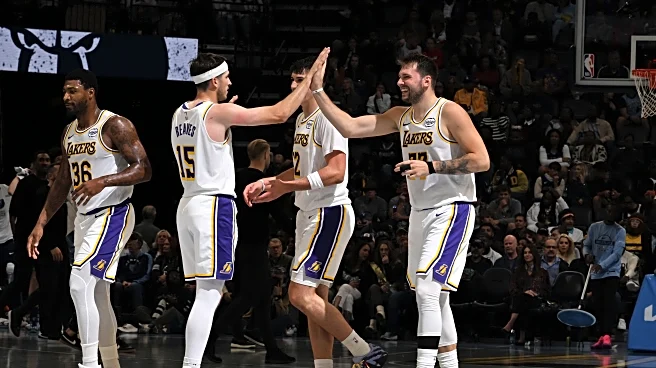
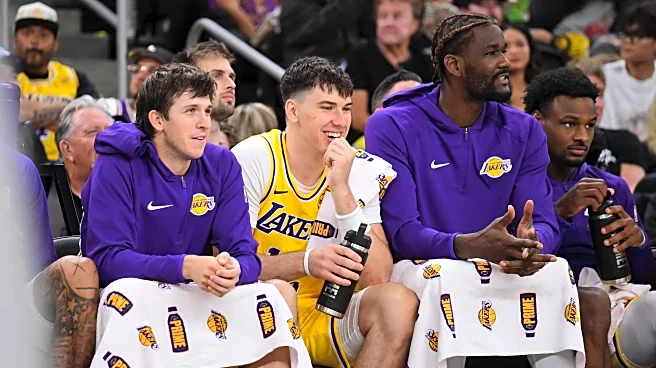
Austin Reaves
Luka Dončić and LeBron James can be the de facto answers to this question, but that’s also a given. If their superstars don’t show up, they’re in trouble.
But Reaves is still a pretty big x-factor. For one, it’s been a long time since we’ve seen the version of Austin Reaves who was consistently putting up 25 points per night. While he did have a 35-point game off the bench recently and was limited by a minutes restriction prior to the All-Star break, the last time he had back-to-back 25-point games was in early December in Toronto and Boston.
With his minutes restriction lifted, the Lakers need the best Reaves to show up again. But he, too, also has some demons to slay from last year’s playoffs as well. His rather woeful showing against the Wolves in the playoffs — where he was hampered by a toe injury — played a notable role in the team’s quick exit.
If Reaves is back to his best, the Lakers have an elite offense and can cause problems for any team. Without him at his best, they become very beatable very quick.
Deandre Ayton
It’s been a roller coaster season for Ayton, who flew out of the gates and looked like a steal and potential long-term solution at center for the Lakers.
In his first 23 games, he averaged 15.3 points, 9 rebounds and shot 71% from the field as the Lakers jumped out to an 18-7 record.
But things have changed quite a bit since then.
A drop in production has led to a drop in minutes and, often, Ayton watching from the bench in the final minutes of the fourth quarter. In those first 23 games, he averaged 29.4 minutes per game and, more specifically, 7.2 minutes per fourth quarter.
In the 23 games since, everything has gotten worse. He’s averaging only 11.2 points and 8 rebounds, now on 63% shooting. His overall minutes have dropped to 27.2 per game and he’s only playing 5.2 minutes in fourth quarters on average.
The best version of the Lakers also includes an engaged, involved and active Ayton. They had that early in the year but lost it somewhere along the way in that aforementioned rocky January.
Everyone saw what happened last year when the Lakers did not have a reliable center in the playoffs. Will things keep trending in that direction for the remainder of the second half of the season or will Ayton find his early-season form once more?
The return of Reaves to the starting lineup, a pick-and-roll partner he had great chemistry with, should help things. But it’s also on Ayton to step up and get back to that level, too, or risk really damaging his standing not just with the Lakers, but within the NBA.
Ayton spoke in the offseason about the importance of this season in regard to how he’s viewed around the league. Not since his run to the Finals has there been a more important stretch in Ayton’s career.
Jake LaRavia
Realistically, I think you could make an argument for any of Marcus Smart, Rui Hachimura and LaRavia as the most important.
Smart seems like the frontrunner, for now, to remain in the starting lineup with everyone healthy while Rui will have the Sixth Man role locked down in the meantime. That leaves LaRavia, who has fluctuated between looking like a nailed-on fifth starter and unplayable at times this season.
Unfortunately, it’s been more of the latter as the season has progressed. The most notable struggles this season have been from range where he’s shooting 32.6%, a career-worst mark.
The Lakers also showcased a remarkably thin bench last season. LaRavia was brought in as part of an upgrade and a long-term play over Dorian Finney-Smith. He’s shown flashes of potential, but the Lakers need consistency and production.
For a bench that has ranked at the bottom of the league in scoring, LaRavia could be a big spark in the big games alongside Rui. But he is going to have to start producing offensively.
You can follow Jacob on Twitter at @JacobRude or on Bluesky at @jacobrude.bsky.social.