




Time is linear: At least, in terms of human perception.
Little else is.
An NBA career is certainly not always linear. There’s a tendency to falsely assume it will be. A rookie is bad on league-wide standards, and we accept it. They improve incrementally until year three, when they’re officially good, and then continue to improve incrementally until they peak, and start to decline. That’s how an NBA career goes, right?
On rare occasion, sure. Usually, a player’s career is more chaotic. They decline significantly
in their third year. Fans think they’re done – until year six, when they have a career-best season. That’s the new baseline, they incrementally improve for two more seasons, fall off – etc, etc.
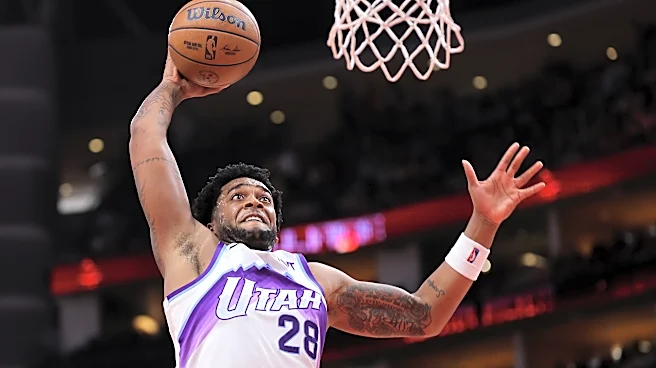
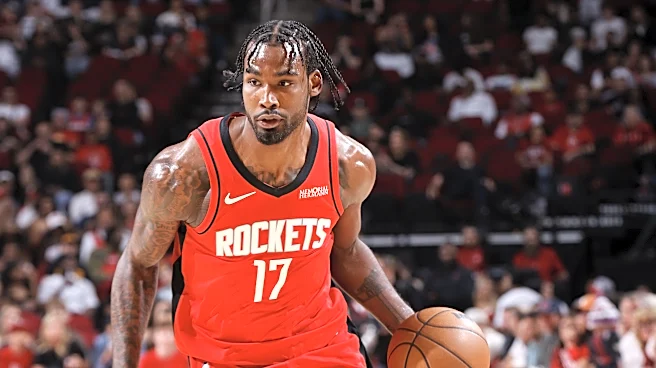
As always, theory is clean, and reality is messy. Unfortunately, the 2025-26 season has been a bit of a mess for the Houston Rockets’ Tari Eason.
Rockets’ Tari Eason has had a strange year
Much of 2025-26 was looking like a coming-out party for Eason. Before the All-Star break, Eason was averaging 12.2 points per game while hitting 46.0% of his 4.8 threes per game.
Sure, he seemed to be regressing in other areas. Eason’s 7.1 Offensive Rebounding % during that stretch had ticked down from 2024-25’s 8.1 mark. His 25.5% steal percentage was a major drop off from his 39.1% in 2024-25. It seemed safe to assume that those numbers would normalize.
If only it were possible for assumptions to be safe.
Instead, it was his shooting that normalized. Perhaps fans should have seen that coming as well. Shooting variance disrupts linearity like a 7/8 time signature. Eason has struggled to get a rock into an ocean since the break.
Now, he’s shooting 36.9% from deep on the season. That’s barely a career high, while he’s still posting career lows in the two areas (offensive rebounding and steals) that once made him special. The fact that this all comes after Eason allegedly turned down a deal worth $100 million over four seasons this summer.
What should the team do with him now?
Rockets should still prioritize Eason
Having declined that extension, Eason will hit Restricted Free Agency this summer.
Every foray into RFA does not look the same. The league’s cap landscape has to be surveyed. Heading into this summer, the only space-heavy team that looks like a real threat to wrestle Eason from the Rockets would be the Los Angeles Lakers.
All the Rockets have to do is identify their breaking point and hold the line. The $25 million per season they once earmarked for Eason is likely off the table. Would they do $20 million? Surely, they’d do $15 million?
Here’s the thing: Eason is sure to make good on a $15 million per season contract. Fans have grown tired of his warts. Eason indeed plays basketball like a bull in a China shop. He’s reckless, and the only question is whether it benefits Houston or the opposing team more often.
For most of his NBA career, the answer has been Houston.
It may be callous to suggest, but his poor play ahead of RFA could be a blessing. Ultimately, we should only feel so bad for someone who missed out on $40 million if they’re still getting more money over four years than 99.999% of Americans will ever make in a lifetime. From the Rockets’ perspective, it’s well worth gambling $15 million a year – probably even 20 – that Eason will exceed that contract value.
Who knows where his career could go from here?