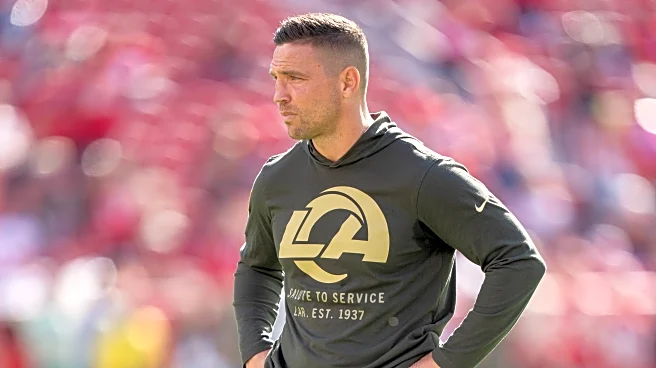


Over the second half of the 2025 season, the Los Angeles Rams defense took a lot of criticism, with a lot of that landing on defensive coordinator Chris Shula. However, while the defense, and specifically the secondary, ended up being the downfall of the Rams’ season, Shula won’t be going anywhere. After interviewing for multiple head coaching positions, Shula wasn’t hired and he is set to end year three as the Rams defensive coordinator.
While it may not be a majority, there are some that would like
to see McVay move on from Shula. Those voices get even louder when names like Jim Schwartz and Brian Flores were available after the season. However, especially in the case of Schwartz, it’s hard to see the fit with that Rams defense. Even if the Rams were to move on from Shula, the ethos and general ideology of the defense won’t change.
The defensive coordinator may call the plays and have some freedom of defensive scheme. With that said, it’s the head coach that still decides on the philosophy of the offense or defense that they want to run. For example, when the Rams employed Jeff Fisher, they went through several offensive coordinators that included Brian Schottenheimer, Frank Cignetti, and Rob Boras.
In all three stints, the offense struggled and generally looked the same. It was the Jeff Fisher offense that was focused around a strong run game. The Rams struggled meshing the offensive scheme to the players. To say Fisher had no say in the offense as the head coach would be naive. After five years of Fisher in charge, the offense was systematically set up to fail and only ever got worse.
It may not be to that extreme and McVay certainly gives his coaches on the coaching staff more schematic freedom. However, the general ethos of the defense remains how McVay wants it to look. That’s not necessarily a criticism on McVay, but it’s why the complaints going from Brandon Staley to Raheem Morris to Chris Shula remain the same.
An important factor here is what McVay wants in a defense and it goes back to some of his worst losses. A turning point in the McVay timeline was the 2018 loss to the Chicago Bears led by Vic Fangio. That game plan was then used against McVay by Brian Flores in the Super Bowl loss. As The Athletic’s Jourdan Rodrigue wrote, “in the following years, McVay became “obsessed” with elements of Vic Fangio’s defense.”
It’s why McVay went out and hired Staley who was Fangio’s right-hand man. When Raheem Morris took over after Staley left, he continued many of the Staley ideas. Morris maintained the foundation that Staley built based around lighter fronts and two-high safeties. Shula has then continued the defensive ideas established by both Staley and Morris. After all, Shula worked under both defensive coordinators.
As seen over the last two years under Shula, the Rams have played in lighter boxes almost more than any other team in the NFL. Shula has used three safeties and operated in dime at an extremely high rate. The idea is to put an umbrella over the offense and force them to work underneath. The Fangio defense is built on eliminating big plays and focusing on coverage disguises with match coverages rather than relying on blitzes.
It really comes down to these three ideas:
- Two-high coverages take away vertical shots, limiting explosive plays and forcing quarterbacks to live underneath, testing their discipline and patience.
- Fangio’s philosophy centers on playing defense moving forward rather than retreating. By aligning deeper, defenders keep everything in front of them and can attack downhill, where they’re naturally faster and more decisive.
- Fangio defenses are built around two-high shells and lighter boxes. Showing split safeties before the snap forces quarterbacks into post-snap processing, making reads slower and decisions harder.
This is the Rams defense in a nutshell. They allowed a 12.3 explosive pass play rate which ranked 10th in the NFL. Their 11.2 explosive play rate allowed against the run was the sixth-best this season. The Rams blitzed at a rate of 20.7 percent which was the 29th-lowest rate in the NFL. In last place was the Philadelphia Eagles at 18.8 percent who are coached by Vic Fangio. It’s how modern defenses operate in today’s NFL. Taking away the explosive play and keeping everything in front of you is the priority. As PFF’s Daire Carragher wrote,
“On the defensive side of the ball, “limit explosive plays” has become more than just a coaching cliché — it’s a guiding principle shaping coverage decisions across the league. Defenses are increasingly prioritizing keeping the ball in front of their safeties, and quarters-based coverages have become a primary tool in that effort.”
Some of the biggest complaints about the Rams defense under Shula are core philosophical ideas of the Fangio defense. This past season, the Rams allowed 30.77 yards per drive which ranked 12th in the NFL. Sitting behind them at 14th was Fangio and the Eagles. Fangio and the Eagles forced 6.37 plays per drive which ranked 24th while the Rams were 21st at 6.33. It’s a bend but don’t break defense. Both defenses ranked inside the top-12 in red zone efficiency and inside the top-10 in points allowed per drive. They give up a lot of plays, but they tend to lock down in the red zone.
Still, it’s a defensive scheme that needs talent and this is where the Shula part of this comes into play. Back in 2023, the Rams completely tore down their defensive structure from the ground up. They traded away Jalen Ramsey and moved on from players like Leonard Floyd and Bobby Wagner. They’ve drafted and developed nicely with players such as Kobie Turner, Jared Verse, and Byron Young, but it’s still a process.
In the divisional round of the playoffs last season, the Rams gave up 285 yards rushing. In the three playoff games this year, the Rams allowed 318 yards rushing combined. This season, the Rams allowed -0.06 EPA per rush which ranked 13th and their 110.8 rushing yards allowed per game ranked 12th. Their 41.8 percent rushing success rate allowed was the seventh-best.
This is a defense that went from not being able to stop the run to being a borderline top-10 run defense. A big part of this was adding players like Poona Ford and Nate Landman while getting high-level play from their safeties in Kam Curl and Quentin Lake.
However, this is still a defense limited in upside because of the talent. They played the fourth-most zone coverage and the fourth-lowest man coverage. This wasn’t a team that blitzed because of the lack of talent on the perimeter. They played the second-most light boxes and played the 10th-most sub packages. The inability to play man hurt the upside in the secondary. It’s hard to run the complex zone in the Fangio scheme with cornerbacks who are unable to mentally process route concepts in real time to pass things off.
The Rams ranked dead last in defensive spending this season at $73.97 million. Some of that is because of the number of rookie contracts, but that’s not the case at other positions. Two of the Rams’ primary cornerbacks in Darious Williams and Ahkello Witherspoon made a combined $10.5 million in 2025.
In 2023 under Fangio, the Dolphins had the 12th-ranked defense in EPA per play. However, they allowed the 11th-most points per game. It was an inconsistent unit with complaints about his refusal to blitz. After moving to the Eagles in 2024, Fangio was given top, young cornerbacks in Quinyon Mitchell and Cooper DeJean. He also got all-pro seasons in Jalen Carter and Zack Baun. The result was the second-best defense in the NFL.
That type of turnaround may not happen with Shula and the Rams. However, more investment in the secondary is needed. This was likely never the top-5 defense from the first-half of the season. They ranked 12th in EPA per play from Weeks 10-18 and 15th from Weeks 12-18 which feels more accurate. They weren’t a bad defense, but they were never great. The Rams’ $13.6 million spent at cornerback ranked 28th in the NFL. When given better run defenders, the run defense improved under Shula. He should get that same opportunity in the secondary.
When the Rams entered the season, the defense was based on being able to get pressure on the quarterback. However, it was still a very unbalanced team-build. The Rams got pressure on the quarterback. They simply didn’t have cornerbacks who could hold up their end of the bargain.
Shula’s approach in the secondary can’t be properly criticized until he’s given sufficient talent. Heading into the season, the Rams needed cornerbacks and that ended up being their downfall. It’s like asking a chef to make a five-star meal with two-star level ingredients. Aspects of the dish may be good, but it still has limitations.
Even if Shula had been hired as a head coach, it’s unlikely that the Rams would have targeted someone like Jim Schwartz whose defensive style is completely different than what McVay wants. That’s the role of Shula. While he still has some schematic freedom, the ethos of the Rams defense is ultimately decided by the head coach and Sean McVay. Until he decides to change it, this is the Rams defense.