


I began writing for Pounding the Rock in October 2014 in the soft autumn afterglow of the Redemption Finals in June of that year. No one predicted that would be the Spurs’ last trip to the NBA Finals for over a decade.
Because I am both a Spurs fan in particular and a basketball fan in general, I would still watch the NBA finals each season, even without the Spurs involved. Long-time readers know that I cannot watch a sporting event without rooting for one team or the other. Those parts of my personality
led me to write an annual column about which team Spurs fans should root for in each of the Finals which did not once include the Spurs after 2014.
Last year, the Finals were between OKC and Indiana. In my June 5, 2025 piece, I gave six reasons to choose the Indiana Pacers over OKC, and concluded with:
Like that Warriors team, this Thunder will be a massive problem for the league, and the Spurs, for many seasons to come. As a result, even if they aren’t already doing so, Spurs fan might as well start rooting against the Thunder. We certainly will be doing exactly that for the foreseeable future. Go Pacers!
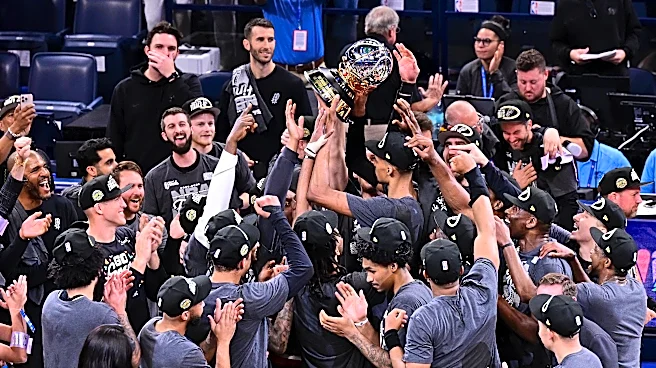
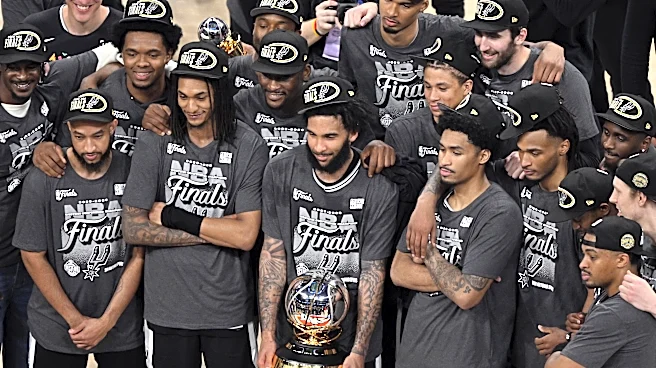
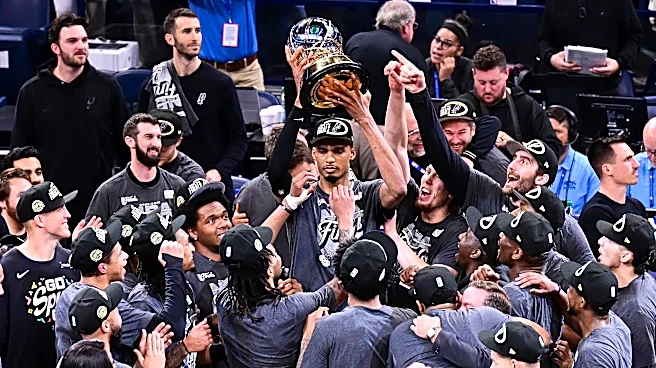
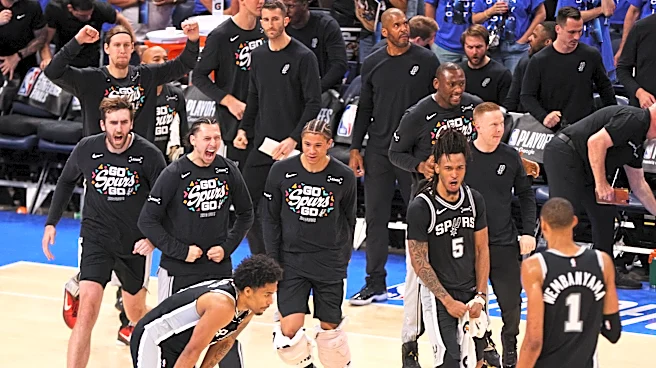
When I wrote that nearly a year ago, no one (including mylsef) knew that our Spurs, not the Thunder, would become “the massive problem for the league” this season. As a result, for this season at least, I can retire my annual analysis of which team Spurs fans should root for in the NBA Finals. I have some more thoughts to share, but if you are reading this to determine who I think Spurs fans should root for in the 2026 NBA Finals, I don’t need to provide a lengthy analysis or a list of reasons to root for one team or another. Go Spurs Go!
Other thoughts
In my piece from last year, I explored the English derivation of the word “juggernaut”. I assumed it was Germanic. (Try saying “juggernaut” with a German accent. Very Germanic, right?) It turns out that the word comes from India, not Germany:
“An idea, custom, fashion, etc., that demands either blind devotion or merciless sacrifice,” 1854, a figurative use of Juggernaut, 1630s (Iaggernat), “huge wagon bearing an image of the god Krishna,” especially at the town of Puri, drawn annually in procession during which (apocryphally) devotees allowed themselves to be crushed under its wheels in sacrifice. Altered from Jaggernaut, a title of Krishna (an incarnation of Vishnu), from Hindi Jagannath, literally “lord of the world.”
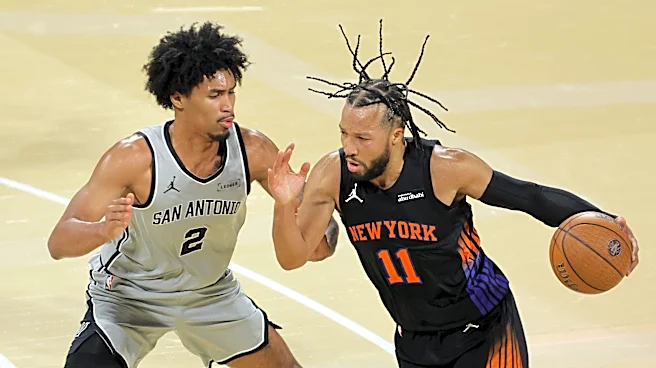
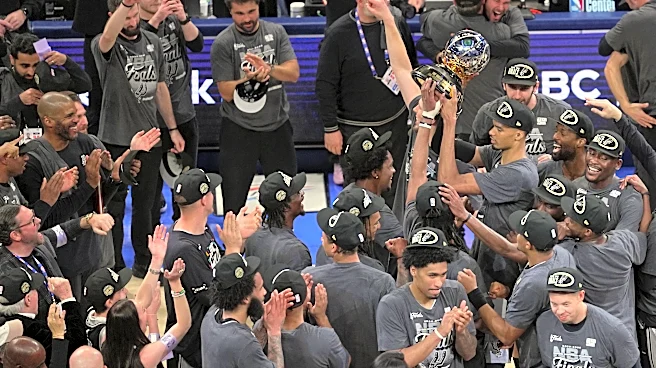
I raise this word again this year because after the Spurs established themselves as true contenders this season, many pundits began describing the Spurs and Thunder as the two true juggernauts in the league. Many assumed that the winner of the Western Conference Finals — assumed by all to be either OKC or San Antonio — would crush the Eastern Conference winner like the Krishna devotees under the massive wheels of his huge wagon. It turns out that we may have a third juggernaut — the New York Knicks. Although their competition was not up to Western Conference standards, the Knicks smote their playoff competition in a truly historic manner. From The Athletic:
“The Knicks enter as the hottest team in the history of the NBA playoffs. They have won 11 games in a row, against the Hawks, 76ers and Cavaliers. In running up a 12-2 playoff record, the average score of their games has been Knicks 120, Opponents 101. New York’s 19.4-point margin per game is, for the moment, six points ahead of any other postseason team since the NBA-ABA merger.”
Despite this historic dominance, and the Knicks’ massive rest advantage, the Knicks are 2-1 underdogs to a team who was picked as a possible Play-In Tournament participant at the start of the season. Of course, the Knicks have had a spotty history in the 50+ years since their last title, while the Spurs won a crown or two (or five) while the Knicks were flaming out each year. And the Spurs have several perimeter defenders a little bit better that the Harden/Mitchell backcourt that the Knicks’ guards torched in the Eastern Conference Finals. That being said, 2 t0 1 still seems a bit high.
The player of the game for the Spurs in Game 7 was Julian Champagnie. He went 6 for 10 from three, scored 20 points on 11 shots, and was a game-leading +16 during his 38 minutes on the floor. For much of the time down the stretch of an absolute must-win Game Seven on the road, Mitch Johnson went with his four top-5 lottery picks, and Julian Champagnie.
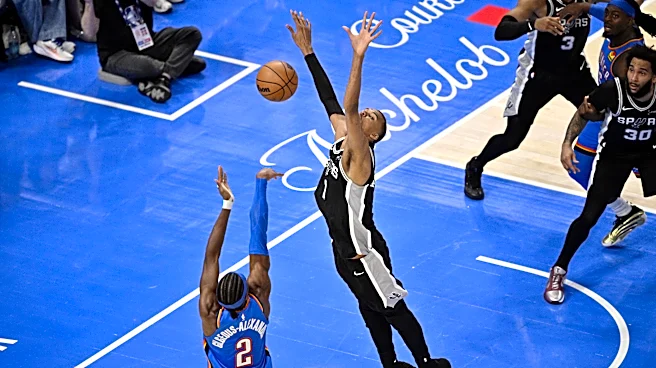
In a related note, the absolute play of the game was Luke Kornet’s block of Isaiah Hartenstein’s breakaway dunk attempt.
That play happened with just under seven minutes left in the fourth quarter and the Spurs up 97-91. Absent that block, OKC would have cut the lead to four, probably forcing a Spurs time-out with the OKC fans making it impossible for anyone to hear. Instead, the Spurs got the ball back and scored, turning the game into a much more comfortable (and quiet) 99-91 eight-point lead. During the six minutes he played, Kornet had the same number of blocks as Victor Wembanyama (1), and two more offensive rebounds (3 to 1) — and hustled into the key play of the game that sent the Spurs into the NBA Finals.
Why do I mention Champagnie and Kornet together? Each of them were undrafted out of college. Very Spursian. They join other key Spurs from the past who were either undrafted or second round picks: Avery Johnson, Manu Ginobili, Patty Mills, DannyGreen! and many others. The Spurs’ proud franchise was built not only on top picks like the Admiral, the Great Duncan and Victor, but also on players other NBA teams decided were not good enough to play in the league.
I haven’t done a Fun with Box Scores edition in quite a while, largely because Pounding the Rock has a guy who does it much better than I can. But Game Seven’s box score has some notable items. For instance, both teams shot 45% from the field, but the Spurs went 17/40 from three, while OKC was 12/35. Put another way, the Spurs shot five more threes — and made all of them.
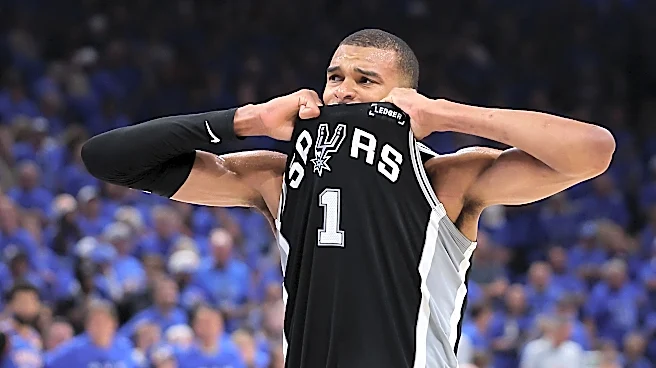
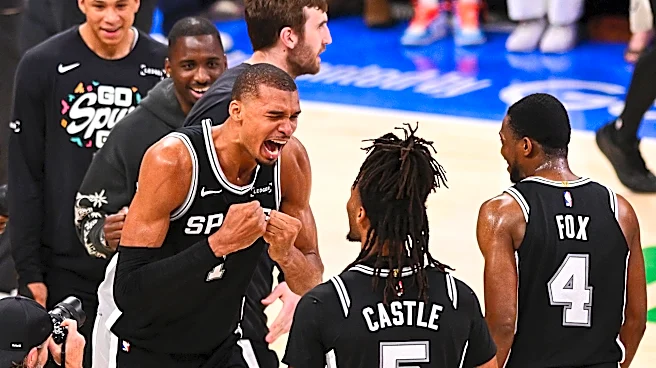
Also, Stephon Castle had the devil of a game: 6 rebounds, 6 assists and 6 turnovers. The Spurs’ nuns still forgave him because he had 16 points and 4 offensive rebounds. Ryan Harper had 3 offensive rebounds, meaning the two young Spurs guards combined for 7 offensive rebounds.
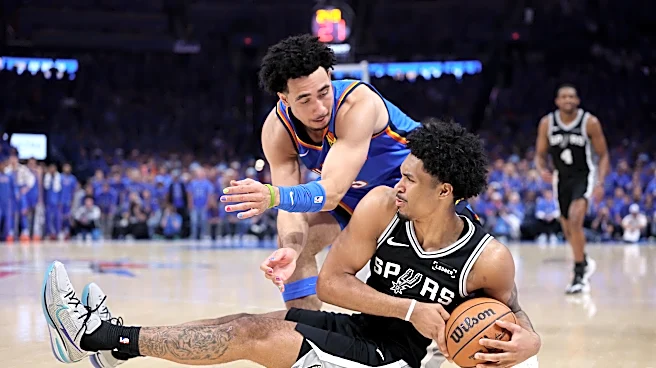
Another cool stat — after OKC got 9 offensive rebounds in the first half, they had only 1 in the entire second half. You think the Spurs coaching staff may have emphasized that at halftime? Yeah, me too. The Spurs got 5 more offensive rebounds for the game (15-10), and had 1 fewer turnover (13-12), which means 6 extra opportunities to score in a game decided by 8 points. By the way, the 111-103 final was the second closest game of the series. A very odd series, with two excellent games bookending five contests which were not in doubt in the fourth quarter.
One final question: why does ESPN always have Dylan Harper listed last on the Spurs box score? It is certainly not alphabetical, or based on his uniform number. Maybe because he went to Rutgers?? If anyone has a logical answer, please drop it in the comments.
One last stat: this one from halftime of Game Seven. The Spurs were up 3 points, 46-43. In the first half, the Spurs were 7 for 8 from the free throw line, while the Thunder were 4 for 8. Which means that with all the shooting and rebounding and steals and defense in the first half, the Spurs were ahead because they made three more free throws than OKC on their eight attempts.
That also made it odd that OKC’s coach chose to replace two of his starters to start the second half. I thought that sent an unusual message to a team that had the best record in the league the past two seasons. It might have been better to tell his guys “we got this”, “we are at home and we weathered the storm”, and yes, “we are the defending champs, let’s go out and show the world.” Instead, OKC benched two starters.
In contrast, when Stephon Castle got his 4th foul in the third quarter, and Victor got his 5th foul with over seven minutes left in the game, Mitch Johnson subbed them out for less than two minutes each, and then sent them back into the game. He trusted his guys to play without fouling, and switched Castle off SGA for much of the remaining game. (During Victor’s minute-long rest, Kornet has his chase down block — and then immediately subbed out to much adulation from the Spurs’ bench.) Johnson knew that the team needed Castle and Victor on the court for the Spurs to win Game Seven on the road, and he was right. Nice job by the Spurs’ head coach — also a rookie in his first playoffs.
Several good quotes to mention. First, Anthony Edwards said this about the Spurs, and in particular their offense when Victor was not in the game: “It made it hard on us because now everybody (on the Spurs) was playing free,” Edwards said. “They play egoless basketball anyway, but they made it a little tougher.”
As a coach, I want opposing players to describe my team’s offense as “egoless”. Love it. The second quote was from Reggie Miller after Keldon Johnson, who lives on a farm, drained two key threes in the fourth quarter: “His goats are very happy.”
Finally, my buddy Ferg dropped this dime describing Chet Holmgren’s four point, four rebound performance in Game Seven. “He Chet the bed”.
Because this is my “rooting for” post, I end by pointing out that the Spurs were clearly the fan favorites in the Western Conference Finals. Other than people from Oklahoma, or the OKC players’ close relatives, it seems that everyone was either rooting for the Spurs or against the Thunder. I don’t know if that will carry over to the Finals. There are an awful lot of New York Knicks fans out there, and I mean awful when describing Knicks’ fans. (To my Knicks fan buddies, sorry for the cheap shot.)
Anyway, because I traditionally root against teams from New York, my choice is doubly easy. I just don’t believe the series will be.