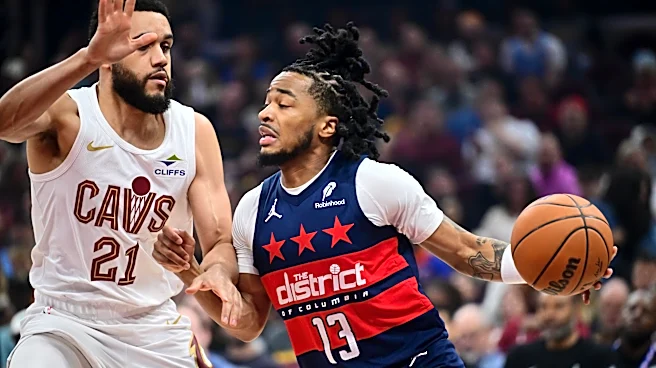




Welcome to our Wizards player review series. We’ll go through each guy that played meaningful minutes and look back on their season. Here’s Sharife Cooper.
Sharife Cooper has had a winding basketball journey, bouncing around China, Turkey, Greece, and France after a year of sparse minutes as a rookie with the 2021-22 Hawks. The Wizards brought him in this season on a two-way deal.
In some ways, he was a classic tank captain — a journeyman guard who struggled defensively and primarily played big minutes
in late-season games.
To Cooper’s credit, his numbers would place him above that status. He put together a 61 percent true shooting percentage, well-above-average for position, and he knocked down 38 percent of his threes. He was able to get to the basket consistently and finish. He’s capable of playmaking, too.
When the Wizards gave him the ball, good things generally happened. He put up positive numbers when he created out of the pick-and-roll and in isolation. When he iso’d, he managed an even one point per possession, an upper-percentile number.
Cooper plays with darting speed and a score-first mentality. He can score at all three levels, including a fairly efficient midrange shot, and he did a better job than the Wizards’ other young guards of penetrating the defense on a consistent basis.
That’s the good news. The flip side is that Cooper is not a particularly threatening off-ball player and doesn’t provide enough as a playmaker to offset that. His three-point shot, while efficient last season, came on low-volume despite his heavy offensive role. He has a low, somewhat labored shot-put release, lightly reminiscent of a Ball brother. He is not seeking out threes, and defenses at times sagged off him.
While he ran a solid volume of pick-and-rolls and produced a respectable number of assists, he did not turn that usage into consistent shots for his teammates. Per Databallr, he ranked in the 28th-percentile in potential assists per on-ball time — measuring how often he created shots, relative to how much he had the ball.
It’s likely for that reason that Cooper rarely broke into the team’s healthy rotation, and did not navigate his way to a standard NBA contract, unlike Tristan Vukcevic and Jamir Watkins. Small, defensively-challenged guards have to be higher-end playmakers in today’s NBA.
And Cooper was certainly defensively challenged. Defensive metrics can be wonky, but they point to him being one of the worst individual defenders in the league.
On a team with Trae Young and Tre Johnson, he is duplicative, which likely makes it an uphill battle for him to stick with the Wizards as they look to elevate out of tank territory.