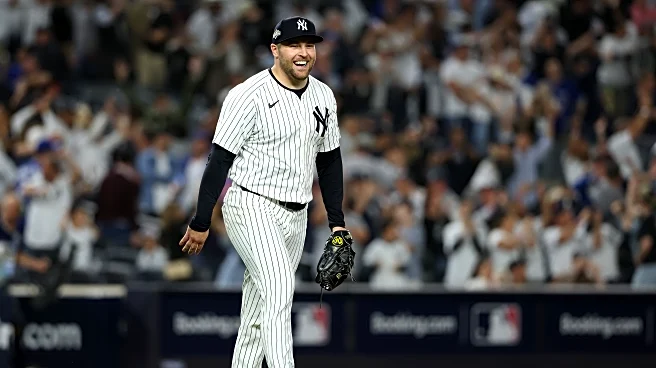

The past few seasons of Yankee baseball have produced a familiar pattern when it comes to closing games. The first option the team tabs to handle the ninth inning invariably falters, forcing Aaron Boone
to thumb through his bullpen to find a suitable replacement, or for Brian Cashman to acquire one from elsewhere.
In 2022, Aroldis Chapman’s struggles led to Clay Holmes being installed as the closer. Holmes held the role until 2024, when a succession of blown saves forced Boone to replace him with Luke Weaver. Last offseason, the Yankees traded for Devin Williams in the hopes that they’d have more stability in the role, but Williams’ unreliability forced Cashman to bring in more outside help. That came in the form of Pirates All-Star David Bednar.
Bednar was the closer the Yankees needed to stabilize the bullpen and gave them an option they could feel confident about in 2025. The two-time All-Star was lights-out, performing better in New York than he did in Pittsburgh. But again, we’ve seen this movie before. The Yankees’ ninth-inning guys have performed well…right up until they haven’t. Can Bednar buck the trend and provide a full season of late-game reliability?
2025 statistics (between PIT & NYY): 64 games, 62.2 IP, 2.30 ERA, 2.18 FIP, 27 SV, 34.3 K%, 7.6 BB%, 2.0 fWAR
2026 Depth Charts projections: 65 games, 65 IP, 3.26 ERA, 3.26 FIP, 33 SV, 30.2 K%, 8.1 BB%, 1.3 fWAR
Reasons for concern do exist for Bednar despite his spectacular excellent 2025 season. After all, the Pittsburgh native began the year in Triple-A, and slogged through 2024 with an ERA well north of 5. But Bednar has faced plenty of adversity in his career already. A former 35th-round draft pick who used his myriad rejections from Division I schools to fuel his competitive fire, Bednar has been underestimated and doubted before.
The routine questions about whether Bednar had the makeup to succeed under the bright Yankee Stadium lights were assuaged when Bednar pitched to a 2.19 ERA with 10 saves after the trade. He finished all three games the Yankees won in their eventual far-too-short postseason run, allowing just one run over six total appearances.
Bednar boasts a strong three-pitch mix, but his success hinges on his ability to get ahead in the count and put hitters away with his curveball. He has a north-south attack, with his fastball working best up in the zone and changing eye levels to set up his curve and his split. Both pitches missed bats at an elite level last season. As a result he boasted a strikeout rate just outside the top-10 in baseball for pitchers who threw at least 50 innings.
FanGraphs projections don’t predict his strikeout rate to regress much from that elite clip, and similarly don’t forecast his walk rate to increase much from 7.6 percent, where it sat last year. Bednar proved to be less volatile with the free passes than Williams, and has only exceeded 10 percent once across a full season in his career, in 2024.
Despite that, there are still some indications—which I pointed out in his report card post last fall—that Bednar won’t perform quite at the same level in 2026. For one thing, Bednar’s strand rate with the Yankees was unsustainably high: 84.2 percent. That number is bound to regress at least a bit; otherwise we have another real Houdini on our hands. (Happy retirement, D-Rob!)
Second was the high volume of seemingly free strikes Bednar was receiving early in the count, as hitters’ approach towards him was oddly passive. He only saw a 62.9% in-zone swing rate on his pitches, a little more than four percentage points below league average. If teams get a bit more aggressive, might that play to their favor? Or will they overcompensate and become more vulnerable to chasing? That will be a dynamic to follow with number 53 this season.
Ultimately, even if he allows more of his baserunners to score and allows more loud contact, I don’t believe Bednar will suddenly turn into a pumpkin this season. Glancing at his percentile rankings year-over-year, it’s fairly obvious that 2024 was the outlier for him. He’s an excellent closer who got a good dose of big-game experience last year, has less overall risk in his profile than Williams’, and got a full offseason to get fully accustomed to his new digs. I expect the Renegade to have it made at the back of the Yankee bullpen in 2026.