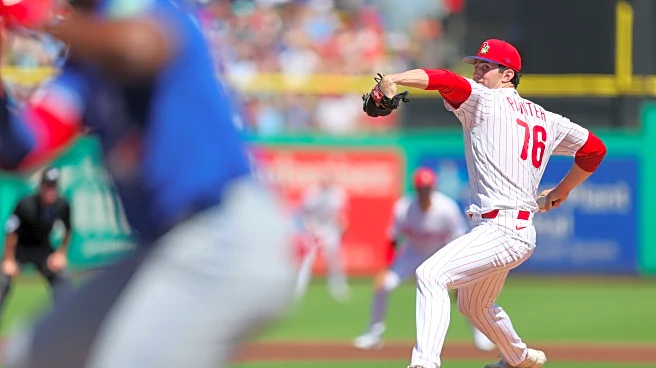

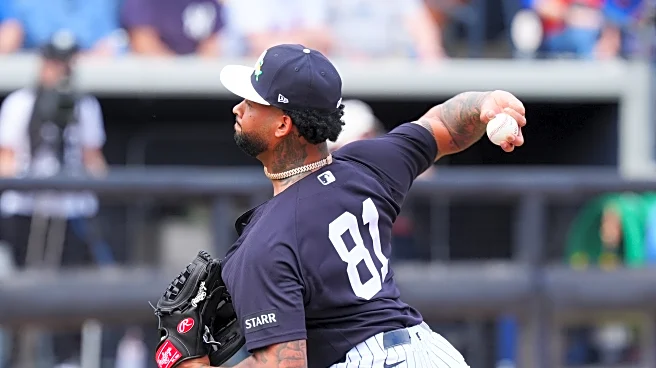

This past Saturday was Andrew Painter’s second start of the spring and if you looked at a box score, you’d be rather happy with the results. Three innings pitched in which he gave up no runs, even against a depleted Blue Jays lineup, is cause for optimism that corners are being turned in his development. However, scour the various pitch modeling “experts” that exist and you’d come away with a different point of view of what he pitched like.
Even with the results that showed Painter didn’t excel with under the hood metrics, he still did not allow a run, the ultimate goal of pitching. Yet pair that with his first spring start and you’ll start to see a pattern forming.
Postgame, Painter talked about his outing and noted that his fastball command was not there during his start, nor were many of his pitches.
“I didn’t have my best stuff today,” Painter said. “Four-pitch walk to start, kind of go into a hole, but you’ve got to go out there and compete and get yourself out of it. I thought I made some good pitches. I thought the spin was good. I would love to get the changeup going a little bit, but you’ve got to take what you’re given that day and work with it.”
It’s part of his maturation as a starting pitcher in the major leagues, that he would be able to go through situations like that and be able to come out on the other side with a decent outing. For a spring start, that’s both encouraging and concerning at the same time. Going back to those pitch modeling “experts”, both posts that are given talk about Painter’s lacking good fastball “shape”, something that could be a death knell for some pitchers. This is where, despite his putting up another shortened start of 0’s on the board, there is an underlying concern with his season might unfold. But what exactly are they talking about when it comes to Painter’s “fastball shape”? Let’s explore.
The first thing to understand is that when people are talking about said shape, they’re focusing more on the four seam fastball. Induced vertical break (IVB) is a fastball’s vertical movement, only without gravity, “rising” as it approaches the plate even though we know that the concept of gravity will not allow that. Pitches with good IVB are going to arrive at home plate from the vantage point of looking like it is not moving downwards as it is supposed to and induces more swings either underneath or on the bottom half of the ball, leading to whiffs or easily caught fly balls. Fastballs that have an IVB of 16 inches would be something we would consider average, so anything above is great, anything below is going to be an issue. That may not seem like a lot, but as the old axiom goes, baseball is a game of inches. One of Andrew Painter’s biggest strengths as a prospect was that he was able to combine upper tier fastball velocity with above average IVB to create an elite fastball that he could use in the upper quadrants of the strike zone, meaning he missed barrels and bats.
Post-Tommy John surgery, that pitch and the form that it was in is now missing. Seeing these pitch model experts talk about fastball shape concern with Painter might be startling at first, but it’s nothing new that it’s current shape is something that is now a bug in his pitching profile’s ointment. Matt Winkelman noted this in his write up this offseason:
The problems start with Painter’s four seam fastball. Once an elite pitch before the injury, it was a liability by the end of the season. Predictably for a pitcher ramping back up from not pitching for two years, he gradually lost a little bit of velocity month over month. His arm slot also changed, and it led to less vertical movement. Since Painter’s height is never going to give him good attack angle on the pitch, the loss of movement led to it being very hittable in the strike zone.
It’s also something that Jarrett Seidler noted when doing his writeups on the Phillies’ system for Baseball Prospectus:
His fastball shape is just straight up worse; he’s lost nearly an inch and a half of vert while his release traits have been all over the place, and ultimately got more generic as the season went along. He doesn’t spot the pitch nearly as well as he used to or scrape triple digits as much, and the pre-surgery vs. post-surgery differences in whiff generation are drastic. Based solely on 2025, he looks like a sinker-primary candidate, and the old reports of a guy with a 70 four-seamer don’t match up.
Again, these are reports one does not want to see when discussing the team’s top pitching prospect and likely candidate for a rotation spot in 2026. Both of them talk about Painter’s changes from when he was actually pitching, but without some numbers to look at and compare ourselves, it can be difficult to just accept as gospel. So, it’s best to compare apples to apples and look at Painter pre- and post-surgery.
Using Robert Orr’s amazing work, we can compare Painter’s fastball shape from when he pitched in Clearwater in 2022, when we have available Statcast data for him, and the majority of his season in 2025 in Triple-A Lehigh Valley.
This is what we call confirmation of the scouting reports. While the maintaining of velocity, or at least his getting back to his pre-surgery levels is great, there are two things that jump out. The first is the loss of the ability to induce swinging strikes with the pitch. Even with a fastball that averages in the upper nineties, touching 100+, even Triple-A hitters are going to be able to square it up if it is flat. This leads to the aforementioned concerns both from the scouting reports and the data from which they are partially based: the loss of vertical movement is very real and very much an issue. Without getting that ride on his fastball that he used to such success when he started pitching professionally, he’s going to start seeing major league hitters take that pitch and do more damage with it.
Now, when using that earlier data point of 15 inches of IVB being average, this may not seem like a big deal. After, with that starting point in mind, the IVB on Painter’s fastball seems like something that we would consider to be decent. Yet let’s consider some major league data. Using Baseball Savant, we can do a league-wide search for pitches that have Painter’s current velocity and shape from the spring and see how batters fared against them in 2025. So, let’s set the parameters: fastball velocity between 95 and 97 miles per hour with vertical movement that is between 15 and 17 inches.
The average wOBA against that type of pitch in 2025: .379.
Were Painter to be able to add even a few tenths of an inch of induced vertical break, changing the search to between 17 and 18 inches, maintaining the same velocity, the average wOBA against that type of pitch is much more palatable: .317.
To put it into player terms, that’s the difference between the batter being Juan Soto and Trevor Larnach.
Another thing that was pointed out to me by Matt Winkelman was the loss of cut on his fastball as well. We were discussing this topic and he noted that at it’s best, Painter’s four seam fastball has cutting action to it as well as near elite IVB. Both of those things went backwards, hence the concern for what that fastball shape is looking like these past two starts. He also noted that at times, Statcast is thrown for a loop by classifying his sinker as a four-seam as well, causing some of the data to be a bit wonky, but I wonder if that happened enough to influence the numbers that much.
The lack of induced vertical break on his four-seam fastball, or at least the drop in Painter’s data, and loss of the natural cut he was leaning towards having is going to be an issue for him once he finally does ascend to the major leagues. A fastball with these characteristics is akin to the one that needs above average to elite secondaries to let him get away with it and Painter simply is not there yet. We can douse some of this panic by understanding that we basing all of this concern on two spring starts, lest people get too overly worried. The team was focusing a lot this offseason on making sure that Painter’s arm slot was getting back to where it was, which may have led to some of the issues he had with his fastball in 2025. If that gets “fixed”, and by the sounds of it, it has, the team can then move on to the next part of concern that surrounds his fastball and see if they can get that pitch to jump a little bit more. Because as the numbers show, if his fastball continues on with its current shape and form, he’s going to have to rely either more on his sinker (which isn’t really that much better) or his secondaries to consistently get major league hitters out.
Not exactly the news one wants to hear about their top pitching prospect.