
The predominant storyline of the Ruben Amorim era centered around the coach’s insistence on using his 3-4-2-1 formation. One of the many pain points of that system was how many players had to be used outside
of their natural – or best – positions just to work inside the system.
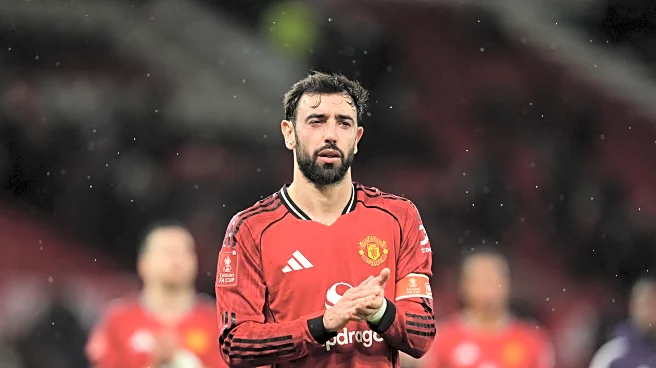
The conversation often centered around United’s captain and talisman Bruno Fernandes. Fernandes has shined as a number 10 for United, but spent large chunks of last season and all of this season playing central midfield. As United struggled for results the spotlight as to why the club’s best player wasn’t playing in his best position only got brighter.
Amorim may have made too many decisions out of stubbornness or the desire to prove a point but his reasoning for putting Bruno in midfield was simple. Without him there United had no one else that could effectively progress the ball forward.
When Darren Fletcher took control of the team against Burnley, it was all but promised that United would return to a back four. The question over where Fernandes would play was still valid, but Fletcher opted to return Bruno to his number 10 role in a 4-2-3-1 formation with Casemiro and Manuel Ugarte in the pivot.

But this is not the role we are talking about today.
When it came to pushing forward and attacking, United did not get off to a strong start against Burnley, managing just three shots over the first half hour and only two from open play. Perhaps it’s because there were rumors of Ole Gunnar Solskjaer returning as interim boss swirling around in the buildup to the match but watching Ugarte and Casemiro in midfield I kept having one though, this looks like McFred.
Like the old Fred-Scott McTominay pivot, Ugarte and Casemiro were putting in a workman like shift. They were doing a good job keeping structure. They weren’t allowing Burnley to easily move the ball up the middle and were helping keep United solid at the back – Burnley managed just two shots in the first half. In possession they weren’t turning the ball over, opting for safe passes and retaining possession. It was functional, but United needed more than that. They failed to offer creativity which United needed as they tried to take the game to their opponents. They struggled to get the ball up to United’s attackers in positions where they could be dangerous.
It didn’t take long for Bruno to start waving his arms in frustration over not getting the ball from the overly safe passing. This was a staple of Bruno during the McFred era. As a result Bruno started doing what he always does when he’s playing in front of a functional but lacking midfield pair. He started dropping deep to get on the ball.

After the half hour mark Bruno started dropping deeper to get the ball off the center backs and help United move the ball forward. United quickly grew into the game and the attack came alive. Over the final 15+ minutes of the first half they had eight attempts at Burnley’s goal and had one cleared off the line.

Football is a game of give and take. Bruno’s dropping deeper gave United the passing from deep that they needed, but in doing that it takes something else away.

That something else is Bruno up the pitch. With Bruno deep, that leaves one fewer attacking player to receive passes, and it leaves a Bruno Fernandes size hole in the middle of the pitch.

Seeing what was happening on the pitch Fletcher made a halftime adjustment moving Bruno out to the right wing while Mathues Cunha came central to play as the no. 10.
Bruno had previously played on the right wing under Erik Ten Hag in a move that wasn’t too popular with fans. When Ten Hag deployed Bruno the right, he mostly asked him to play as a right winger. Bruno’s passing could be an asset from there, but his lack of dribbling and ability to beat his man made it an awkward fit.
This was not the role that Fletcher was asking Bruno to play. Rather, Fletcher deployed Bruno very similarly to how Ole Gunnar Solskjaer had used Paul Pogba on the left wing – a role some refer to as “left wingba” or what The Busby Babe has long referred to as “the Mata role.”
The Mata role involves an attacking midfielder playing on the wing, but rather than trying to supply width or run in behind, during the buildup the drops a bit deeper and tucks inside to help the midfield progress the ball up the pitch. Beyond him the fullback can then push up to keep the defenders occupied and give that attacking player a pocket of space.

Moving Bruno to the right wing allowed him to tuck inside and better help the midfield progress the ball. By being closer to them, he cuts down the distance it’ll take for them to get the ball to him. It also makes it easier for the defenders to pass it directly to him, without having to skip over all of the midfield.

More importantly is that while Bruno becomes an option in midfield, United aren’t lacking players up front. Diogo Dalot pushes up to occupy the defenders on the last line, while United still have an central attacking player in Cunha. That gives Bruno the chance to make something happen as soon as he receives the ball.

Once United get the ball forward, Bruno now gets to push back up and operate in the half spaces where he can be really effective. When United get the ball deep but work it back to midfield, Bruno is able to find a pocket in the half space where he can easily receive a pass from Casemiro.

Bruno has something here he almost never gets. Time and space in the final third. And when you give him time and space this close goal, he’s very good at making it count.

United scored twice in the first 15 minutes of the second half – they arguably could have had more – before Bruno was removed in a pre-planned substitution after 60 minutes.
On Sunday Fletcher reverted to putting Bruno at the no. 10 when United took on Brighton in the FA Cup this time with Mason Mount on the right wing and Cunha on the left. In theory there could have been a similar plan here but Mount is much more Jesse Lingard coded than he is Juan Mata or Bruno coded. Mount is someone who does a lot of off the ball running, whether it be pressing, or someone who makes a lot of runs to open up different channels.
Mount isn’t looking to drop deeper and have the ball be played to him on the right side, he’s looking to make a run to open up the right side. This of course leads to the problem United have had for the last three years – Diogo Dalot consistently being the furthest player forward and getting the best chances.

With another functional but lacking midfield – this time Ugarte and Kobbie Mainoo – United struggled to effectively move the ball up to the attackers and take advantage of Bruno playing in his best position. The attack struggled all game. United took 19 shots against Brighton but for 1.76 xG – an xG per shot of 0.09. Worse, 0.55 of that xG came on Dalot second minute chance. Over the rest of the game United had 18 shots for 1.21 xG – a paltry 0.06 xG per shot. By the end of the match with United chasing goals, Bruno had been moved back to central midfield.
Is “the Mata role” the way forward for Bruno?
There are plenty of arguments for why United should utilize Fernandes in this way the rest of the season but the simplest one is the midfield. Bruno Fernandes in midfield is not the answer, but none of United’s other midfielders can offer close to the passing that United need from that position. They do offer a level of work rate and defensive ability that Bruno doesn’t.
That last part is crucial. United have been a bit weak in the middle park all season long – a tradeoff in having Bruno Fernandes operate there. United need to bolster their defense – they’ve conceded the seventh most goals in the league. They need to get better and start keeping more clean sheets so they can make a single goal hold up for a win a bit more often.
Playing Fernandes in the Mata role on the wing gives United a third midfielder to help in buildup while still having two workman midfielders behind him in the center of the park. This would also create more opportunities for Kobbie Mainoo to get into the team. In theory they would be able to provide a solid base to protect the back four as well as provide a first layer of coverage for fullbacks pushing up the field.
More importantly is putting Bruno in the Mata role could provide more balance to the team up front. Bruno was deployed on the right wing against Burnley but with the imminent return from AFCON of both Bryan Mbeumo and Amad, Bruno would shift to the left side. That would make the fullback pushing up to hold the width be either Luke Shaw or occasionally Patrick Dorgu. Both better options than Diogo Dalot in that spot.
I’m not worried about a log jam being created for the other attacking spots. Signing Sesko, Mbeumo, and Cunha in one summer was always questionable as the three are an awkward fit together that’s never really clicked. Cunha is a player who wants to drop deep, get the ball, and run at defenders. Mbeumo wants to operate like a second forward. Sesko needs service from out wide or clever through balls to be effective. That’s not Mbeumo or Cunha’s game.
Sesko was effective against Burnley as United set out determined to get him the ball. Fletcher swapped Cunha and Patrick Dorgu to be on their “natural” sides of the pitch, increasing the number of crosses. This would increase the number of crosses coming towards Sesko and prevent those players from only trying to cut inside onto their stronger foot and shoot. Their priority was getting the ball to the striker. Dorgu played very well but Cunha struggled. When Cunha is in his more natural position on the left wing and Mbeumo on the other side, Sesko has struggled.
With Bruno on the left you don’t have to force the Cunha-Sesko-Mbeumo front three to work despite the awkwardness. There are options to how you can do things.
Cunha can go into the middle and play as the no. 10 behind Sesko. Amad can come into the team on the right wing with Bryan Mbeumo moving centrally, forming a no.9/no.10 pair with Cunha as the two did against Bournemouth. You can also try Amad out as the no. 10 behind Cunha or Sesko. His performances at AFCON and ability to play with th ball in tight spaces garner enough to certainly try it out in the Premier League.
Resurrecting “the Mata role” and putting Bruno out on the wing is not putting United’s captain in his best position. But in order to salvage the rest of this season, United are going to have to extract the most football that they can from the current squad. A squad that has holes up and down the pitch. Cracks are going to need to be papered over, compromises will need to be found.
Perhaps this is the best compromise?