
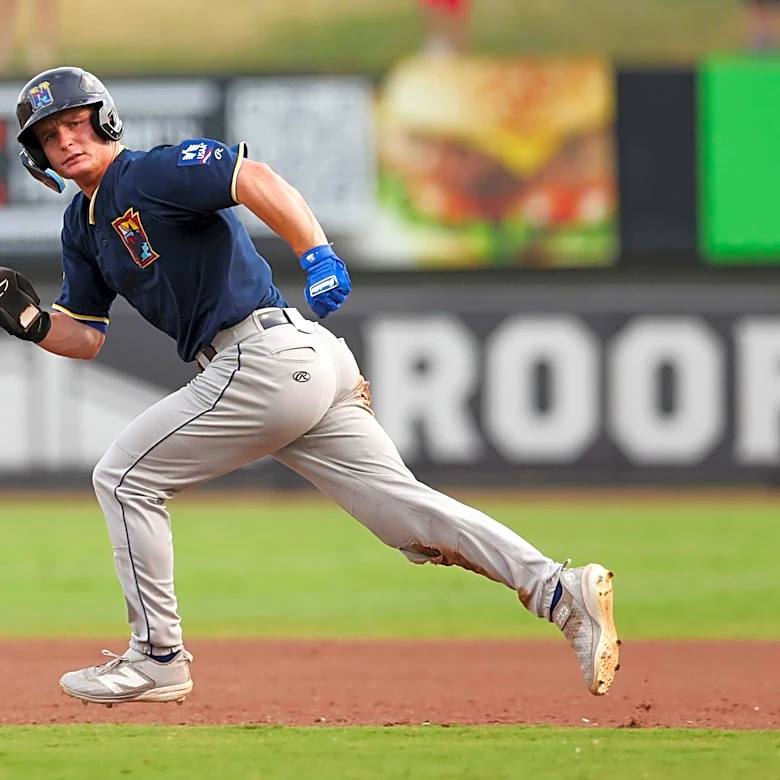
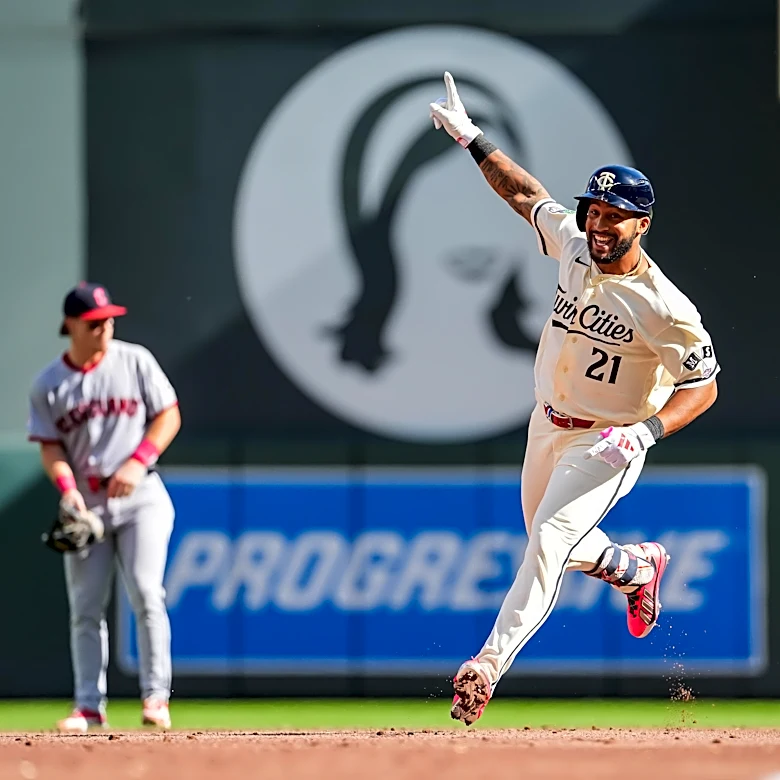
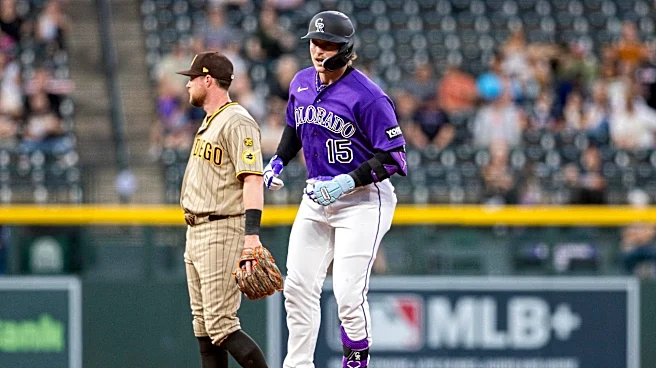
The first article I wrote for Purple Row was a look at the 2025 Rockies base stealing prowess… or lack thereof. In general, the 2025 Rockies were a very fast team across the entire lineup that kept running into outs on the basepaths despite their speed. I posited that the main issue had to do with their conservative approach to taking leads before attempting steals.
On the positive side, while the 2026 Rockies still remain near the bottom in the league in their lead distance they have managed to improve
their overall base running by a pretty substantial margin.
The most surface-level means of assessing base running success is to look at a team’s stolen bases. With roughly two weeks remaining, the 2026 Rockies have stolen more bases (100) than they did last season (87). What’s more, they’ve done so with a higher overall success rate (72.5%) than they had last year (68.5%).
Stealing bases, however, is only one component of running the bases.
Fangraphs Base Runs above Average (BsR), which is an attempt to calculate the cumulative baserunning value, is the widest lens through which to get the full picture on the basepaths. Using BsR, we can see obvious improvement for the Rockies this year. While the 2025 version of the team was 30th in MLB at -10.3, this year’s squad has jumped all the way to 14th with a respectable 0.3.

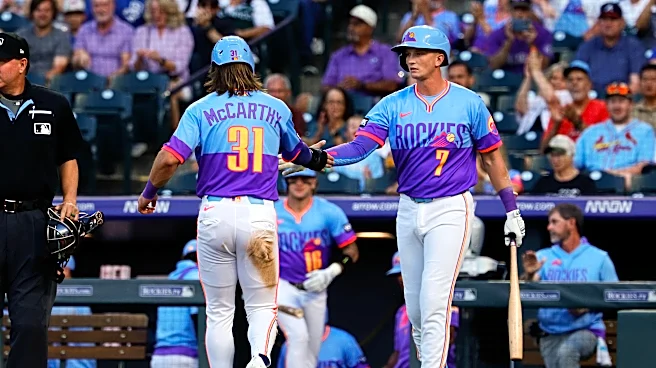
The interesting thing is, almost all of their baserunning gains can be traced back to one player: Jake McCarthy.
- Removing his 7.5 BsR would drop the Rockies from 14th in the Majors down to 28th.
- Removing his 30 stolen bases would drop the Rockies from 15th in the Majors down to 27th.
McCarthy is almost singlehandedly pushing the Rockies as a whole into a respectable middle-of-the-pack team in terms of baserunning. This is one of the many reasons that McCarthy has solidified his spot as the Rockies leadoff hitter this season.
Although McCarthy’s legs have lifted the entire team up, the legs of fellow newcomer TJ Rumfield appear to be dragging it down.
Last season, every single Rockies player that got at least 100 opportunities on the bases graded out with a sprint speed above the league average line of 27 feet per second. The highest was Brenton Doyle with a sprint speed of 29.5, and last was Hunter Goodman, who just barely clocked in above league average at 27.2 ft/sec.
This season, the team has a much larger disparity between the fastest and slowest runners on the team:

It should not come as a shock that Rumfield is the slowest runner on the 2026 Rockies by a wide margin. We’ve all seen him run. He’s a hitter not a sprinter.
The margin of his speed difference with the other players on the team, however, is noteworthy.
Rumfield is more than a full foot per second slower than the Rockies second-slowest runner, Troy Johnston. He’s a whopping 5.1 ft/sec slower than the Rockies aforementioned McCarthy, the fastest Rockie. Only four teams have a wider disparity between their fastest runner and their slowest, with the Kansas City Royals taking the crown for the incredible 6.4 ft/sec difference between the sprint speeds of Bobby Witt Jr. and Salvador Perez.
As covered this past spring, pure sprint speed isn’t everything when it comes to baserunning. For Rumfield, though, the results do not get prettier when looking beyond his raw speed tool.
While Rumfield hasn’t been caught stealing this season, that’s a result of his decision not to attempt stealing bases. At first glance, it would seem that he knows his limitations as a player and sticks to moving station-to-station on the basepaths.
Baseball Savant attempts to count a player’s full contributions on the basepaths with “Baserunning Runs.” This is counting stat that combines the total outs made on the basepaths (including caught stealing and thrown out trying to stretch hits) and successful advances (including both stolen bases and successful attempts to stretch hits into more bases) and translates them into an equivalent number of runs. Even without having been caught stealing a single time, Rumfield’s negative six Baserunning Runs are the worst in the league.
McCarthy’s six Baserunning Runs are tied for sixth overall in the Majors.
Conclusions
The 2026 Colorado Rockies base running looks wildly different than it did just last year. This is no longer a team full of only speedsters without the ability to make use of that tool effectively.
They are, instead, a team of extremes on the base paths. They are buoyed by a single baserunning star at the same time they are anchored by one of the least-valuable runners in the league.
Given the high value that both McCarthy and Rumfield have brought at the plate and in the field this season, both should be expected to remain fixtures in the lineup heading into next year. This dichotomy of extremes at either end of the baserunning spectrum is likely here to stay for the foreseeable future.
On the Farm
Triple-A: Salt Lake Bees 7, Albuquerque Isotopes 2
The Isotopes lose their second game in as many days to the Salt Lake Bees. Unlike Tuesday’s game, where the Isotopes lost in heartbreaking fashion in extra-innings, the Bees were in control from the very start of this one.
Jack Mahoney (No. 15 PuRP) continued his struggles at Triple-A. Mahoney started this game and only managed to get through the first two and a third innings before being pulled due to a right-leg injury sustained while fielding a grounder. On the whole Mahoney was charged with three runs, all earned, on four hits and a walk while striking out no one before departing in the third.
Valente Bellozo took over after the unexpected exit of Mahoney in the third and did his best to keep the Isotopes in it. Bellozo pitched until the ninth inning, five and two third innings all told, and allowed a further four runs on nine hits. Evan Shawver took the ball in the ninth, when the game was already out of hand, and threw a scoreless frame.
At the plate the Isotopes struggled to score runs all game long. They scored their first run in the bottom of the fourth when Sterlin Thompson (No. 16 PuRP) walked, advanced to third on a single by Vimael Machín, and then driven in by a Chad Stevens sacrifice fly. The only other Isotopes run of the night occurred after Tyler Freeman led off the eighth with a double and advanced on a couple of ground outs.
All told, not a fun game for the Isotopes.
Heartwarming Reasons Explain Rockies Kyle Freeland Roberto Clemente Nomination | SI.com
Every year MLB names a Roberto Clemente award winner for best representing baseball on and off the field through positive involvement within their community. This year the Rockies have nominated Kyle Freeland for his continued work supporting Special Olympics Colorado. Maddy Dickens of SI.com digs into what qualifies Freeland for the award now that voting has officially begun.
Here are the breakout prospects of the year — one for each team | MLB.com
The MLB Pipeline crew go through every team in the league and name their biggest breakout prospect of the year. For the Rockies they have named Cristian Arguelles which shouldn’t be much of a surprise considering the 19-year old earned the DSL MVP award.
MLB Farm System Grades For Every Team In 2026 | Baseball America ($)
Ian Cundall goes through each organization in MLB and assigns their minor league systems with grades for the year. This isn’t comparative rankings between the systems, BA has already done that recently, but instead an assessment of how that system performed and improved from where it was at the start of the year. While the Rockies system only managed to reach the 23rd rank in BA’s midseason farm system rankings, Cundall gives them a high B+ grade for 2026 thanks to the improvements and talent influx this year.
Join the conversation!
Sign up for a user account and get:
- Fewer ads
- Create community posts
- Comment on articles, community posts
- Rec comments, community posts
- New, improved notifications system!
Download the SB Nation app on iOS or Android.
Please keep in mind our Purple Row Community Guidelines when you’re commenting. Thanks!