


I am not about to pretend I’ve been a ride-or-die WNBA fan since the league started in 1997. I’ve been a casual — I know who the top players are, I know when the Mystics are good or bad, and that’s about it.
The league has gotten by just fine without me. This season, the league started a new TV deal that’ll pay them $281 million a year for the next decade. That’s good news for the league and for broadcast partners. The W draws more viewers than the NHL for less than half the price.

After a period of
stagnation and modest decline, WNBA attendance has shot up post-pandemic — fueled in no small part to the introduction of the Caitlin Clark v. Angel Reese rivalry, as well as incoming stars like Paige Bueckers. The attention gained from Sabrina Ionescu’s shooting contest with Stephen Curry (she nearly won) didn’t hurt either.
The league’s stars are getting lucrative endorsement deals and appearing in commercials and the like. Six women are making $1 million or more off the court. Four are earning $9 million or more. The top off-court earners are cultural icons like Clark, Reese (check out her signature Barbie doll, announced during All-Star Weekend), and Bueckers.
The highest paid players for on-court performance are more established veterans like A’ja Wilson, Ailyah Boston, Napheesa Collier, Kelsey Mitchell, Breanna Stewart, Shakira Austin, and Jonquel Jones.

The business stuff is all fine and good, but ultimately I’m a basketball fan. Which is to say, when I tune in, I want some basketball. And for me, (after some schedule-induced time-shifting) All-Star weekend delivered.
Let’s start with the three-point shooting contest, which was hella fun, especially when the Chicago Wings’ Azzi Fudd shot 21-27 in the final round to become the first rookie to win the contest. She tallied 30 points out of a possible 40. I mean, she hit her first six shots and then her last four.
For me, the highlight of the night was the Shooting Stars Challenge, which replaced the skills contest. And not just because the Mystics won. The Shooting Stars event included a legend (Elena Della Donne), a current player (Austin), and a youth player (Jezelle “GG” Banks). All-Star team “managers” — legendary players Cynthia Cooper and Teresa Weatherspoon passed to the competitors for each shot, which they had to take from seven different locations.

The Mystics won in large because Banks hit four logo threes (counted as four) — two in each round, including the contest winning shot in the finals. The whole event had an enthusiastic and joyful vibe to it that evoked for me a feeling similar to what I felt watching Magic Johnson and Isiah Thomas turn the NBA All-Star game into a rollicking basketball festival.
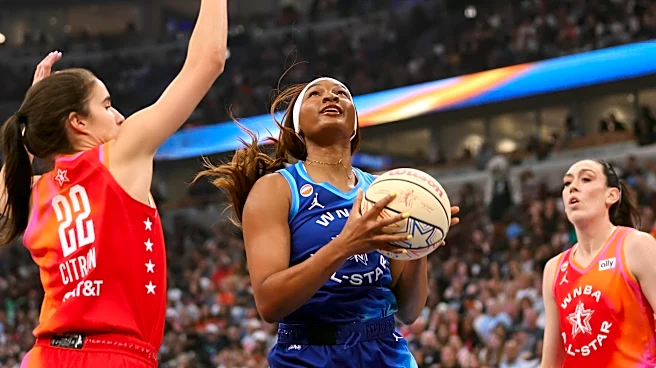
The game itself was a fun watch and set a new W All-Star Game attendance record with 19,783 on hand.
During the game, second-year center Dominique Malonga became the youngest WNBA player to dunk in an All-Star game. Jonquel Jones won MVP honors, becoming the first player in WNBA history to win all four versions of the league’s MVP trophies:
- WNBA MVP — 2021
- Commissioner’s Cup MVP — 2023
- Finals MVP — 2024
- All-Star MVP — 2026

The Mystics were well represented. They won the Shooting Stars contest, and both Kiki Iriafen (10 points, 6 rebounds), and Sonia Citron (8 points, 2 assists in 11 minutes) played well. Both Iriafen and Citron have been All-Stars in each of their first two seasons — something that bodes well for the Mystics over the next several seasons.
If you didn’t watch, check out the Shooting Stars competition (above) and do some googling or YouTubing for highlights or replays. If you’re a basketball fan, I suspect you’ll enjoy it. I know I’ll be checking out a few more regular season and postseason games.