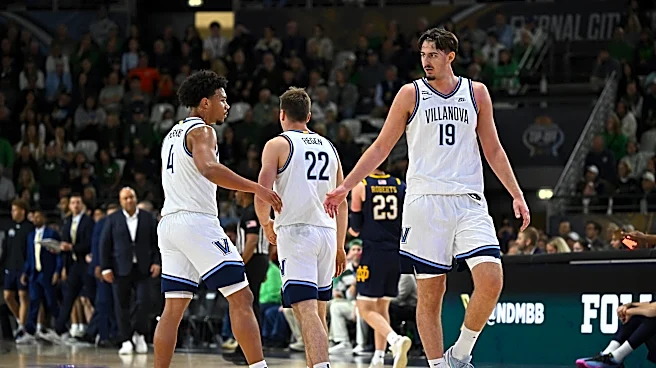


This offseason was one filled with change, much like most of the NCAA landscape. But with that change came excitement, as Villanova was able to increase its spending and bring in what many felt was a good transfer class. Kevin Willard spoke all summer about how the team needed to get tougher, bigger and stronger. In theory, he did that by securing two high-end performers from the Big Ten in Kwame Evans Jr. and Devin Royal, as well as one of the best international prospects in the 7’3” Luigi Suigo.
Tyler Perkins was no longer going to have to play forward for the entire game. Rebounding and defense were supposed to be elite. Through the two games that really matter, that hasn’t come close to being true.
Let’s start with the team as a whole. Coming into the season, Villanova was expected to beat Notre Dame and Pittsburgh fairly comfortably. The Wildcats were selected to finish third in a much-improved Big East, while Notre Dame and Pittsburgh were projected to finish 16th and 12th in the ACC, respectively. None of that has mattered, as Villanova had more turnovers than an Italian bakery in Rome, while basically doing nothing right in a 20-point blowout loss to Pittsburgh. These “performances,” coupled with some mildly-unconvincing wins against La Salle and Holy Cross, have resulted in the following drops in metrics since the beginning of the season:
KenPom: 32 to 50
Torvik: 30 to 42
Evan Miya: 30 to 52
The days are early, but Villanova now needs wins to get into an expanded field. Thankfully, the majority of the rest of the conference is pulling its weight, as Torvik currently has the Big East ranked as the second-best conference in America (only behind the SEC). Villanova and Marquette, the teams selected to finish third and fourth respectively, are not doing their part. This means that, as of now, the Wildcats will have plenty of chances to get back into solid position in the long run, but what could possibly give you confidence in that happening right now?
Willard has spoken after most (if not all) games this year about how the team has hardly been able to practice. I won’t pretend to know exactly what that means, but I’m not sure how that could be anything close to true in a literal sense. Kwame Evans Jr. has been nursing an injury at multiple points throughout the summer and the early parts of the season. Matt Hodge is still on his way back from a torn ACL. Suigo didn’t get into the states until August. All of that makes sense, but that still leaves more than ten players for practice at any given time. How the team looks so disjointed is beyond me. Notre Dame had only a couple of players back from last year’s squad. Pittsburgh has an entirely-new team, although three of those players have played in college together at Georgia Tech. To me, Willard comes across as someone who is constantly saying this in order to buy himself grace. He sees in practice what we don’t, and I don’t think he really likes what he sees.
Much was made about the added frontcourt in the summer, but we all knew that the true ceiling for the team would be determined by how good (or not good) the point guard play is. Willard decided to allocate his resources elsewhere, leaving him to bring in a couple of mid-major point guards. Elijah Crawford, while a former four-star recruit who played his freshman season at BYU, had not proven to be able to play at this level. And Darryl Simmons II, while projecting as a spark plug, doesn’t have the size to be able to consistently defend at the Big-East level. But between the two, the hope was that the play would be just-good-enough to allow the true stars of the team to shine. So far, that has not been the case.
Crawford, to his credit, was the only one who showed up down the stretch against Notre Dame. The problem is that he shouldn’t be asked to do that. Willard recently spoke about how it’s been a transition for Crawford, as he was asked to score a lot for Illinois-Chicago. He’s not being asked to do that on this team. In fact, the expectation is that he sets the table for others and looks to score as a secondary option. There is no world where he should be taking the second-most shots on the team, which is exactly what he did last night in Pittsburgh. A lot of his fit with this team and in this conference was conjecture, with his final game with the Flames being the primary source of that. Crawford scored 14 points and dished out 12 assists (with only two turnovers) in a road game at California, who also happens to be in the ACC (still weird). Being able to produce like that, on the road, against a team that almost made the NCAA Tournament was enough to talk yourself into it working. So far it has not.
Crawford also has some parallels to the point guard for the team that Willard based a lot of his team-building philosophy on: Michigan’s Elliot Cadeau. The former North Carolina guard was solid but unspectacular for the Tar Heels in his first two seasons. Former Michigan coach Dusty May saw more potential in him. And on a team with a large and versatile frontcourt, Cadeau was asked to set the table and hit open shots for the Wolverines. He did just that, averaging 5.9 assists (to only 2.4 turnovers) while making 37.6% of his three-point shots. Prior to coming to Michigan, Cadeau only made 28% of his shots from range (sound familiar?).
Now, I’m not saying Crawford is Cadeau. They both have “EC” as their initials and share some similar traits/projections. That said, Cadeau was a five-star recruit and Crawford was not. But Willard saw the parallels and was hoping for a similar result. Like Willard did, May spent most of his resources on a frontcourt that ended up dominating en route to an NCAA championship.
Projecting a frontcourt of Royal-Evans Jr.-Suigo was almost a discount version of Yaxel Lendeborg-Morez Johnson Jr.-Aday Mara. Lendeborg is a combo forward who can both play-make and score inside. Johnson Jr. is a versatile, lanky and athletic forward. Mara is a 7’3” international center. Do these traits sound familiar? Because they should.
Lendeborg was the best transfer in America a year ago, so I’m not saying that Royal is Lendeborg. He’s not. But he (theoretically) had the ability to play a similar role as he did. Not as a primary point guard, but some initiation in the half court and secondary creation. That has not been seen yet against good competition, at least not during the regular season. Royal is built like an NFL tight end, but so far he’s been content to take mid-range shots and go up softly. He and Perkins were supposed to be the pitbulls on the team. We need to see more of what he did in the exhibition games. Even if you include the game against La Salle (as they are at least not a bottom five-to-ten team in the nation), Royal is shooting 8/23 (34.8%) from the field in those three contests. That is simply not good enough.
Evans Jr. is a tough case. While Royal was not expected to be Lendeborg, Evans Jr. was expected to be better than what Michigan was getting with Johnson Jr (or at least very close to it). And while I acknowledge that he has been battling injuries, he’s just playing too softly for a senior who spent three years in the Big Ten. Against both Notre Dame and Pittsburgh, Evans Jr. is a combined 4/13 (30.8%) from the field in 39 minutes played. He has yet to hit a three on the season (0/6), with all but one of those misses coming in those contests. That is simply not good enough, regardless of circumstances.
Then we go to Suigo, who flirted with the NBA prior to committing to the Wildcats. That NBA potential comes with expectations, but most understand that he came over late, is only 19-years old and will need time to adjust to the college game. Nobody rational was expecting him to be junior-year Mara, but we were expecting better than sophomore year. Through the two ACC games, Suigo is averaging 6.5 points and five rebounds on 42.9% from the floor in 23.5 minutes played. He’s also not playmaking as much as he is against inferior opponents, only dishing two assists with three turnovers combined. That is simply not good enough, patience aside.
In addition, we have yet to see these three players share the court together, which three weeks into the season is a wild thing to say. If the team looks like they haven’t played together now, wait until these players play together for the first time. Royal and Evans Jr. especially are not performing well enough for it to even be attempted. At the rate things are going, it might not be a good idea to try this combination until further notice.
Without having the numbers confirmed, these three players are presumably the highest paid on the team. It is possible that Perkins is ahead of a combination of them, but regardless, those are the four that are supposed to be leading this team beyond where it was a year ago. Perkins is not without blame, either, as he is turning it over far too much and is inefficient in every shooting category thus far. Those have to do with the things that have been alluded to thus far: subpar point guard play and a lack of production from the ones who are expected to produce. Perkins likely feels that he has to put it all on his shoulders, which was evident in last night’s game in the first half. While he should be expected to be a top scorer on the team, he should be expected to be a top creator.
The rest of the pieces are what they are. Simmons II is a short and quick guard who can shoot. He will have performances where he flips games, and others where he’s unplayable. Jake Fiegen is a tough shooting guard who can play a vital role on this team, but it’s supposed to be a role. He’s doing his part thus far. Adam Oumiddoch is a freshman guard who can score, but he needs to mature and adjust. Don’t expect a lot. And eventually, Hodge will be a connecting piece in the frontcourt who provides two-way production, but he will not be expected to be a leader of this team.
And with all of this said, the struggles of the season thus far fall squarely on Willard’s shoulders. Willard is the one who put this roster together. Willard is the one who has handled the practices (or lack thereof) how he has. Willard is the one who continues to play drop coverage while Baye Ndongo eats them alive in the paint. Willard is the one controls how the offense is being ran. Willard is the one who has decided to not play Evans Jr. and Suigo together against the ACC opponents. Willard is the one who is letting this team play as softly and disjointed as it has been.
CBS’ Jon Rothstein has a catchphrase for Villanova’s leader: Kevin Willard. More adjustments than a chiropractor. Thus far, I’m not seeing many adjustments. And if things continue the way they are, it might be time to start thinking about seeing a new chiropractor before there’s irreparable neck and back damage. The next opportunity for those adjustments comes on Saturday, which is ironically against the team he modeled this Villanova roster after: Michigan.