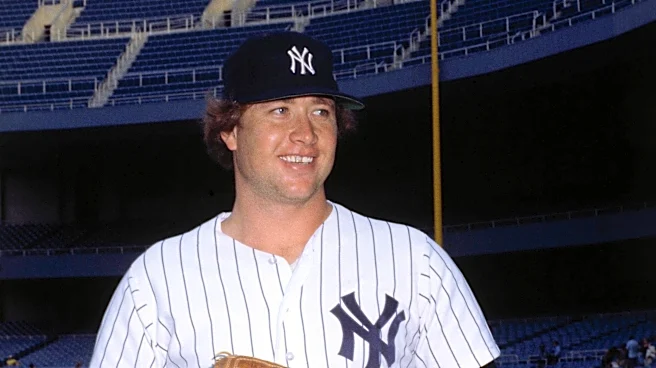





Across the last century of baseball, few players fit their era quite as well as Rich “Goose” Gossage. With a high-octane fastball and an intimidating, occasionally hirsute look on the mound, he rose to prominence in the game as the concept of a capable bullpen was undergoing a revolution, and in those days of firemen and multi-inning relief aces, Goose stood out as one of the best. Among the first big-ticket names in free agency as well, Gossage signed with the Yankees as they were coming off a championship
in 1977 and then helped them win another in ’78.
Richard Michael “Goose” Gossage
Born: July 5, 1951 (Colorado Springs, CO)
Yankees Tenure: 1978-83, 1989
Before he was Goose, he was simply Rick to his family. Growing up as the fifth of six children, Gossage formed a close relationship with his father, Jack, who worked as a landscaper by trade and spent much of his free time prospecting for gold after catching a case of gold fever.
Gossage attended Wasson High School in Colorado Springs, where he starred in both baseball and basketball. During his junior year, tragedy struck when his father passed away. A firm believer in his son’s powerful right arm, Jack Gossage allegedly insisted from an early age that Rick would someday pitch in the major leagues. If true, it was a prediction that proved prophetic or, at the very least, one spoken into existence.
Gossage’s path to the majors began right out of high school when the White Sox selected him in the ninth round of the 1970 MLB Draft. He impressed enough that summer to finish the season in Class A. Gossage soaked up advice and formed close bonds with his coaches as he adjusted to professional baseball and dedicated himself to the game.
In 1971, at just 19 years old, Gossage found himself in the starting rotation at the Class A level. It was the season that put Gossage on the map as he was named the Topps Midwest League Player of the Year. He earned the honor by winning 18 games while posting a 1.83 ERA with 149 strikeouts across 187 innings.
Chicago was impressed enough to invite Gossage to spring training before the 1972 season. It was there that the legendary nickname was born when teammate Tom Bradley told Gossage he looked like a goose while peering in for the catcher’s signs. The nickname stuck. Before ever throwing a major league pitch, the legend of Goose Gossage was born, and it would become the name baseball fans knew him by for the rest of his life.

Gossage was so impressive with an upper-90s fastball that could touch triple digits that he broke camp with the big league club. In his rookie season, Gossage went 7-1 with a 4.28 ERA, but he was still learning to harness his electric arm. That lack of command resulted in him averaging nearly five walks per nine innings. In many ways, he looked like the real-life version of Rick “Wild Thing” Vaughn. Those command issues led to Gossage bouncing between the major and minor leagues over his first few professional seasons.
Then, in 1975, everything clicked. Coincidentally, it was also the same season Major League Baseball adopted the modern save rule, forever linking one of the game’s most intimidating relievers with the birth of the statistic that would help define his Hall of Fame career and later become one of his most frequent subjects of criticism.
At 23 years old, Gossage made his first All-Star team. He finished the season with a 1.84 ERA, 26 saves, and 141.2 innings pitched while striking out 151 batters. Following that breakout campaign, the White Sox hoped to maximize Gossage’s value by converting him into a starting pitcher for the 1976 season. In the rotation, Gossage made his second straight All-Star team despite pitching for a club that lost 97 games. Across 29 starts, he went 9-17 with a 3.94 ERA over 224.0 innings.
Prior to the start of the 1977 season, Gossage was traded alongside Terry Forster to the Pittsburgh Pirates for outfielder Richie Zisk and pitcher Silvio Martínez. Gossage never enjoyed the rhythm of being a starting pitcher and gladly welcomed a return to the bullpen.
The move paid immediate dividends. The 1977 season proved to be one of Gossage’s best, and it came during his walk year. He recorded 26 saves with a 1.62 ERA while striking out 151 batters in 133 innings. After the season, the Pirates were unable to reach an agreement with Gossage, making him the crown jewel of the free-agent market.
The Yankees were fresh off a World Series championship and already had the reigning Cy Young Award winner, Sparky Lyle, anchoring the bullpen. However, never one to sit on his wallet, George Steinbrenner wanted another splash, and he decided Gossage was the ticket. As teammate Graig Nettles said, Sparky “went from Cy Young to Sayonara.” The two sides agreed to a six-year contract on November 22, 1977.
After a rocky start in pinstripes, much like the rest of the club, Gossage and the Yankees turned the summer of 1978 into one for the ages. At their lowest point, the Yankees trailed the Red Sox by 14.5 games. New York completed one of baseball’s greatest comebacks, and it was Gossage who induced Carl Yastrzemski to pop up to Graig Nettles for the final out of the legendary one-game playoff, completing one of the greatest collapses and comebacks in baseball history.
The Yankees went on to claim the World Series title, the only World Series championship Gossage would win as a player. The following season was one Yankees fans would rather forget. Still reeling from the untimely death of Thurman Munson, the club also lost Gossage for nearly three months after he tore ligaments in his thumb during a clubhouse fight with teammate Cliff Johnson. The Yankees missed the postseason in what became the definition of a lost season.
The Yankees and a healthy Gossage rebounded in 1980. Gossage recorded a career-high 33 saves and was selected to his fifth All-Star team. Everything appeared to be going according to plan until George Brett sent the Yankees home with a home run off Gossage in the American League Championship Series.
That defeat proved to be a turning point in Gossage’s relationship with the organization. As a way to needle Steinbrenner, Gossage grew his now infamous Fu Manchu mustache in protest of the Yankees’ facial hair policy.

Gossage continued to be a force while sporting the new look. Over the final three years of his contract, he recorded 72 more saves and earned All-Star selections in both 1981 and 1982. Despite the success, the relationship with Steinbrenner continued to deteriorate. Gossage famously referred to the owner as “the fat man upstairs,” and he also maintained a strained relationship with manager Billy Martin.
New York tried to re-sign Gossage after his contract expired following the 1983 season, but the veteran decided his time in Yankees management had run its course and instead signed with the Padres. During his age-32 and age-33 seasons, Gossage made the All-Star team both years and helped San Diego reach the 1984 World Series, where the Padres fell to the Tigers.
Gossage spent four seasons on the West Coast before the Padres traded him, along with Ray Hayward, to the Chicago Cubs for Mike Brumley and Keith Moreland. He spent the 1988 season on the North Side, completing a tour of both sides of Chicago. Prior to the 1989 season, the 37-year-old Gossage signed with the San Francisco Giants. That August, he was placed on waivers, and the Yankees successfully claimed him.
His return gave Gossage seven seasons in pinstripes. During his final stint in New York, he appeared in 11 games and posted a 3.77 ERA.
It seemed to most that this would be it for Gossage, but he opted to pitch professionally in Japan in 1990 before returning to the majors for four more seasons. Those final years included one with the Rangers, two with the Athletics, and the final campaign of his career with the Mariners in 1994.
In 2008, Gossage received baseball’s highest honor when he was inducted into the National Baseball Hall of Fame. The voters made him wait eight ballots before finally enshrining him in Cooperstown.
Whether you hate his old-school, unfiltered vocabulary or love his tough-guy mentality, I’d bet he probably feels the same way about you. Like him or not, there is no denying Gossage remains one of the greatest relief pitchers ever to wear Yankee pinstripes and one of the original great closers in baseball history.
Happy birthday, Goose.
See more of the “Yankees Birthday of the Day” series here.