


When the New York Giants 2026 schedule came out, Ed asked me if I wanted to handle the game-by-game predictions.
I, of course, said “sure”, and took my time going through the games and came away with a 10-7 record for the Giants. I felt like I was being optimistic, but not outlandishly so considering what I saw on tape in 2025, the coaching changes, and the personnel changes.
Pretty much immediately, I caught criticism for being wildly optimistic and far too high on the Giants. Even Ed said in his
own prediction piece that 9-8 was the most optimistic he could credibly be. While I was thinking about the response to a favorable view of the team, I came to the realization that I need to talk about how absurdly unlikely it is that the Giants find themselves in the situation in which they are now.
It’s been a while since I’ve sat down to do one of these. It isn’t so much that I haven’t had the itch to sit down and write a piece that explores what I’ve been thinking about a topic, but rather that circumstances haven’t cooperated.
Between covering the Giants coaching search, free agency, and the 2026 NFL Draft, time has been at a premium. There have also been some topics I did carve out the time to write about, only for circumstances to change and whole posts be invalidated before they could be published.
It happens.
But to circle back a bit, I want to explain why I felt I was being measured in my optimism with respect to the Giants in 2026: Math.
In particular, I want to bring up Win Probabilities.
The concept of trying to model how likely a team is to win a game has been around for a long time now. Not only is Las Vegas more or less built on it, but various statisticians and outlets have been modeling win probabilities in real time for about 25 years now.
At it’s core, Win Probability states that a certain percentage of teams in given a certain set of circumstances (like game time, field position, down and distance, and score) will win.
As the NFL itself puts it,
Models use familiar inputs including score, down, distance, and field position, and also more subtle variables, including which team kicked off to start the game and the number of timeouts each team has left.
Most, if not all, models also factor EPA (Expected Points Added) into the equation. EPA is a commonly cited stat which measures how likely a given action is to result in a score on the next play. What isn’t commonly talked about is that EPA is old and dates back to 1971.
The NFL has given it’s mark of approval to the work of statisticians and has used Win Probability to help the Competition Committee make decisions to (try to) improve games.
It isn’t, as it’s been described by some, a “voodoo stat”. In addition to the NFL, there have been multiple studies on Win Probability done at the university level which have found most known models to be both stable and predictable.
Some models, like the ones used by Pro Football Reference and nflfastR are publicly available while others, like the one used in ESPN’s Gamecasts, are a proprietary black box. But even while they aren’t perfect, they’re still reliable for getting a sense of how likely a team is to come away with the win at any point within that game.
That all serves as a preface for why I was higher on the Giants coming out of the 2025 season than many others.
It gets glossed over at the local level, and largely ignored at the national level, that the Giants lost five games in which they built double-digit leads (and as underdogs, no less).
The attitude toward that fact can largely be summed up with a sarcastic “Bad team loses games. News at 11:00.”
That attitude misses two important facts:
- The Giants were good enough to build those double-digit leads as underdogs.
- They still should have won at least a couple of those games through sheer dumb luck.
There was no single through-line in the Giants’ losses. Injuries, execution, coaching decisions, penalties, and random chance all played a role in those losses.
I went back to ESPN’s live Win Probability models for those five games to see just how likely it was that the Giants lost all five of those games.
- Week 2 – vs. Cowboys – peak Win Probability: 92.3% (7.7% Loss Probability)
- Week 5 – vs. Saints – peak Win Probability: 78% (22% Loss Probability)
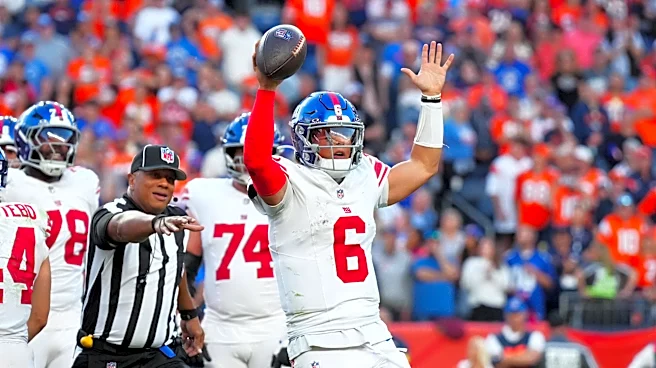
- Week 7 – vs. Broncos – peak Win Probability: 99.8% (0.2% Loss Probability)
- Week 10 – vs. Bears – peak Win Probability: 96.1% (3.9% Loss Probability)
- Week 12 – vs. Lions – peak Win Probability: 92.1% (7.9% Loss Probability)
While we tend to view a season as a whole, complete with narratives and through-lines, every game is a distinct instance from a statistical point of view — like flipping a coin. If you flip a coin, there’s a 50% chance it lands either heads or tails, and if you flip the coin twice, there’s a 25% chance you get heads or tails twice (0.5 x 0.5).
So if we take the Giants’ peak win probability from each of those five games (0.923 x 0.78 x 0.998 x 0.961 x 0.921), there was a 63.6% chance that the Giants would win all of those games and go 5-0 with a d0uble-digit lead.
But that didn’t happen. Instead, something almost absurdly unlikely happened and the Giants lost all those games.
If we take the other team’s minimum win probability as the Giants’ minimum probability of a loss, then the odds of losing to the Cowboys and Saints and Broncos and Bears and Lions (0.077 x 0.22 x 0.002 x 0.039 x 0.079) was just 0.00001%
In other words, it wasn’t just a 1-in-a-million chance that the Giants lost those five games. It was a 1 in 10 million outcome.
As I mentioned earlier, there really wasn’t a single through-line in the Giants’ losses, with a variety of factors playing a role in each one. Some, like young players making mistakes or coaches making bad decisions, we can expect (hope to) change. After all, the idea is to develop young players and for them to make fewer mistakes as they mature, while the Giants also have a new coaching staff. Meanwhile things like injuries, penalties, and untimely turnovers are chaotic and should normalize over time.
But for some reason it’s easier to comprehend teams like the Chicago Bears not coming away with a litany of come-from-behind wins powered by incredibly timely turnovers than it is the Giants putting away games after they build leads.
Both trends should regress toward the mean, and for that Giants that should mean a better record even if they didn’t make any changes.
We are not, however, going back in time to replay 2025, and the Giants did, in fact, make changes.
The first of which was to hire John Harbaugh after he was fired by the Baltimore Ravens following an 8-9 season. And even there, the win probability suggests that the Ravens could (or should) have won another 4 games against the Bills, Lions, Patriots, and Steelers.
- Week 1 – vs. Bills – peak Win Probability: 98.6% WP (1.4% Loss Probability)
- Week 3 – vs. Lions – peak Win Probability: 74.8% WP (25.2% Loss Probability)
- Week 16 – vs. Patriots – peak Win Probability: 91.3% WP (8.7% Loss Probability)
- Week 18 – vs. Steelers – peak Win Probability: 83.5% WP (16.5% Loss Probability)
Without going through the math again, there was a 56.2 percent chance that the Ravens win all four of those games, and a 0.005% chance that they lose them.
In other words, more than half the time a team is in similar circumstances, they would come away with a 12-5 season. Had that happened, John Harbaugh would likely still be the Ravens’ head coach and not available for the Giants to hire. Kevin Stefanski would (probably) be the Giants’ head coach today, and while he’s very well regarded, he wouldn’t bring the instant cache and experience as a proven winner that Harbaugh does.
That brings us to the other knock-on effect of the Giants’ improbable losses: The draft.
The Giants controlled the 1st overall pick right up until their Week 17 game against the Las Vegas Raiders, despite the fact that they also could have had 7 underdog wins instead of just 2 at that point. The final two wins to bring their total to 4 secured the 5th overall pick, however had the Giants won even a couple of those games they could have been outside of the Top 10, or perhaps in the mid-teens with 8 or 9-win teams.
That’s significant as it was considered a massive stroke of luck that Arvell Reese fell to the Giants at 5th overall.
It isn’t a perfect measure, but Reese was only selected by the Giants in 5% of the mock drafts recorded in the Consensus Big Board database. He was mocked to the Giants in 75 mock drafts out of a total of 1,282 mock drafts, with the bulk of those coming before the end of the season when the Giants had the first or second pick.
By the time the draft rolled around, Reese was widely mocked between picks 2 and 4, while OL Francis Mauigoa was commonly mocked to the Cardinals at 3rd overall.
Joe Schoen said after the Giants managed to land both Reese and Mauigoa that it was a “pipe dream” to land the two, while Harbaugh added that they ran about a “million” mock drafts and the scenario never came to pass.
It wouldn’t have happened if the Giants won any more games. Likewise, they probably wouldn’t have landed CB Colton Hood in the second round with a lower pick.
Final thoughts
When I put put my flag on a 10-7 record flag for the Giants, I wasn’t viewing them as a team that only won four games off of bottom feeders. I was projecting a team that stunned two playoff teams and built double-digit leads over five other teams as underdogs.
That was a team with an unsettled quarterback position and missed two of its best offensive weapons for much of the year. And even with all their problems, they were still able to compete with playoff caliber teams. I’m not going to say that the 2025 Giants were good, but their 4-13 record was still “get hit by a meteorite” levels of unlikely.
That was the team I was projecting to rebound to a 10-7 record.
Jaxson Dart is now an experienced starter and put up stats as a rookie that put him on a similar footing as Dan Marino, Justin Herbert, and Cam Netwon going into Year 2. The Giants will be getting Malik Nabers and Cam Skattebo back at some point to bolster the offense around Dart.
And to that team the Giants are adding one of the most experienced and consistently successful coaches in the NFL in John Harbaugh. A coach who is probably only available through his own stroke of improbably bad luck.
They’re also adding a Top two talent in Arvell Reese, a player widely considered the top OL in Francis Mauigoa, and a corner who is typically considered Top five in a talented group in Colton Hood. I hold that the Giants weren’t at a talent deficit last year, and adding what could be three first round talents (two of whom could be Top 5 talents) is a potentially huge infusion.
If we look at the Giants as a team that should have had a 7 to 9 win season with a brutal schedule, making the type of coaching and personnel additions they have should be the foundation for a leap in performance. To my mind, projecting a 3 or even 1-win improvement is only modestly optimistic.
But, of course, we’ll see.
It would be nice if rather than defying the odds to snatch defeat from the jaws of victory time and again, the Giants do what they’re supposed to and put teams away once they’ve built a lead.