

“Pretty unprofessional, huh?”
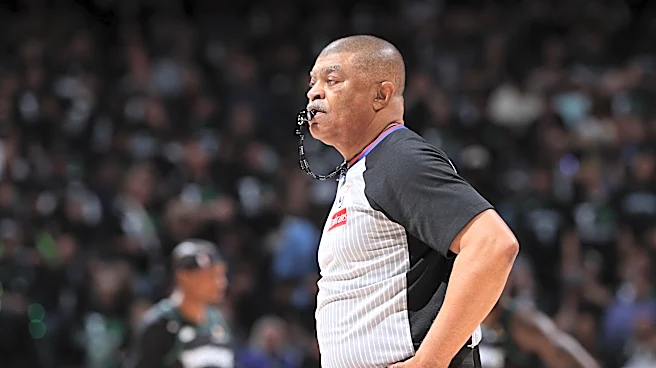
Wolves coach Chris Finch sat behind a table in the Target Center media room after a 115-108 Game 3 loss to the San Antonio Spurs in the Western Conference semifinals. Clearly ready to get something off his chest, he was asked about a second-half mid-court conflict with veteran NBA official Tony Brothers.
Wanting to call a timeout and reorganize his group, he felt as though Brothers disregarded his job and ignored him.
He let him know that. Brothers took exception.
Instead
of a typical technical foul and a warning issued to go back to the bench, the grizzled crew chief took things a step further…quite literally.
“He clearly heard me,” Finch said when recounting the situation of asking for a timeout and getting ignored. “It almost cost us a turnover…he lost it.”
Following a six-point loss in which the Wolves were -12 in the free-throw disparity, and a game that saw plenty of stoppages, you might think that the website you’re reading this on prequalifies this piece to be a “the refs cost the Wolves the series” soliloquy.
Not quite. Much of the Wolves’ free-throw discrepancy throughout the series came from a tentativeness in attacking the basket after saying they would be unrelenting in doing so after Game 1.
However, when themes keep coming up from multiple people who are given a microphone around the league, one thing to me remains relatively common. Including Castle himself recently, talking about selling contact and the trend in doing so around the league.
Simply put, the NBA and its officiating crews are at an inflection point on how they go about their night-to-night jobs.
As seasons keep going, tension between players, coaches, and officials keeps boiling over.
By my count, more than six coaches called out officiating specifically during the season in postgame press conferences.
That doesn’t count some of the playoff tangents we’ve had, including tenured veteran Devin Booker going out of his way after Game 2 of the Phoenix Suns’ series with Oklahoma City to call James Williams out BY NAME.
There are plenty of examples of frustration with NBA officiating. Perhaps brought to its peak when the Oklahoma City Thunder played a series against a Los Angeles Lakers team that always has millions of eyes on it and a fanbase not afraid to speak its mind, questions and tension between fans, players, coaches, and those instructed to keep the game together have reached a point where the NBA simply has two options.
1). Completely ignore the situation – The worst option. This pisses fans off more who clearly want answers to why games are so different from a flow perspective on a nightly basis
2). Address the issue with changes – I’ll talk about this soon, but I believe there are a couple of clear-cut, subtle ways in which the NBA can make the game easier on its officials while making a game already played a rapid pace more fun to watch.
So, blog boy, what issues could be smoothed over that could be the cure-all, if you know so much?

Stop Discouraging Pace
It’s truly underrated how much faster the NBA has gotten over the last 20 years.
In the 2011-12 regular season, the Sacramento Kings led the NBA with a PACE metric of 97.3 (the number of possessions a team uses per game).
This past season, the slowest team in PACE was the Boston Celtics, with a metric of…97.7.
Shots go up quicker. Teams move faster. And for some reason, games could not go any slower.
It’s simple. Refs are having a hard time making the right call with a game moving as fast as it is, and the fear of getting every call right tends to send them to the monitor more than they should. Furthermore, the amount of time spent at the monitor for simple calls like an out-of-bounds play, flagrant, or goaltend is painstaking.
Adam Silver has come out and said the NBA plans to augment this with an AI officiating system for calls like this. I’m not sure AI is necessarily the answer here, but could something similar to what the NFL has with the sky judge be implemented here? Perhaps a 10-second stoppage in play if the call is extremely questionable to hear from a sky judge, or additional official watching 2-3 different angles in Seacaucus that can call this out?
With gambling culture becoming rampant, I understand officials wearing an earpiece can be shady, but it’s better than what we have now.
Imagine games that aren’t completely smeared with reviews. Where up and down basketball is back. Go back and watch a few games from the early 2010s. The contrast to now is so unbelievably stark in a good way.
Now take that, hit the 1.5x fast forward, and get an idea of what the potential of this league could be. These players are awesome, and I don’t need 100% accuracy on out-of-bounds calls and weak flagrant calls in exchange for what could be a far more entertaining product.

We Can’t Get Rid of “Grifting”, But There Are Steps to Take
You know those fouls at the baseline that get called all the time?
Where a team has no other shot against good defense, so they drive from the elbow to the baseline, try and catch the defender at a bad angle, and completely fall backwards, hoisting the ball up in a situation where it’s surely not going to go in, but it gets called a shooting foul anyway?
It seems to happen all of the time, and more often than not, they award the out-of-control player. Finch has said it before, and my main gripe matches it. For some reason, out-of-control players are being awarded more than ever now. Fall on a fast break? Sure. Fall on a drive? You got it.
Fouls like the one I laid out could be given the rip-through treatment, as always, being a foul on the floor. There’s no intent to actually score the ball during game action with the embellishment of contact, and it’s obvious it’s a move players practice because they know it’s a cheap way to get to the line if the shot clock is breaking down.
A simple way for something like that to not get the rip through treatment? Playing through the content to show actual scoring intent.
The baseline fallaway is just one example. So many times, a defender could be in complete control while the offensive player is not, and the latter will tend to get rewarded. It might be a place that the league is at, but seeing more play-ons through marginal contact and making things like the above fouls on the floor could be ways to curb what’s happening and also prevent further stoppages.
All in all, I don’t want something like this to take away what’s shaping up to be an awesome finals, and frankly, a finals that’s being officiated extremely well with plenty of contact.
But where we’re at can’t continue to happen. It ruined the discourse of the playoffs this year, it’s slowly ruining the NBA product, and giving a bad example for youth hoopers on what to build their game around.
Is Adam Silver the right guy to figure out? I’m not sure, but man, do I sure hope he is. Basketball can’t keep getting played and talked about like this at the highest level.
Fans, players, coaches, and organizations are clearly getting tired of it. Hell, I’m sure refs are too. Now it’s time for those who run the league to show they are, too.