

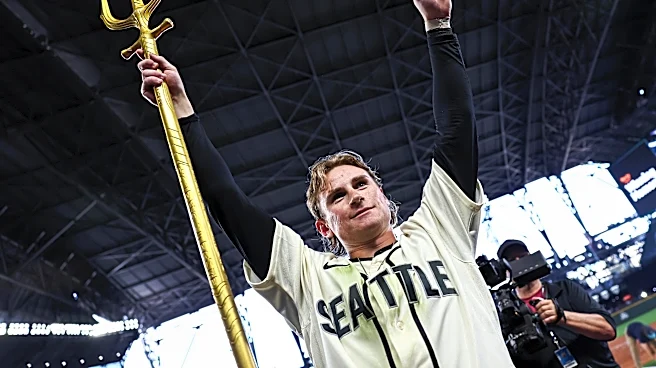
As we’ve written about extensively over the past few days, the Mariners didn’t make splashy moves this trade deadline, but they did make moves to address their biggest weaknesses in the bullpen and right-handed hitting outfield, even if those returns might not move the needle for fans. Both Seranthony Dominguez, the reliever acquired in the Luis Castillo trade, and Taylor Ward, acquired in the Alex Hoppe trade, are in the midst of down seasons. Nick has dug into why Seranthony Dominguez might be
a candidate to rebound in Seattle, a piece I strongly recommend you take a look at if you haven’t yet (almost as strongly as I’d recommend not looking at what he did in his Mariners debut). Today I’d like to do the same for Taylor Ward (with the similar caveat about not looking at his first game as a Mariner).
Jerry Dipoto, at least, is certainly happy to have acquired Ward:
“We feel like with Taylor Ward, we got at least—if not the best right-hand bat that moved at this deadline, certainly on the short list of the best right-hand bats,” said Dipoto, pointing to Ward’s solid performance for over six years in the league, elite on-base skills, and the way he fits the team. “Obviously, an everyday player who can handle both, but he’s particularly good against lefties.” (Ward has historically crushed lefties, with a 130 wRC+)
Mariners fans are familiar with Ward as a Los Angeles Angel, where he was famously the last first-round pick of Jerry Dipoto’s GM tenure before Dipoto skipped town for Seattle. But don’t let the first-round pedigree fool you: Ward, who was college teammates with Aaron Judge at Fresno State, is a lifelong grinder. Barely inside MLB Pipeline’s Top 100 when the Angels took him at 26 with an underslot deal, Ward was seen as a surprising selection by many in the industry, projecting him as a potential backup catcher, a defense-first prospect with a cannon for an arm, although he drew praise for his (Dipoto catnip alert) advanced plate discipline and approach. He spent his summers in both the prestigious Cape Cod League and the less-prestigious Alaska Baseball League, an experience he calls “one of the coolest things I’ve done,” describing waking up at 1 AM to go work out at the field.
Unsatisfied with his performance in High-A in the 2016-17 seasons, which was acceptable but not exemplary, Ward linked up with an old teammate from Fresno State, Trent Woodward, a minor-leaguer with the Astros, who told Ward about all these newfangled hitting metrics the Astros were using like attack angle and bat path ellipses, as well as technology like TrackMan, BlastMotion, and K-Vests. Ward, an eager student, dove into swing mechanics, refining his swing and roaring into the 2018 season and the upper minors, posting a 161 wRC+ for the season but failing to appear on any Top 100 lists.
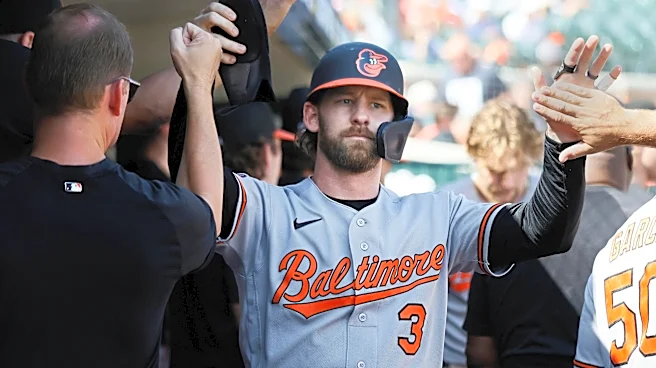
A move to right field, where his cannon arm could continue to play without the mental load of catching, allowed Ward to focus solely on offense, and by 2022 he was an established regular for the Angels. While he continued to take his walks, he also became a little more willing to swing, trading a modest uptick in his strikeout rate – still below league average – for more power. Outside of 2023, when he missed time with a gruesome facial fracture after crashing into the away scoreboard at the broken-down haunted ride attraction currently known as Daikin Park, Ward has hit 20+ homers every season until running into another haunted house, this time righty-power-killing Oriole Park, where just one (1) of his seven (7) home runs this year has been hit.
Ward countered that suck on his right-handed power by dialing his selectivity at the plate up even further, testing the bounds of how close to a near-equal K/BB rate an everyday player can run. He leads the AL in walks, with 87, and is doing it while striking out about 20% of the time. He’s made himself into a valuable player, an OBP king, but at the cost of sacrificing his power.
But while he’s not been pulling the ball in the air for power, Ward has been spraying the ball around more. On the left, his historic heat map; on the right, 2026. His flyball rate has dropped while his line drive rate has increased and he’s hitting the ball up the middle more than ever. In order to do this, he’s flattened out his swing a ton, going from a 9° attack angle, just under the MLB average of 10°, to a 6° attack angle.

All of that sounds like something that would be in harmony with the Mariners’ current hitting coaches, who preach a similar up-the-middle approach.
“I think getting into a different ballpark situation, or back to the (AL) West where you know he’s in familiar environments [could help],” said Dipoto. “I don’t know that there’s a tougher place for a right-hand power hitter to go hit right now than Baltimore since they made their stadium change in left field, but I’ll give Taylor a ton of credit. He took what was already a skill and turned it into an elite skill, and he found a way to contribute on an equal level to what he was doing in Anaheim in a very different way. And I’ll take either one of those guys. I’ll take the 36 homer guy or the 380 on base guy. They’re they’re both good to me.
Going from Oriole Park to T-Mobile might not be the boon Dipoto is painting it as here – Oriole Park ranks right at the middle of the pack for right-handed power hitters for homers, fifth best for xwOBAcon, while T-Mobile is in the bottom third of the league for righty homers, 26th for xwOBAcon – but the good news is Ward doesn’t need to be his lift-and-separate self of yore on this roster. Despite what we know about how much T-Mobile doesn’t reward hitters for good quality contact, contact is contact, and the Mariners have enough power on their roster – in the forms of Dom Canzone, Randy Arozarena, Julio Rodríguez, and the version of Cal Raleigh that hasn’t been conked over the head by a very large flowerpot, plus the sneaky power source that is Cole Young – that all Ward needs to do is get on base, something the 2026 Mariners have treated like they’ve been told they need to solve the Yang-Mills theory gap first before they can set foot upon pillow, and wait to get driven in by one of the boppers.
For his part, Ward says he likes the experience of hitting at T-Mobile, even as he saw limited success here as a visitor.
“I think one big thing is, I’m just happy not to have to face this staff anymore,” Ward joked. “Definitely top-tier in baseball.
But yeah, I like it here. I like playing outfield here. I like the batter’s eye, as well, I like the dark feel that it has here. Definitely looking forward to playing here.”
Ward also said he’s aware he’s in a down year for power, something he’s hoping to re-establish with his new team, as he’s looking forward to getting into conversations with the Mariners hitting staff.
“Just continuing to learn the league and how they pitch me,” said Ward, who said the thing he wants fans to know about him is that he’s a hard worker. “I do my own homework and game planning against them, so hopefully I’ll be able to come in and tap in to some power I’ve been missing, but also keep the walks going, keep the on-base going. But it’s been interesting year for sure. Hoping I can fill in some gaps as we get close to the end here.”
That’s not all Ward is hoping for: the long-time Angel has never been to the playoffs, and is hoping for his first shot at post-season play with the Mariners.
“That would be huge. Obviously, I haven’t been to the playoffs in my career, and that’s one thing I want to do. That’s what every player wants to do, win a world championship. So that’s my goal.”
Dipoto said the plan with Ward is to give him time to re-familiarize him with playing right field, since he hasn’t played it regularly in a couple of seasons, so the team will give him some time to practice getting accustomed to the angles in T-Mobile Park while giving him DH days, but the eventual plan is for him to play the majority of right field, while Canzone, who is comfortable with DHing and less comfortable with his nagging hamstrings, will eventually be the primary DH.
For Dipoto, he’s finally gotten his man after years of trying.
“We have tried to acquire Taylor Ward for years, but you know, at his original location, it was an impossibility.”
“I laughingly said to him yesterday, just as I always thought, my second conversation with Taylor Ward was going to be welcoming him as a 32-year-old corner outfielder, because the last time I talked to him, he was a 21-year-old prospective catcher.
“It’s cool to have a full circle deal,” laughed Ward. “I’m just really excited about it.”