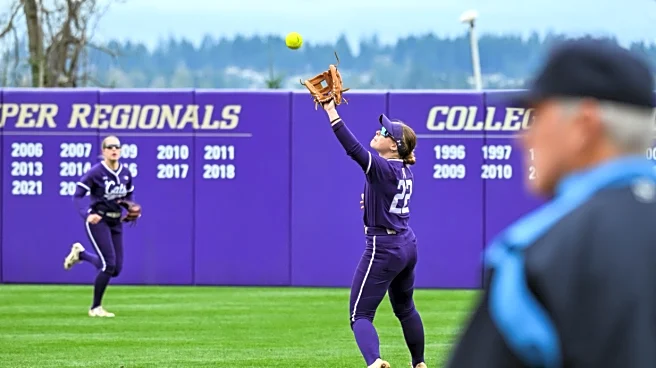


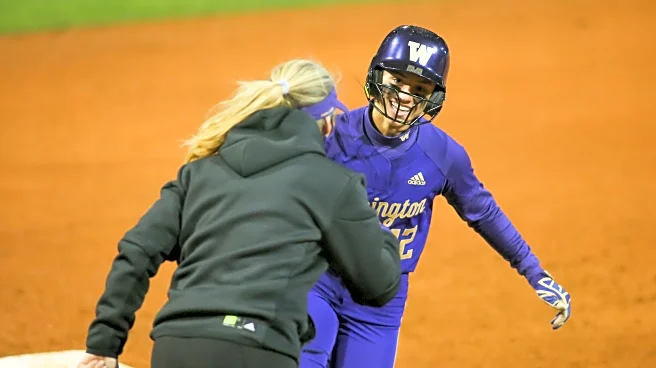
Washington Softball head coach Heather Tarr told the Big Ten Plus broadcast crew that she believes the Huskies’ tough early-season schedule helped “accelerate the development of the roster.”
If this is the case for the Huskies, why can’t it be the case for the ’Cats?
Heading into this series, Northwestern faced 14 unique opponents. Six have been ranked in the top 25 (UCF unranked at the time, though it has since risen to No. 22), and four others received votes. By comparison, Washington’s played 16
unique opponents, with four ranked teams and one receiving votes.
This means the ’Cats have faced twice as many “tough” opponents as the Huskies, and yet the development is slow to catch on.
I feel like a broken record every week, but it seems like Northwestern as a whole just isn’t learning. Maybe it’s the young talent. Maybe it’s the ugly trend the Wildcats tend to follow with slow starts to the season. But I think this is the result of a team not playing together.
Trust shows up in small moments; it’s a hitter trusting a teammate to finish the job if she gets on or moves a runner over. It’s pitchers believing the defense will back them up, attacking the zone instead of pitching cautiously. When trust isn’t there, hesitation creeps in.
Grace Nieto, who is the only player left from the ’Cats’ 2022 WCWS roster, said a major part of that team’s success was the connection they built throughout the season. This year’s team is working toward that same connection now, she says, but my question is whether they can find it quickly enough to turn this season around.
Let’s keep picking apart a couple of performances from this week and the trends noticed.
Grab your favorite snack, and let’s dive in.
The Checked Boxes.
Small wins
I want to give a brief shout-out to three deserving players from this weekend!
Kansas Robinson continues her trend, hitting .375 on the weekend with a home run and two RBI. She also got a lot of work at first, with five unassisted outs.
Head Coach Kate Drohan gave Tru Medina a break at third, turning to Teagan McCue to get the job done. On three chances, McCue recorded a putout on an infield fly and an assist for a grounder she fielded and fired across to first. This marked her second defensive appearance of the season — she primarily played short during high school, so this was a new spot for her. Only one error blemished the outing, but overall, she looked comfortable at the corner, hopefully giving the Wildcats another reliable option behind Medina when she needs a breather
Avery Garden also stepped into left field once again and did an immense job. She converted all five chances that came her way, including an impressive catch at the wall. She went .286 with an awesome triple, reportedly 72 mph off the bat deep to center field, and had the second most hits on the team (behind Robinson).
Bullpen Boost
Picture this: Inning four has gone awry, and it seems nothing will keep the opposition from cementing their lead as they make their way through the lineup. There’s a mound visit. You see a faint figure in the distance, jogging her way to the rubber like a knight in shining armour. That’s when you realize — it’s Emma Blea!
I jest, but Blea has indeed been far more effective coming out of the bullpen compared to taking the mound first. Take a look at the comparison below:

(Note: Innings are calculated based on outs, meaning that .1 of an inning is one out. One full inning is three outs.)
As you can see, in 15.1 innings of relief work this season, she allowed just three earned runs on 10 hits (one home run, two doubles). This is a stark difference compared to her starter numbers: 13 earned runs on 19 hits across 11 innings (four doubles). For further comparison, her ERA as a reliever is 1.39. As a starter? 8.27.
We’ll even isolate the numbers from this weekend in Washington, laid out on the chart below.

Interestingly, I would expect these stats to be flipped. Blea opened the series as a starter when the lineup had yet to see her pitching at all. By the third game, hitters already faced her and found success. With this logic, we would expect hitters to adjust more quickly to Blea in the reliever role and struggle against her as a starter. We see the opposite.
This difference could be chalked up to a timing gimmick, as entering mid-game can disrupt a lineup’s rhythm, but I think this is too shallow. Instead, the pattern suggests something more structural, hinting that she simply performs better in relief.
Coming into a game where momentum is already up is extremely tough; it’s hard to stop the train once it’s moving. But Blea has done a considerable job at halting opposing teams’ momentum this season. When not starting, opponents have managed far fewer baserunners against her, and she has been able to work more aggressively in the strike zone to stabilize games.
With any of these stats, it’s hard to make a full statement that she will continue doing this all season. I’m working with a small sample size, but I hope Drohan keeps using her in this relief position.
What’s Still in Play?
Wasted Outs
The ’Cats went through 57 outs this weekend, yet they managed just 13 hits over the series, the same amount Washington collected in the first game alone. Across all three games, the Huskies tallied 26 hits, highlighting the difference in offensive production between the two teams.
We can take this at face value, but I think breaking down these outs offers further insight into Northwestern’s offensive struggles. Of the 57 outs, nine were fly balls, 22 were grounders, six were infield flies, two were fielders’ choice and 12 were strikeouts.
For the most part, it seems the Wildcats are staying on top of the ball; only the occasional dips into an infield pop-out detour their swings. However, power and placement are another story. A good hitter knows how to adjust, noticing when there is a gap and pushing it through for a single.
Softball is a game of chance; sometimes, a ball just finds a fielder’s glove. However, these are opportunities that need to be converted, especially if Northwestern hopes to compete in close contests. Balls aren’t finding holes, swings aren’t producing and opportunities are slipping through the cracks.
In the second game, the Wildcats had more hits than in the first but scored no runs. This shows a lack of cohesiveness. When a team can’t consistently bring runners home, those missed chances accumulate.
But alas, this problem isn’t new; I first raised concerns about runners left on base in the column’s opening week. And yet, the trend has persisted: In week two, the ’Cats left 27 runners stranded; Week three, 16; Week four, 15. This weekend, Northwestern left 12 runners on base against Washington’s 17, a number that might seem reasonable until you consider the Huskies had 26 hits and 25 runs compared to Northwestern’s 13 hits and six runs.
The issue remains in making solid contact with the ball and stringing together hits, something that needs to change going into the second half of the season.
Weeklies
Best game: Game two was the closest I saw to command in the circle and solid defense this entire weekend. Unfortunately, the Wildcat offense couldn’t back it up and they lost 0-2, but don’t worry about that right now. Let’s instead celebrate a competitive contest, even if it ended with a loss.
Mason did very well, allowing no earned runs in six innings and recording six K’s — four swinging and two looking. Despite not cashing in, I also want to point out that three of four hits in the game came from the bottom three in the lineup. The ’Cats also had the fewest number of offensive strikeouts in this contest, meaning more chances for on-base opportunities.
The unfortunate hiccup in this game occurred in the bottom of the sixth, when two throwing errors on the same play allowed for Washington’s lone two runs. Despite this bump, Mason forced the next two outs with infield flies before anything could get worse.
Again, a loss isn’t always the best thing, but I’ve been harping on the defense for quite a while and was overall happy with the performance.
Best play: What a game for Garden, huh?
In a then-scoreless contest, this catch was crucial for the ’Cats — especially with a Husky lineup capable of pushing runs across. With the ball pelted to the wall, Garden tracked it masterfully before slamming into the ‘N’ of the barrier, securing it in her web and holding on as she crashed to the ground.
The Bounce Back
This week, Northwestern travels to Kentucky to compete in its last tournament before conference play continues. I cannot understate how crucial this stretch is.
Detroit Mercy (6.98 ERA), Northern Kentucky (4.94 ERA) and Northern Iowa (4.38 ERA) are all teams Northwestern should beat. If it gives up a loss, their postseason hopes feel even farther than they do now.
This should be a week to show what this team is capable of and absolutely dominate, and I hope I can continue the column with much good news. Success here builds momentum heading into an Illinois weekend and then the home opener against ranked Oregon.
It’s a do-or-die weekend; it’s time for Northwestern to consistently bring together its offense and defense, trusting each other to get the job done.