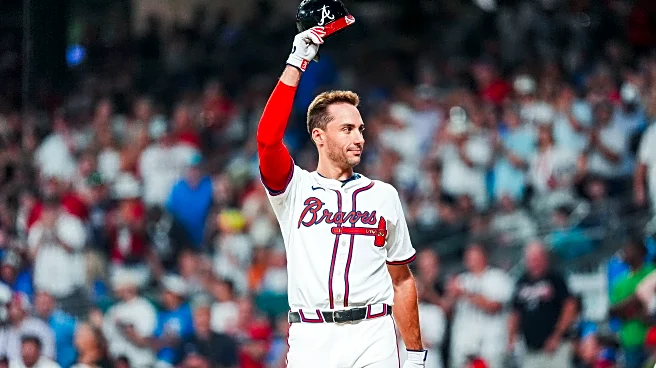

Not a whole lot went right for the Atlanta Braves as a whole in 2025, as evidenced by the fact that they ended up missing the Postseason for the first time since 2017. However, despite all of the muck
and mire that this team had to trudge through during the past season, one thing that definitely went right was Matt Olson’s performance. Atlanta’s star first baseman had himself a lovely season in 2025 and now it’s time to take a deeper look into how that ended up happening.
How acquired
The Braves picked up Matt Olson in a trade with the Athletics in exchange for then-prospects Ryan Cusick (now with the Phillies), Joey Estes, Shea Langeliers (both still with the Athletics) and Cristian Pache (currently with the Mets). Immediately after the trade, the Braves signed him to an eight-year, $168 million contract extension. The move made Olson Atlanta’s new first baseman for the foreseeable future as he replaced some guy named Freddie Freeman, whom you may have heard of once or twice.
What were the expectations?
The obvious hope was that Olson would be able to bounce back from a disappointing 2024 season for his standards. Now granted, it was always going to be extremely tough for him (and apparently the rest of the lineup) to deliver a repeat of the plate production that he delivered during the 2023 season. However, seeing Olson go down from a 162 wRC+ and a .413 wOBA in 2023 to a 117 wRC+ and .339 wOBA was a precipitous decline and one that you could hope wasn’t a case of Olson hitting the infamous age-30 threshold and having a sudden decline. He did end 2024 on a high note after spending most of it scuffling for his standards, and there was at least a thought that he could at least return to something approaching the fantastic production that he delivered in 2023.
When the Braves acquired Olson, he was coming off a career high 5.0 fWAR, and his major league tenure to date featured a 133 wRC+ and about 3.6 fWAR per 600 PAs. Olson’s first season as a Brave was not super-exciting (3.1 fWAR, 121 wRC+), he went absolutely ham in 2023 as noted (6.6 fWAR, 162 wRC+), and then really backslid in 2024 (2.6 fWAR, 117 wRC+). Unlike many of his teammates, Olson outhit his xwOBA in this span, with his two “down” seasons seeing no differential and him outhitting it substantially to go with his excellent inputs in 2023.
Take the above together, and Olson projected as something like a 3 to 4-win player, depending on how much you were willing to weight the likelihood that he’d go berserk like he did in 2023 again. ZiPS had him closer to 3 wins with a 126 OPS+, but his three-year average with the Braves so far was a .366 wOBA, .360 xwOBA, and 134 wRC+. Those numbers are stated for a reason, because…
2025 results
…he had a .366 wOBA, .360 xwOBA, and a 136 wRC+ in 2025.
In other words, he bounced back from his 2024 nadir and returned to something akin to the fantastic production that he delivered in 2023, but largely just hit like his aggregate self since becoming a Brave. In the end, he delivered a high level of steady production that basically made him the MVP of the Braves over this past season.
Olson also combined the lovely plate production (.272/.366/.484 and 29 home runs) with some elite defense as well. His one calling card in 2024 was that he finished in the 87th percentile of all first basemen in baseball with an OAA of 5. He improved upon that in 2025 with a 95th-percentile OAA of 9. So, while his plate production still lagged behind what he did in 2023, he improved enough at the plate from 2023 while stepping it up in the field as well. That’s a lovely combination and it was enough to leave him with 4.7 fWAR on the season.

Olson was the best Braves player in 2025 and the good news is that he did receive some recognition for the role that he played in helping to keep this team from being an even worse tire fire in 2025. Olson took home a Fielding Bible Award, a Gold Glove Award, made it to both the All-Star Game and the Home Run Derby as a hometown participant, and he also received MVP votes as well. He also led all first baseman in baseball for fWAR on the season at 4.7 and did so by nearly a full point ahead of Vladimir Guerrero Jr. and our old beloved friend, Freddie Freeman. As far as bounce-back seasons go, you can’t ask for much more than what Olson produced for the Braves in 2025.

What went right?
I could just leave it at “A whole lot went right, my dude!” but I suppose y’all come to this website for more substantive analysis, right? I suppose we’ll first zero in on his defense here because this was one of the facets of his game that made him such an attractive player when he was initially acquired by the Braves. 2025 was clearly his best season with the glove as a member of the Braves so far. He finished in the 89th percentile when it came to Fielding Run Value, as Statcast graded him out at having produced a value of 8 for the 2025 season. This was after he had lagged behind in those categories in both of his first two seasons with the Braves.

In fact, it was probably his best season as a fielder since 2019, which is when he finished in the 90th percentile with a Fielding Run Value of 9. It’s very safe to say that he absolutely earned the hardware that he took home for his defensive prowess once they started handing out awards during the offseason and the obvious hope now is that this elite defense becomes the norm instead of just another quick aberration before a return to simply being good.

While the defense was fun to watch, the reason why Olson had a great time in 2025 compared to many of his teammates was that he took to the team’s new offensive approach swimmingly, but then also went back to raking once there was little reason to stick with it down the stretch.
For the season as a whole, Olson posted his lowest rate of swinging at pitches in the zone since his tiny cup of coffee in 2016, his lowest chase rate since 2020, and his lowest whiff rate since 2021. He stepped way back in the box, and his bat speed was much slower than previously in three of the season’s first four months. While attempting to make a bunch of similar changes doomed some of his teammates, Olson thrived, gaining in walk rate while not not losing anything in quality of contact. This is probably what the Braves envisioned happening team-wide as a way to make their offense less one-dimensional, but it crashed and burned with nearly every other player. Meanwhile, Olson had a .396 xwOBA in April with as many walks as strikeouts, and after a bit of an adjustment period in May to keep it going, he posted another high mark with a .384 xwOBA in June. Through July, he was just outside the top ten in walk rate, and just outside the top 20 in xwOBA.
Then came August, where Olson clearly seemed to be switching gears. His bat speed went up, he moved back up in the box, and things took a while to click… but when they did, he posted a season high .404 xwOBA and 173 wRC+ in September, hitting eight homers in just 110 PAs. Sure, it took a bit of tinkering to switch over, but Olson went from a bunch of walks and okay power output earlier in the year, to a concentrated slugging profile as the season drew to a close. Most of his teammates didn’t even show the flexibility to get one of those down over the course of the 2025 season, and here he was doing both.
Unsurprisingly given his standout season, Olson led the Braves in offensive WPA. He had 2.37; no one else even got above 1.00. Still, his best game and best play by WPA weren’t really all that exciting. In fact, his best game by WPA came in a loss — no game-rescuing dramatics here. Maybe that’s apt for a guy who prides himself on consistency. In any case, Olson’s game on July 5 against the Orioles was a tour de force. He had a double in the first, and then scored the game’s first run. He then hit a solo homer to tie the game in the third. In the fourth, he had a two-out single to pull the Braves to within a run; they’d tie the game right after, though he was thrown out at home. He walked in the sixth, setting up a go-ahead single. The Orioles tied the game, and he drew another walk in the eighth; the Braves eventually lost in ten without him getting another PA. Still, that was a 3-for-3, triple short of the cycle, three-walk game.
Olson’s single highest WPA play of the year? An RBI single to tie the game in the ninth — the Braves went on to score a bunch more and win this one.
What went wrong?
I could just leave it at “Not a lot, chief!” but I suppose y’all come to this website for more substantive analysis, right? Well, let’s take a look at his baserunning, because if we’re to take new manager Walt Weiss at his word, that’ll be a point of emphasis for the whole team heading into 2026. Olson is not a quick runner at all and he’s never going to be confused for Trea Turner or Byron Buxton. Olson’s sprint speed is now down to 25.2 feet per second and as you can imagine for someone on the other side of age 30, that’s not going to get better.
With that being said, Josh Naylor has an even slower sprint speed of 24.4 feet per second, placing him in the third percentile of all baserunners. Despite suffering from a case of running with a piano on his back, Naylor somehow broke even in Baserunning Run Value in the 47th percentile. Matt Olson’s Baserunning Run Value coincided with his Sprint Speed in that both of them were incredibly low. He placed in the seventh percentile in sprint speed and (most importantly) in the third percentile of Baserunning Run Value.
You don’t have to be fast (though it absolutely helps) to run the bases well and if there’s one area of Olson’s game that could certainly be improved, it’s his baserunning. Now granted, it’s not like he was an isolated offender in that regard when it comes to the 2025 Braves and it’s a reason why that facet of the game has been identified by Weiss and his coaching staff as an area of improvement for the whole team and not just Matt Olson.
With that being said, Olson certainly has the capability of being an effective baserunner. All you have to do is look at what he did in 2023, which is when he was still slow as molasses but finished with a positive number in Baserunning Run Value. It really would be great to see both the Braves and Olson take strides (no pun intended) in improving this part of their game going forward but I’m no coach.
Because Olson was so consistent, it’s hard to identify any particularly brutal games. The closest for him would probably be September 24, when the Braves took a one-run loss to the Nationals, in which Olson had an infield pop with the Braves down two, the bases loaded, and one out in the fifth, and then followed that up by striking out with the tying runs on base and none out in the seventh. The Braves got within a run in the ninth, but Olson struck out for the second out in the inning. His lowest single WPA play came when he struck out against Ryan Helsley with the tying and go-ahead runs on base in the ninth with none out on July 13.
2026 outlook
Now we get to the most intriguing part of this analysis: Can Olson keep it up for a second year in a row? All you have to do is take a quick cursory glance at the WAR section of his FanGraphs page to notice a trend: He tends to alternate between good-to-great seasons and a drop-off season. In 2019 he had a breakout year before coming back down to Earth during the shortened COVID season of 2020. He bounced back with an incredible swan song season in Oakland before taking a slight dip during that pressure-packed first season in Atlanta. He exploded for nearly 60 dingers in 2023 before once again cooling off in a big way the following season.
Olson is now coming off of a lovely season and it’s time to figure out if he can do it for a second year in a row. Sure, he’ll probably still be an above-average first baseman in MLB even if he does have another dip in performance but I think it’s safe to say that we’d much rather see him avoid the dip and continue to play at the level that he’s proven that he can reach on multiple occasions now — both over the course of his entire career and here in Atlanta. I’m not going to say that he’s got something to prove because he’s definitely established himself as a star for this team but I will say that it would be absolutely lovely to see some year-to-year consistency.
Steamer sees him back in the 3 WAR range for 2026, though this is not surprising because Steamer heavily regresses defensive standouts, and Olson tends to add to his value with good defensive work at first base. That said, ZiPS is pretty much in the same place, as it’s a bit less sanguine on his offense than Steamer.
Another intriguing question is whether or not Olson will make it a fifth consecutive season of playing in all 162 games. His consecutive games played streak is currently at 782 and he’ll enter the Top 10 for consecutive games played should he make it through the first 41 games of the season as an active member of the lineup. In fact, he’ll fly past Stan Musial at 895 games if he can make it 114 games deep into this upcoming season, so there’s that. Having watched Olson do what he did this year, it might be tempting to take the over — two of his last three seasons have now been tour de forces.
Assuming he’s healthy, he’ll be in the lineup and then the question becomes whether or not it’s actually such a good thing to go that long without taking days of rest of any sort of breather. The DH could be an option for him, and this is also where Mauricio Dubón’s versatility as an infielder comes into play because he’s played first base a bit over the past few years as well. Assuming that the Braves do decide to go with a DH-by-committee result, that could be a way to spell Olson for a bit while also making sure that his presence at first base wouldn’t be dramatically missed since they’d have a capable defender there in case Olson did need to take a day off from being in the field.
Either way, it’s certainly intriguing to see how 2026 goes for Matt Olson. I think we’re all hoping for the Braves to have a bounce-back season as a club and it’s easy to imagine Olson playing a very important part of any future success for this Atlanta team going forward.