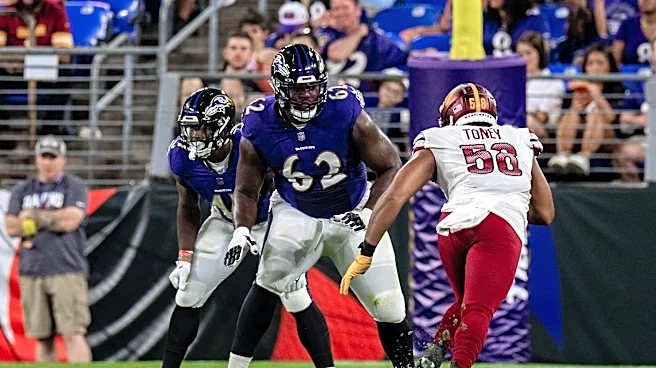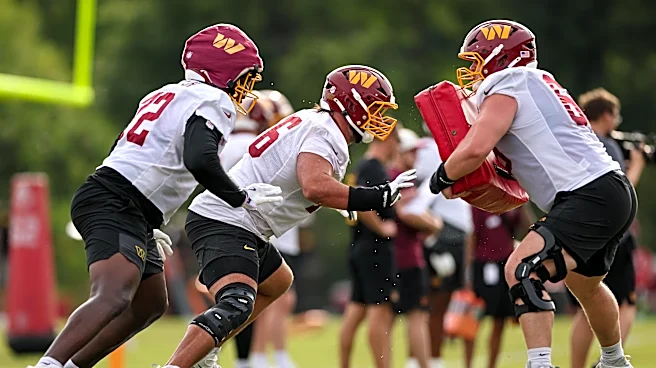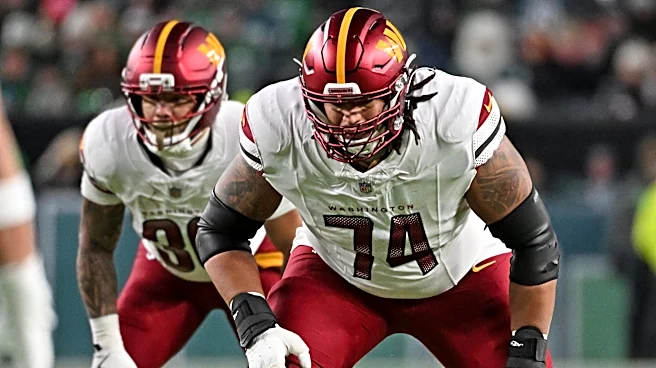




Rising optimism for the Commanders’ season was dealt a setback when Laremy Tunsil suffered a torn triceps in training-camp one-on-ones against edge rusher Odafe Oweh. The injury required surgery and is expected to sideline the team’s franchise left tackle for a large portion of the season.
The announcement that Brandon Coleman would take Tunsil’s place during the rehab was met with mixed reactions within the fanbase. Many welcomed the opportunity for a young player who has shown growth in his first
two seasons to step up and show what he can do, while gaining valuable starting experience.
Others pointed to Coleman’s struggles while starting at left tackle in his rookie season and suggested that the team will need to find another replacement in free agency or elsewhere on the roster. A few panicked, and declared the season lost before it even started.
Fortunately, with more than four weeks to go before the season opener and more than $37 million in cap space, the Commanders have time and resources to make sure they have a viable solution in place to protect quarterback Jayden Daniels’ blind side until Tunsil is ready to rejoin the starting lineup.
In this article, I’ll use advanced stats from Pro Football Focus to review the main options which have been proposed to fill in for Tunsil from within the Commanders’ roster, or via free agency.
The Baseline – Laremy Tunsil
Let’s start by taking a look at Tunsil’s advanced blocking metrics. This sets the baseline against which we can measure the various options which the Commanders might try as temporary replacements.
The following graph shows Tunsil’s pressure rate allowed in pass protection and run blocking grades throughout his 10 year NFL career. Pressure rate is the percentage of pressure opportunities on which he allowed a pressure (sack, QB hit or QB hurry). Pressure opportunities are pass blocking snaps, minus spikes and plays negated by penalties. Pressure rate is a well validated advanced stat, which is predictive of career outcomes at offensive tackle. Run blocking grades are PFF’s metric based on analyst ratings of a player’s contribution to play outcomes on every snap in a season. PFF grades are used here for want of any better validated metric for run blocking.

The green line highlights 6% pressure rate. This is something of a magic number for offensive tackles. Tackles who achieve pressure rates below 6% by the end of their rookie contracts tend to get signed to long-term starting-level contracts. Those who don’t get below 7% tend to become backups, switch position or wash out of the league. Players in between have more variable outcomes, with some getting extended long-term and others getting short term contracts or going other directions.
In 2025, 6% pressure rate fell between 9th and 10th place among primary starting left tackle (each team’s player with the most snaps at the position). That is a little high, because my sample includes a few backups filling in for starters. In most seasons, 6% is a little better than average among starters, if more care is taken to identify teams’ actual intended primary starters. (Regular readers might note I have previously set the threshold at 5%, using raw pass blocking snaps as the denominator. Switching to pressure opportunities provides greater accuracy, and inflates the figures by around 1%.)
Tunsil is one of the rare offensive tackles who entered the league playing at a pro starter level in pass protection, and has improved over time. From 2020, he has been playing at an elite level, with the exception 2021, when he played through a torn ulnar collateral ligament in his thumb. That season, his pressure rate rose to normal starter level, while his run blocking grade took a dip in the opposite direction. This is a typical pattern – sudden spikes in blocking metrics are frequently associated with injuries.
In 2025, Tunsil’s 3.4% pressure rate ranked third among primary starting left tackles. Only Denver’s Garrett Bolles (3.0%) and the Giants’ Andrew Thomas (3.1%) were better, and not by much.
Tunsil is sometimes described as being just OK as a run blocker. His blocking grades have improved throughout the course of his career. In 2025, his 75.3 run block grade was 22nd highest among 94 OTs, which is not elite (Max: 96.6 – Penei Sewell; 2nd place 92.0 – Trent Williams), but not too shabby either. He ranked 10th among tackles who played predominantly or exclusively on the left side. Right tackles were over-represented at the top of the run blocking rankings.
To summarize, the player the Commanders are seeking to replace is an elite pass protector and a better than average run blocker at left tackle. That skillset is generally not available among street free agents in August, and would be an extremely lucky find on a team’s depth chart. Realistically, general manager Adam Peters’ challenge is to come as close as possible to prevent a significant drop off at protection on Jayden Daniels’ blindside. Quality run blocking to suit coordinator David Blough’s offense would be a bonus.
Best Available Free Agent – Taylor Decker
By happy coincidence, 2026 just happened to be one of the unusual instances when a starting-level left tackle was allowed to walk and not re-signed elsewhere.
Earlier in the offseason, the Detroit Lions failed to reach agreement on a contract restructure with 10-year veteran left tackle, Taylor Decker, who was then granted a release. The Lions moved on, switching Penei Sewell to left tackle and drafting Clemson’s Blake Miller in the first round to play right tackle.
Decker was drafted three picks after Tunsil in 2016 and has been well regarded as a starter for Detroit. However, he underwent multiple surgeries on his feet and ankles in 2024, followed by shoulder surgery in the 2025 offseason. It was reported that the request for release was prompted by the Lions’ asking him to take a pay cut.
Could the Lions’ loss be the Commanders’ gain? Let’s have a look a look at Decker’s stats to get an idea of what he might have left in the tank.

Decker’s early career progression in pass protection is more typical of offensive tackles than Tunsil’s. In his first two seasons, he allowed higher than desirable pressure and then progressively improved to starting level performance in the final three seasons of his rookie contract. However, his peak performance in 2020 fell well short of the numbers Tunsil has posted over the past six seasons. Furthermore, as the wear and tear has accumulated over the past three seasons, the pressure rates have creeped up above 6%. Nevertheless, in 2025, Decker’s pressure rate ranked 12th among primary starting left tackles. Unless he has a significant drop off this season, he should still be an average to above average starter.
Decker’s average run blocking grades over the course of his career have been a little better than Tunsil’s, but it’s not a stark difference. Tunsil has been trending up over the past three seasons, while Decker’s curve is heading in the opposite direction.
The numbers suggest that the wear and tear has been taking a toll on Decker’s performance. At age 33, he could well be entering the declining phase of his career. In that context, the Lions’ decision to move on makes sense.
The Commanders don’t necessarily need someone to come in and play at Tunsil’s level. If he can maintain his level of play from 2025, Decker could provide a level of insurance as a solid veteran presence to back up and compete with the younger developing players on the roster.
Decker’s availability has led many to wonder why the Commanders have not raced to sign him. To get a better handle on what they might be thinking, let’s have a look at the numbers of Tunsil’s chosen replacement.
The Next Man Up – Brandon Coleman
The Commanders’ response to Tunsil’s prognosis was quick and decisive, leaving many in the fanbase scratching their heads. Head coach Dan Quinn announced that Brandon Coleman would move back to left tackle — he was previously in a position battle at left guard — while his teammate and mentor rehabbed from surgery. Quinn further stated that the team has no immediate plans to bring in free agents to shore up the position. It was also revealed that Coleman had spent a month in Alabama training with Tunsil during the offseason – a move which seemed to presage later developments, and would seem to suggest that Coleman still had his eyes set on playing left tackle.
After initially splitting series with Cornelius Lucas at left tackle in his rookie season, Coleman progressed to full-time starter by Week 9 and held the role for the final 12 games. Following the 2025 offseason trade for Tunsil, he moved to LG and lost the starting job to Chris Paul after Week 2. Coleman was pressed back into service at left tackle in Week 8, and then played the final four games of the season at left tackle when Tunsil suffered a hamstring injury.
To see why the Commanders have confidence in their internal replacement for Tunsil, here are Coleman’s numbers at left tackle in 19 games in 2024 and five games in 2025 (omitting two games at LG in 2025):

As you’d expect from a third-round draft pick, Coleman struggled at times and flashed at times in his first season starting at left tackle. He finished his rookie season with a 7.3% pressure rate, which is not quite starting-level but also not terrible for a rookie.
He appeared to show substantial improvement in 2025, getting his pressure rate down to 4.2% at left tackle. He actually allowed a higher rate of pressure in the two games he started at left guard, bringing his season average up to 5.5%. That could be anomalous, since guards allow fewer pressures than offensive tackles, or it might just be a small sample size glitch. Regardless of what he did at left guard, his pass-pro performance in five games at left tackle was not up to Tunsil’s level. But it was still very good for the position, slotting him right between Tunsil and Patrick Paul (4.6%) in fourth place, if he had been a primary starter.
The big caveat on Coleman’s 2025 numbers is that he only played 119 gradable pass blocking snaps at left tackle. That is pushing the limits of sample size to calculate meaningful blocking stats. Ideally, I’d like to have about three times as many reps to be sure I’m not getting fooled by game-to-game variability. But at the very least, the trend from 2024 is in the right direction.
Coleman’s run blocking grade also increased from 62.4 in 2024 to 69.0 in 2025. However, given the level of error inherent in subjective metrics like PFF grades, and the small sample in 2025, I wouldn’t read too much into that difference.
Of course, NFL teams don’t base their personnel decisions on stats. They are just an indicator. If the film evaluations and practice performances are backing up what we can see in the numbers, then it make sense to roll with a young player with upside rather than bringing in a veteran who is likely on the downward slope of his career trajectory.
Other Options – Josh Conerly Jr. and Andrew Wylie
While Coleman’s numbers are encouraging, what if they don’t hold up? He could fail to sustain the progress he appears to have made with more reps in preseason, or he could get injured. That might be where Decker comes in. But might there be another option on the current roster?
One possibility would be to move Josh Conerly Jr. to his natural position of left tackle, with Andrew Wylie taking over at RT. Let’s wrap this up by taking a look at those two players’ numbers.
Conerly has only played a single season with the Commanders. Since rookie offensive tackles often have a steep learning curve, in his case it makes sense to break it down to individual game performances.

Conerly had a baptism by fire as a rookie, starting his NFL career matched up against some of the best pass rushers in the league with the Giants, Packers and Raiders. He got off to a promising start, allowing just two pressures against a Giants defensive front featuring Brian Burns, Kayvon Thibodeaux and Abdul Carter. The following week, he struggled against the Packers’ Micah Parsons before pulling it together in Week 3 with his first shutout against Maxx Crosby and the Raiders.
As often happens with rookie offensive tackles, Conerly’s debut season was a rollercoaster ride, with standout games against the Raiders (Week 3), Broncos (Week 13) and Eagles (Week 18), and wobbly performances against the Packers (Week 2), Chargers (Week 5), Chiefs (Week 8), and Eagles (Week 16).
It’s a little hard to see amid the ups and downs, but Conerly’s pressure rate stats did show evidence of growth through is rookie season. Four of the five games with pressure rates > 10% were in the first half of the season, while two of three shutouts were in the second half. Overall, his rate of pressure allowed through the first eight games was 9.9%, compared to 5.3% through the final nine.
Conerly’s run blocking grades started out fairly low and then grew to a peak in the high 70s from Weeks 10 through 13.
The signs of growth Conerly showed in pass protection as a rookie might be enough to tempt a coaching staff to try him at left tackle. But with a more experienced option in Coleman also showing promise, there is no need to move him immediately. Still, he might be an option if Coleman becomes unable to fill the role for any reason.
Moving Conerly to left tackle would require someone to move to the right side. The most likely option on the current roster, assuming Coleman is unavailable, would be veteran Andrew Wylie. Wylie is an experienced, versatile veteran option, with experience starting in two Super Bowls and three conference championship games at right tackle.
Wylie has started at right tackle and both guard spots throughout his career. The following graph shows his blocking stats from 2021 through 2024, when he played exclusively at right tackle for the Chiefs and Commanders.

Interestingly, Wylie’s pressure rate stats show steady improvement throughout his four seasons at right tackle, crossing the 6% threshold in 2024, when he turned 30. His run blocking grades have been trending in the opposite direction (i.e. getting worse), although it looks like they are going the same way in this graph, because of the way the axes have been plotted.
Wylie had a shaky performance filling in for Sam Cosmi at right guard in 2025. That is a concern, since he will be 32 this season. He would not be anyone’s first choice to start at right tackle, but he can probably be counted on as a serviceable replacement option if the initial plan of Coleman at left tackle and Conerly on the right side needs to change.
Conclusion
The Commanders won’t be able to completely replace Laremy Tunsil’s skillset at left tackle until he is fully recovered from injury. That could be later this season or the beginning of next season.
That doesn’t mean the offense can’t function at a high level. In 2024, they played a season with Coleman learning the ropes at left tackle and Wylie at right tackle. Contrary to some of the more pessimistic predictions making the rounds that preseason, Jayden Daniels had the best rookie performance at quarterback in the Super Bowl era, and the team made its first championship-round playoff appearance since the 1991 season.
Since then, Coleman has showed promising signs of improvement. He has put in the work to refine his skillset at the left tackle position, including training with, and learning from, one of the best in the business. In doing so, he has gained the confidence of teammates and the coaching staff, to the point that the Commanders did not feel the need to bring in external help to shore up the position.
If he is not able to go, for whatever reason, there are other options to avoid a catastrophic drop off in blocking performance, including switching Conerly to left tackle, and possibly calling upon Decker. But there is good reason to hope it will never come to that.