

The Jazz are lined up to select 2nd overall in the upcoming NBA Draft, and this is a unique position for the franchise. They have finished with a losing record in only 18 of their 52 seasons in the league, and in those rare losing seasons, they are rarely subsequently blessed with a high draft selection – only 1 time in the 42 year history of the draft lottery have the Jazz jumped above their expected placement. Ever since the days of Stockton, Malone, and Sloan, the Jazz have not been bad and they have not been lucky.
With this upcoming 2nd overall pick, Utah needs a star.
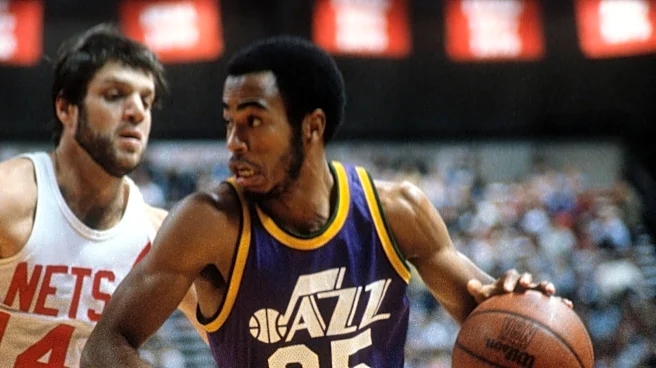
Famed collegiate icon, best-in-the-world level shooter, explosive athlete, and ferocious competitive fire – if I told Jazz fans we’d be picking a guy with these attributes at #2, they’d be ecstatic, regardless of whether the prospect’s first name is Darryn, AJ, or Cam. While it doesn’t seem that any of those guys check all 4 boxes, Forty-six years ago to the day Jazz fans were blessed with a player who did – Darrell Griffith, the sole #2 overall pick in the franchises history, was selected to bring winning and excitement to a team that hadn’t yet given the new home fans in Utah something to care about. Clearly, he succeeded, as his #35 jersey hanging in the Delta Center’s rafters indicate. The history of the Jazz and the 2nd pick starts and ends with Darrell Griffith, but who is he? Today, in honor of the fast approaching future and the nostalgia of the past, we’ll study Griffith’s career and diagnose whether Dr. Dunkenstein was the right pick for Utah’s sole #2 selection in the history of the franchise.
Pre-NBA: Louisville Legend

Almost from the day he was born, Griffith was a phenom – it’s reported that he began dunking at the age of 10 by launching himself off the walls of his family garage, which his brother Michael speculates built up the leg muscles necessary to propel him 48 inches in the air at his peak. Griffith’s youthful successes (state championships in the basketball-crazed state of Kentucky, high school All-American in 1975) convinced the ABA’s Kentucky Colonels that he was the real deal, and they offered him a contract if he skipped college and went professional right away. For context, the 1975 Colonels were no joke – they featured stars Dan Issel and Artis Gilmore, and that year won the ABA championship. Instead, after a high profile recruiting period, Griffith ended up at the hometown University of Louisville.
Griffith took his time to reach the heights expected from such a dominant high school force, but once he reached his senior season, he was nigh-unstoppable at the collegiate level. Winning the Wooden award and Louisville’s first ever National Championship, Dr. Dunkenstein finished a storybook college career – home town kid who had to overcome adversity before becoming a historically great NCAA player. Steep professional expectations accompany a man this accomplished at the amateur level, so when the Jazz selected him at #2 overall in the 1980 NBA draft, they did so with the hope that this was the player to ignite a fire under Salt Lake City and lead the team to their first EVER winning season (the franchise’s record to this point was 39 wins while they were still stationed in New Orleans).
NBA: The Doctor Is In

Griffith didn’t immediately contribute to much more success on the court (24 wins in 1980 to 28 in his first season in 1981) but he wasted no time getting acclimated to the NBA. Averaging 20 points, 3.5 rebounds and 2.5 assists, Griffith narrowly won the 1981 Rookie of the Year award by a single vote over now-obscure Blazers point guard Kelvin Ransey (Basketball Reference lists Ransey’s nickname as Mrs. Butterworth which took me aback, but Ransey himself says his true nickname, Butter, was coined by Mychal Thompson because his game was “rich and thick”).
In terms of accolades, Griffith is unimpressive after his rookie year – despite 4 out of his first 5 years featuring scoring averages over 20 points per game, Griffith never earned All-Star honors. This is not due to lack of popularity among the voters, however – once the Jazz quit their losing ways (their first winning record with Griffith occurred in 1983-84), Darrell began receiving some of the most votes of Western Conference guards, placing 5th in 1984 and 4th in 1985. If he were ever to be an All-Star, it would’ve been 1985 – the Jazz had a respectable record, Griffith had his highest scoring year, and Rickey Green took a small step back so the votes for Utah guards were less dispersed. However, even though the fans were taken with him, the coaches deciding the bench were not, and he was passed up for Norm Nixon and Rolando Blackman.
Griffith still had a spot during the ‘84 and ‘85 All-Star Weekends, however – he participated in the first two NBA Slam Dunk Competitions. I’ve attached tape from his 1984 4th place finish below; watch it for Griffith, for the beautiful green Jazz jerseys, or for an interesting moment in history when the Dunk Contest featured 4 legitimate stars (Griffith, Dr. J, Dominique Wilkins, Larry Nance).
Griffith wasn’t only a dunker, as he also pioneered the three point shot during its early years in the NBA. For one glorious offseason (1985), before Larry Bird took hold of the honor, a Jazzman held the all-time three-pointers made record, after Griffith paced the league in 3PM for two straight seasons. To this day, Darrell Griffith and Mike Dunleavy Sr. are the two players in NBA history to have led the league in three-pointers made and three-point percentage – Griffith was decidedly not a one-trick pony.
However, both of those tricks suffered after Griffith’s successful 1984-85 season. Very soon before the ‘85-86 season, Griffith broke his foot during a pickup game in his hometown Louisville, and missed the entire year during his recovery. After coming back, Griffith wasn’t quite the same – he lost a few inches off of his mythical 48 inch vertical, and even more importantly, he lost efficiency. He was a part of a fun 1988-89 team (first 50 win squad in franchise history!), starting in the backcourt with a young John Stockton, but he wasn’t anywhere near the almost-All-Star of yesteryear, retiring just 2 years later at the age of 32. Still, Griffith ended his career a Jazz-lifer, and an interesting one at that; he functioned as a bridge between eras, starting his career as a key piece of Adrian Dantley teams, and ending it as a veteran presence for a young Stockton and Malone.
Post-NBA Conclusion: Once a Jazzman, Always a Jazzman

Post retirement, Griffith faded softly from the limelight. He returned to a town that named his childhood street after him (“Darrell Griffith Way, AKA Dr. Dunkenstein Way”!) and now works as an ambassador and community outreach specialist for his alma mater. Regarding the Jazz, he made a rare appearance in Salt Lake City as he presented a rookie Donovan Mitchell with his 2018 Dunk Contest trophy, a contest in which Donovan paid an electrifying tribute to Griffith by donning his jersey for one of his dunks (reportedly, one of Griffith’s ACTUAL jerseys, from the archives). Griffith acted as a mentor for Donovan before Spida was ever drafted to the Jazz, with the two of them meeting during Donovan’s time at the house that Darrell built.
While history suggests that Kevin McHale, the 3rd pick in 1980, would’ve been the right one for the Jazz, one should not use that to discredit Darrell Griffith’s legacy with the franchise. Griffith brought excitement and genuine star power to Utah’s first NBA team (even if that was never reflected with All-Star appearances), and could’ve been a key third star into the 90s if not for a series of unfortunate injuries. Even with his career falling apart, he never abandoned ship – he played every game of his professional career wearing the Jazz’s purple and green. We can all hope that the franchise’s upcoming #2 overall pick will have better luck against the injury bug and perhaps be a better defender (Griffith tried hypno-therapy as a last-ditch effort to improve on that end), but we can’t ask for much more in terms of talent and loyalty. So far, the Jazz are 1/1 on their selections at #2 – if they can get that hit rate to 2/2, the Jazz are set to begin one of the most exciting eras in franchise history.
Have any favorite Griffith stories that I didn’t touch on? Sound off below!