

The 1990 season was not a banner year for the Yankees. The team lost 95 games, the most in their entire history (if you don’t count some moribund Highlanders squads around the turn of the previous century). Their manager, Bucky Dent, made it through only 49 games before getting the boot. Don Mattingly, struggling with back injuries, hit just five home runs. Tim Leary, the team’s best-performing pitcher, led all of baseball in losses (19) and wild pitches (23). Their brightest spot was a homegrown
player coming into his own, playing elite center field defense while swiping 42 bags and appearing in all 162 games on a roster decimated by injury. By the time the Yankees returned to the mountaintop six years later, he’d be gone, but his ascent remained a critical piece of the team’s rebuild.
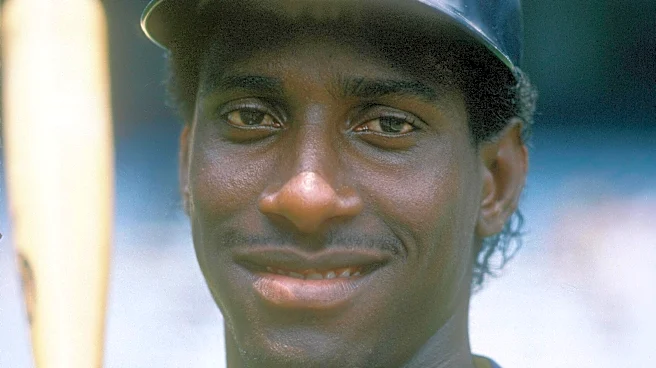
Roberto Conrado Kelly
Born: October 1, 1964 (Panama, Panama)
Yankees Tenure: 1987-92, 2000
Roberto Kelly grew up in Panama City, where he impressed from a young age with his athleticism. Fred Ferreira, the longtime scout who also signed Bernie Williams and Hall of Famer Vladimir Guerrero, signed the 17-year-old Kelly in 1982. He was an immediate force on the basepaths and in the field but, initially, struggled at the plate, hitting below the Mendoza line in Rookie ball. By 1987, though, he’d developed some plate discipline and pop, slashing .278/.324/.435 with 13 homers and 51 stolen bases in 118 games at Triple-A. He got the call that year, joining a contending team in a lineup that featured Mattingly, Winfield, Willie Randolph, and Rickey Henderson.
The opportunities were limited at first, with Kelly appearing in just 61 games at the big-league level in his first two seasons. When Claudell Washington departed after the ‘88 season, Kelly took his place in center field. He was expected to play good defense and add an element of speed on the bases. What no one expected was that he would hit better with the Yankees than he had in the minors. Kelly hit above .300 in his first full season, flirting with a batting title in the early going and finding himself in the center of a mini-controversy when manager Dallas Green insisted on keeping him in the nine-hole despite his success.
Kelly’s 1990 season ended up grading out as the best of his career by WAR, largely on the strength of his speed and defense as well as the volume accrued by appearing in every game.
“I rely on my speed and instincts to get to balls that other outfielders can’t reach,” Kelly said of his defensive philosophy. “I play shallow in center field because I want to take away hits from batters and, to me, that’s rewarding. I take as much pride in making a great defensive play to save a game as I do in getting two or three hits in a game.” At the age of 25, he’d established himself as a major-league starter. “I proved I can play at the major league level,” he said after the season. “I’m not going to say I’m the best center fielder, but I’m up there. I still have some work to do.”
That “work” likely referred to strikeouts, as Kelly was punched out 148 times, sixth in the league. Kelly cut his strikeouts nearly in half in 1991 while hitting a career-high 20 homers. In ‘92, after a hot start, he made his first All-Star appearance. “I could sit here and say a lot of people think I’m going to be a superstar,” he said matter-of-factly after his selection. “But I’ve got to drive in runs. I’ve got to put it in writing. That is the only way I will be put in a group with the big guys.” Later that year, though, the Yankees called up Williams to replace Kelly in center, bouncing him to left, in what was likely the beginning of the end of his Yankees tenure. “I’m not going to talk about it now,” Kelly said when asked about the move. “It makes no sense to talk abut something that might get me upset.”
After the season, Gene Michael made one of the most consequential moves of his tenure at GM, trading Kelly to the Reds for Paul O’Neill. Michael called the decision to move on from the talented Kelly “gambling,” chalking it up to a desire to get more left-handed. The trade looked like a win-win in year one, with Kelly making his second consecutive All-Star team while hitting .319. But his season ended in early July due to injury and he found himself back on the trade block the following year, this time heading to Atlanta.
Thus began the former phenom’s second life as a journeyman. Between 1994-2000, Kelly played for eight teams, bringing value as a versatile outfielder and capable big-league hitter. His best season during this period came in 1998, when he hit .323 with 16 home runs in 75 games with the Rangers. Kelly returned home in 2000, signing a minor-league deal with the Yankees before the season and appearing in 10 games before hanging up his cleats at the age of 35.
After his career, Kelly went into coaching, serving as a base coach on the Giants’ 2010, 2012, and 2014 championship squads. He’s currently the manager of the Toros de Tijuana of the Mexican League, a team that won the league’s 2026 championship with help from former big leaguers Justin Turner, Wilmer Flores, and Luis Guillorme.
While Roberto Kelly never experienced playoff glory with the Yankees, his rise signaled a new era of homegrown talent to come, paving the way for the likes of Bernie Williams. More importantly, his talent convinced the Reds to part with Paul O’Neill, whose importance to the ‘90s Yankees goes without saying. Please join us in wishing a happy 62nd birthday to Roberto Kelly.
See more of the “Yankees Birthday of the Day” series here.