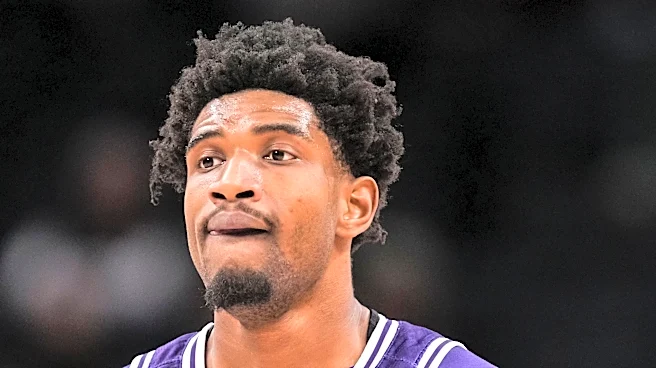




As we move forward with more men’s basketball player reviews, it’s now time to analyze the season of Arrinten Page, the 6-foot-11 junior forward from Atlanta.
The Good
Page caught national attention during his first month bearing Northwestern purple. After starting just 4-of-58 games in his first two seasons of college basketball, Page started for the ‘Cats in their opening 12 games and thrived in his expanded role. The Cincinnati transfer was phenomenal. He was efficient as a paint scorer, poised as a rim
protector and clutch in late-game situations:
As can be seen in the highlight reel above, Page’s play in the paint was truly a force to be reckoned with during the early portion of the season. While a lot of his domination was the result of his 6-foot-11, 245-pound prowess being too much to handle, Page really showcased skill finishing around the rim — he shot 66.7% on two-point field goals through December, which ranked top 20 in the Big Ten. As a result, feeding Page opportunities around the rim coming off of a pick-and-roll or in isolation on the high block became a centric aspect of Northwestern’s early-season offensive strategy.
The high point of Page’s season came during a three-game stretch versus DePaul, Virginia and South Carolina in November. Page terrorized DePaul and Virginia, scoring 42 points across the two games on 18-for-25 (72.0%) shooting splits. Then, against the Gamecocks, head coach Chris Collins turned to Page on the game’s final possession with the score knotted at 77. Martinelli and Page ran a two-man game, causing South Carolina, expectedly, to double the ball handler (Martinelli) while giving Page a chance to convert upon a one-on-one paint opportunity.
GAME WINNER! At this point in the season, Page was automatic in these situations.
By the turn of the new year, the junior was firmly regarded as the ’Cats’ “No. 2 guy” behind Nick Martinelli, averaging 14.7 points, 6.8 rebounds and 2.8 assists per game on 58.6% shooting from the field. Both his 61.2% efficient field goal percentage and 3.8 PORPAGATU! (advanced BartTorvik.com metric for measuring offensive efficiency, adjusted for usage) ranked top 30 in the Big Ten and second on Northwestern. In short, Page was a revelation for Collins and the ‘Cats.
The Bad
As detailed in my midseason article about Page’s decline after the new year, the Atlanta native was paradoxical in the back half of the season.
The problem for Page wasn’t the loss of his skill; the around-the-rim finishing, shot blocking and pick-and-roll potential were all still there. Rather, his weaknesses as a team player were exposed by the higher-quality Big Ten players and coaches.
Page’s biggest issue was rotating effectively on defense. The forward was constantly targeted by opposing pick-and-rolls, taking it upon himself to switch onto guards a laughable amount of times, considering how often he would get cooked off-the-bounce in the subsequent matchup. Though Page was still good as a pure rim protector, opponents knew he struggled to communicate away from the basket and constantly looked to exploit this vulnerability.
On the offensive end, Page wasn’t as effective facing the increased size of Big Ten opponents. Without a clear size advantage in the paint, he was no longer dominant in isolation and struggled to adapt his play style to the heightened competition.
Meanwhile, Page became prone to making mistakes. On both the offensive and defensive end, the forward would have too many concentration lapses: dropping a pass, missing a rotational assignment or making a bad turnover. The hustle was there, and he was still playing hard, but he became too prone to mishaps and lost his credibility in big moments.
By mid-January, NU’s pundits and fans grew frustrated with Page’s lackluster play, and Collins agreed with the noise. Following Northwestern’s 11-point home loss to Illinois amidst a five-game losing streak where Page was particularly bad defending the pick-and-roll, the junior lost his role in the rotation, averaging just 9.8 minutes over the ‘Cats’ next four games. Though he would play more than that down the stretch of the season, his role in Collins’ system significantly changed.
From January through March, Page’s numbers completely declined. He averaged only 7.1 points and 2.8 rebounds per game, with his PORPAGATU! falling from 3.8 (November to January) and second on the team, to 1.2 (January to March) and eighth on the team. Robin was gone — Page finished the season as a role player, if anything, left with the bitter memory of his early-season successes.
The Bottom Line
On April 3, just about three weeks after Page missed Northwestern’s season-ending 81-68 Big Ten Tournament loss to Purdue with an illness, Page entered the transfer portal, ending his time in Evanston. Page will seek a new home for a third consecutive offseason and will suit up for his fourth team in four years come November.
But, did it have to be this way?
I still believe that while Big Ten play illustrated the many weaknesses of Page, Collins didn’t do enough to play to Page’s strengths. Page saw fewer opportunities to go to work in the paint, where he was so good in the early part of the season. Through December, 19.8% of Page’s shot attempts came from behind the arc, but in the new year, that number became 23.1%. The junior is best working downhill and struggles to be effective when pushed to the perimeter. Yet, even considering this usage, he finished the season as Northwestern’s second most efficient scorer behind Jordan Clayton, with a 57.2% efficient field goal metric. I feel there was an opportunity to make Northwestern’s offense more prolific by trusting Page’s ability to be an efficient, dynamic playmaker in the paint.
The bottom line is that Northwestern could not find a way to make Page work for them consistently enough for him to be a part of the team next season. Though Page was the one to enter the transfer portal, the feeling on Collins’ end was likely mutual.
Page’s next suitor will have the opportunity to maximize his size, playmaking and rim protection. Page can thrive in an inside-out offensive, where he gets high usage in pick-and-roll and post isolation scenarios. However, without fewer lapses in concentration and improvement in defending the pick-and-roll, the Arrinten Page paradox is likely to remain unsolved.