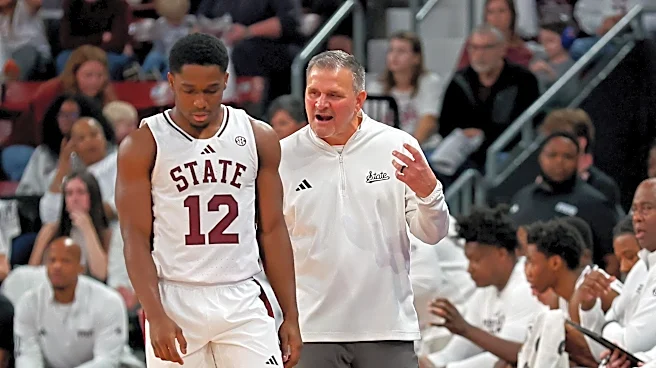


The good news is last year Chris Jans and Mississippi State finally broke the 8-10 curse they’d been facing for the previous 3 seasons (actually five if you include the last two years of Ben Howland).
The bad news is things went really wrong. Just going by analytics, the Bulldogs were the worst team in the SEC a year ago. And it was their worst season in more than 10 years.
The signs were there early, they looked bad against Iowa State in the opening week of the season, then lost back to back games
to Kansas State and New Mexico. They started just 4-5, but scratched to an 8-5 non-conference record and walked into SEC play as a forgotten team.
But then a road win at Texas, who at that stage of the season was still a question mark, and a home win over Oklahoma had many thinking maybe the Bulldogs could turn it around. But then they lost the next four and only one of those games was a close one. They also lost their last five conference games, giving up an average of 99 points per game.
MSU were a bad basketball team. And with Chris Jans in year five, his seat will get pretty warm if things don’t go well this season.

Mississippi State Bulldogs
- Last season: 13 – 19 (5-13 in conference) #102
- The Masses Prediction: 15th in conference
- SEC Media: coming soon!
- Analytics Average: 15th in conference, 72nd overall
HEAD COACH: Chris Jans | 5th Season, 76 -59

When Chris Jans was hired, the reactions around the college basketball mediascape was this was a great fit. But rumors have circulated in recent offseasons that Jans might’ve been looking for a way out of Starkville. And when you see the trends, it’s easy to understand why he might be looking for an exit ramp.
Early in Jans tenure the Bulldogs were a stout defensive team, but their top 10 ranking in year one has slipped every season. They were 22nd in year 2, 46th in year 3, and then sank to 104th last year. The only thing that’s changed is fewer of Ben Howland’s holdovers have been around. If there’s one thing you can praise, it’s that the retention year over year has been really good, and that included guys who were on the roster when he signed up for the job.
Tolu Smith, DJ Jeffries, and Cameron Matthews were all on Howlands last roster, and formed the foundation for Jans’ first two seasons. But focus has turned to Josh Hubbard, who is heading towards being MSU’s all time leading scorer, and he’s a dynamite player. Jans just has to make sure the talent around him is there to support him, without putting all the pressure on him like it was a year ago.

Things have been largely consistent in Starkville, rarely great but also rarely poor. Even in down seasons they’ve been competitive, up until last season. Last season wasn’t just the amount of losses, but the amount of uncompetitive losses. They lost 11 games by 15 or more points, and 9 of those were in conference, and 4 were at home. Competitive losses is a trend to watch early.
LOST PRODUCTION
11th in % minutes, 79.03% | 7th in % points, 66.63% | 7th in % possessions, 69.57%
What’s it like to lose a lot of guys who played but not that much in production? That’s what happens when you aren’t very good and keep your top player who scored all the points.
Basically everyone who started a game last season, except for one obvious guy, is gone. Jayden Epps, Ja’Borri McGhee, Quincy Ballard, Achor Achor, Shawn Jones, Jr, Sergej Macura, Jamarion Davis-Fleming, and Brandon Walker all started at least a couple games last year. But the only returner is the main one, Josh Hubbard.


I’m going to begin this section with the same thing I said last year. This whole thing begins and ends with the production of Josh Hubbard.
Hubbard is wired to score. After scoring 17.1 points per game as a freshman, he’s upped his total each season, finishing last year at 22.1 per contest. On the floor, Hubbard profiles more as a shooting guard, but his size pushes him on the ball on defense most of the time. He’s small, but powerful, built like a running back, and he’s one of the best jump shooters in the conference. Hubbard relies upon his jumper to create offense, and about 2/3 of his shots come from long range 2s and threes. Two years ago he was able to up his usage rate and improve his efficiency, finishing around 1.2 points per possession on offense. But last season his efficiency suffered, likely due to a lack of consistent help on the roster around him.
And what’s around him is the question. Because there isn’t much coming back which contributed last season, just King Grace. A sophomore wing who was lightly used, Grace has the frame to be a contributor. He’s cast with other returners, but none who played. Gai Chol is in his fourth season in Starkville, he’s only played in 31 games for a little over 5 minutes per game. Tee Barlett and Cameren Paul were both lower rated 4-star prospects who didn’t see the floor last year. So it’s anyone’s guess what State will get from them this season.
Then there’s the portal class, where a lot may be riding on whether Kimani Hamilton can stay eligible. As a class of 2022 (high school) player, Hamilton is currently one of the 5 in 5 players who are trying to stay eligible all season. We’ll see, but he’s a rangy wing-forward who can stretch the floor a bit, and can be an impactful defender. Hamilton started his career at Mississippi State, transferred to High Point where he played for two seasons, then moved onto UNLV last year.
There’s also Tajuan Simpkins, a Seton Hall transfer who scored just shy of 10 points per game under Shaheen Holloway last season. He’s a lefty scorer who isn’t a big outside shooter, but is solid on catch and shoots. The biggest sleeper in the class might be if RJ Johnson, Kennesaw State’s leading scorer off a tournament team last year, can translate his bully ball game to the SEC. Johnson has big shoulders and is often looking to get downhill to attack the rim.
ND Okafor wasn’t listed as a transfer on EvanMiya.com, so he doesn’t have a rating. He’s another 5 in 5 guy, but he has a medical redshirt after missing the final 24 games his sophomore season at Cal. He’s about the only experienced interior player on the roster.


Jans took a few flyers on some high upside younger guys like Thomas Bassong and Kendyl Saunders. Couple those two with freshmen Willie Burnett III, Tristan Reed, Jalyn Collingwood, and the holdovers like Bartlett and Paul, and more than half of the roster has a big question mark around it. You can include King Grace and Gai Chol, two more who have not really contributed consistently at this level.
When most of the unproven players are in the front court, as well… it makes it difficult to project how this is going to play out. ND Okafor is going to be relied upon on the interior, with youth behind him, to compete in the SEC.


If there’s an expert at putting together a great schedule without actually playing anyone, it’s Chris Jans. I have to give him credit for his creative scheduling. The last few seasons he’s done a good job of getting his team a manageable but NCAA Tournament friendly schedule. He doesn’t line up top 15 teams like Alabama does, he also doesn’t line up Q4 teams at home either. Last year things got sideways because they lost all the quality games.
This year the quality is down a little bit. Xavier should be quality and a potential tournament team, Marquette should be back in the tournament conversation again this year. VCU could be dangerous, but not much is expected from Wake Forest or Georgia Tech.
In conference, State opens with Alabama, and Jans has yet to beat Nate Oats in 8 tries, including three of those at home. MSU gets Alabama twice, along with Ole Miss and South Carolina. With the Rebels and Gamecocks, there should be opportunities to make up some wins, although the Bulldogs lost last year at South Carolina, and split with Ole Miss. The home slate includes some chances for marquee wins with Kentucky, Texas, and Florida all coming to the Hump.
THE RULING
Last season I picked Mississippi State to go 8-10 in the conference but almost as a joke if I’m being honest. That’s just what the program had done to that point. I even quipped that Jans was intentionally putting together worse and worst rosters to increase the degree of difficultly on reaching that 8-10 mandate.
But the reality was last year’s roster wasn’t very good and there just wasn’t enough support for the number one guy, Josh Hubbard.
Things look marginally better on the perimeter, with Simpkins and Johnson being a little better than what you might get from Jayden Epps, and certainly of Shawn Jones. Epps was so streaky, and Jones was a high effort guy, but never really developed as an offensive weapon. Johnson may not be a great athlete, but he’s strong and physical and that should help him be more effective.
The questions arise around the rim. ND Okafor is serviceable, Tristan Reed has the family lineage (he’s the younger brother of former UConn Husky Tarris Reed) to be some help early, and then I guess you’re hoping to get something from Tee Barlett who didn’t play at all last season. None of those options jump off the page as difference makers.
Having Kimani Hamilton eligible will help the frontcourt, but he’s more comfortable on the wing, and will occasionally float around the perimeter more than mix it up around the rim. He’s a skilled shooter and would undoubtedly help the roster, but he’s never been a good rebounder.
Without consistency around the rim to generate second looks, and a primary scorer who takes a lot of jumpshots, the MSU offense can get stuck in the mud at times. They were 15th in the SEC for free throw rate last year, and 14th in offensive rebounding. In a league that is going to send waves of bigs at you no matter the roster, it’s just hard to see MSU being much better than a Wednesday play in team in the conference tournament at the end of year.
My Results: Mississippi State Bulldogs — 16th in Conference, 3-15
About the preview: a number of respected basketball bloggers were asked to submit one pick for the entire league schedule game by game. The game by game option allows us to account for the unbalanced schedule when addressing any kind of power rankings. Each set of picks are reflected in “the Masses” picks. Included in “the Masses” are various SEC media members who made picks at my request, as well as additional credit given to the analytics projections, and national media outlet predictions.
Additionally, instead of relying solely on KenPom.com for the analytics site projections, we’re taking the average of the three main sites (EvanMiya.com, BartTorvik.com, and KenPom.com) to give a closer consensus picture. These are weighted a touch for reliability.
The projections: In an attempt to be as accurate as we could be, we increased the amount of analytics used to make individual projections which influenced how these teams slotted in order. Matt Watkins used an in-depth method for projecting the entire SEC transfer list, we then mixed in EvanMiya.com’s BPR projections, and BartTorvik.com’s preseason individual projections to round out the expected production based upon how each coach routinely uses his rotations.
GLOSSARY
* – an asterisk denotes a walk-on player
GP – Games Played
%min – percentage of total available minutes played, does not account for time missed due to injury
%poss – percentage of team possessions the player is responsible for ending a possession, whether by making a shot, missing a shot not rebounded by the offense or committing a turnover. For returning players this is noted as a percentage of total team possessions. For newcomers it was total possessions when that player was on the floor, better known as Usage Rate.
ORtg – Offensive Rating, similar to a points per possession but averaged out over 100 possessions. So it’s how many points a player would score if they were responsible for 100 possessions.
BPR – Bayseian Performance Rating, a single player efficiency metric created by Evan Miyakawa to determine both offensive and defensive impact when a player is on the floor.
PAR – Points Above Replacement, a Rock M+ proprietary rating measuring projected on-off impact adjusted for time on the floor.
PPG – Points Per Game, RPG – Rebounds Per Game, APG – Assists Per Game: All traditional statistics used to measure player production.
For newcomer player rankings, we used EvanMiya.com’ s rankings for transfers, and 247sports.com ‘s Composite Rating for Freshmen and Junior College signees.