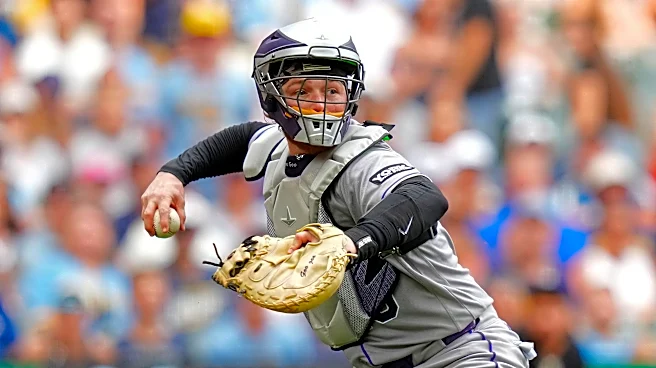


The Colorado Rockies are likely fielding plenty of calls leading up to the MLB Trade Deadline on Monday, with a fair share presumably focusing on All-Star catcher Hunter Goodman. The Rockies have made no indication that Goodman is going to get moved, and the asking price is reportedly high, but it’s still wise to let the process play out until Monday afternoon and see if there is an offer they can’t refuse.
However, opposing clubs are already trying to find a way to reduce Goodman’s trade value by
focusing on his defensive abilities behind the dish. Ken Rosenthal and Will Sammon of The Athletic reported that interest in Goodman among potential suitors is “muted” because of concerns about his receiving abilities.
Sure, Goodman is a bat-first type of catcher, but is his defense truly a cause for concern, or is it just opposing clubs blowing smoke to save a prospect?
Framing
Defensively, Goodman has regressed in 2026, particularly in framing. After ranking 19th out of 57 qualified catchers in catcher framing runs, Goodman ranks 44th out of 61 catchers. However, this metric doesn’t seem quite as big a deal as MLB executives make it out to be in Rosenthal and Sammon’s article.
The fact of the matter is that with the advent of the ABS challenge system, pitch framing was a logical casualty. Catcher framing runs are down across the league as the skill is just a bit harder to utilize than in years past. Framing is still an important skill for catchers, but the opportunities to steal strikes have diminished. In 2025, four catchers had at least 10 catcher framing runs, with Patrick Bailey leading the league at 25. At this point in the 2026 season, the league leader is Toronto’s Brandon Valenzuela with 8 CFR.
Goodman’s -2 CFR isn’t all that bad at the end of the season, considering the league average is 0. There is also the fact that the Rockies have thrown the 10th highest percentage of pitches in the zone, and there isn’t much need for him to frame. If a team is letting framing be a factor in diminishing his perceived value, the argument doesn’t necessarily hold a lot of water.
Challenge King
The framing may be down, but Goodman has proven how well he knows the strike zone when he’s behind the plate thanks to the ABS challenge system.
His 56 ABS challenge wins rank third in all of baseball while his win rate of 67% is 13th. The most impactful challenge for a catcher comes with two strikes, and Goodman has overturned 17 pitches to get a strikeout, which ranks fourth.
As for his Net Overall For rating, which shows how much better a player is at successfully overturning ball/strike calls via the ABS challenge system than an average baseline, Goodman ranks second in all of baseball with 23.9. That ranks just behind Detroit’s Dillon Dingler (24.9) and ahead of Cincinnati’s Tyler Stephenson (15.6).
Since this system is in place, it puts less weight on the framing abilities and more emphasis on strike zone awareness. Walks are up across the league because catchers aren’t stealing as many strikes with framing, but the ABS challenges have been beneficial for both sides of the baseball. Goodman has proven to be one of the best in that department.
Blocking, pop time, and caught stealing
As for the other aspects of his catching game, Goodman has been perfectly adequate in most categories.
When it comes to blocking, his 0 blocks above average ranks slightly above the league average. He’s had the seventh-most block opportunities in the league, showing that he can hold his own just fine behind the plate. There is more to catching than just receiving and framing. It’s working behind the plate and having the spatial awareness to be athletic and get in front of a ball. He has only allowed four passed balls, which may be on the higher end among big league catchers, but in the grand scheme of things isn’t all that big of a deal.
As for pop time, Goodman’s 1.94 seconds to second base is right in line with the rest of the league, while his 1.71 seconds pop time to third base is near the bottom of catchers that have registered a throw to third. These factors put him around the middle of the pack in caught stealings above average. He has a fairly average arm strength but also a slower exchange time than most, which has resulted in a median 19% caught stealing rate.
The running game has been one of Goodman’s shortcomings as a catcher, but should it be all that worrisome that a team balks at the idea of acquiring him for a high-level pitching prospect?
The shortcomings and the fix
Teams are understandably hesitant to acquire a catcher mid-season because of the uncertainty of learning a pitching staff. There is obviously concern about how well Goodman can actually handle a pitching staff because Colorado is such an extreme venue. Can you accurately assess Goodman’s abilities to handle a pitching staff when the Rockies have sent out some of the worst statistical pitchers in baseball? Add in Coors Field and it’s hard to gauge his true abilities.
I’d argue that the onus of helping a new catcher learn a pitching staff is on the new team’s coaching staff. Goodman is a player eager to learn and develop and take on new challenges. There is no question that he could figure out how to work with new pitchers on the fly. Add in a good catching instructor and pitching coach and you’ve got an easy path to get over that concern.
Like most players at the big league level, it would only take a few minor adjustments to overcome any shortcomings Goodman has. Rosenthal and Sammon reported that a catching instructor indicated that fixing up any of Goodman’s receiving flaws would be relatively quick. He has the athleticism and arm strength, so that means technique is what would be addressed.
Cleaning up his technique could remedy his league-leading nine errors as a catcher, eight of which have come from trying to throw out runners stealing a base.
Conclusion
Goodman isn’t going to win a Gold Glove behind the dish any time soon. But it’s funny to see rival teams trying to diminish his value as if his defense is the reason they want to acquire him.
If a team wants a purely defensive catcher, then there are plenty of other options out there. But if they seek a premier power bat that is adequate behind the plate and won’t be a detriment, then Goodman is the player you want.
It’s simply smoke and mirrors to try and reduce the price to pay to obtain his services. The Rockies have all the trade leverage, so rather than make excuses to lower the price, teams have to see how willing they are to meet the demand at the midnight hour.
Join the conversation!
Sign up for a user account and get:
- Fewer ads
- Create community posts
- Comment on articles, community posts
- Rec comments, community posts
- New, improved notifications system!
Please keep in mind our Purple Row Community Guidelines when you’re commenting. Thanks!