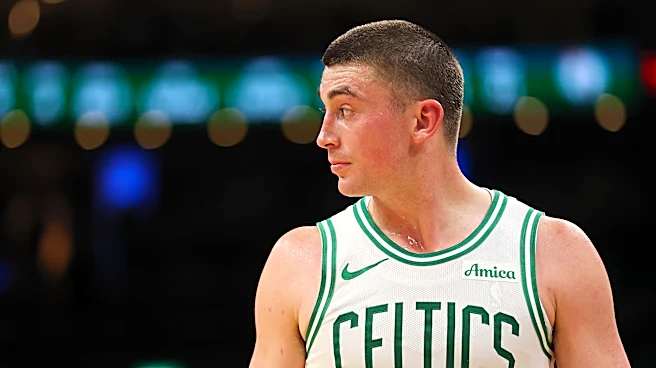




On a sunny August afternoon, I sat down with Payton Pritchard to discuss the reality that the upcoming Celtics season was being widely deemed a Gap Year.
He laughed.
“There’s only one mindset, always,” he told me then. “I’ve never been on any team in my life where the mindset wasn’t to try to compete for the championship.”
It’s the right thing to say, of course.
What kind of competitor would relent to the notion that an entire NBA season was a wash?
But I could immediately tell that he wasn’t just saying
it because that was the right thing to say. All summer, I had chatted with people in and around the NBA — media members, executives, scouts, coaches — and almost all of them warned me I was in for a long season of losing, a significant departure from my first two years on the Celtics beat.
A 10-minute conversation with Pritchard almost single-handedly convinced me otherwise — as ridiculous as that may sound. The then-27-year-old was back in Boston, where he had begun working out with the other Celtics youngsters after spending most of the summer on the Cape with his wife, Emma. He was already getting to know the new guys and reuniting with the same Celtics coaches who led the team to 61 wins the year prior.
On this particular day, Pritchard hosted a 1-on-1 basketball tournament at the Reggie Lewis Center in Roxbury. Afterwards, we caught up, and I began to broach the topic of the year ahead.
When I said the word “Gap Year,” Pritchard’s face changed so quickly that I immediately instintively myself from the concept. He looked at me in the most matter-of-fact way he could, his eyes widening.
“It’s not a gap year,” he said firmly. “It’s a year to prove something, take a step, and show people that we are still that team.”
Still that team? They weren’t still that team.
In my first year covering the Celtics, they were historically dominant, winning 64 games en route to a championship. The following year, they won 61 games.
But after an unexpected elimination in the second round of the playoffs last Spring, the Celtics lost Kristaps Porzingis and Jrue Holiday in salary-shedding trades, and Luke Kornet and Al Horford to free agency. Franchise cornerstone Jayson Tatum was likely to miss the season with an Achilles rupture he suffered in May. However you wanted to slice it, the offseason served as a financial overhaul, and this wasn’t the same team coming back in the fall.
But Pritchard was a perennial winner, playing for an organization that’s won more titles than any other. He was a key part of the 2024 championship team, and now, he was just months removed from a Sixth Man of the Year, career-best season.
His pedigree of winning began much earlier than the pros. In college, he was the starting point guard for the Oregon Ducks for four straight years, during which time his team won 70% of its games (and the PAC-12). In high school, the Oregon native won four straight national championships.
Why would things change now?
“We’ll put the pieces together,” he told me. “And we will come out and compete, and try to win every game, and put together a great season – and go for a championship.”
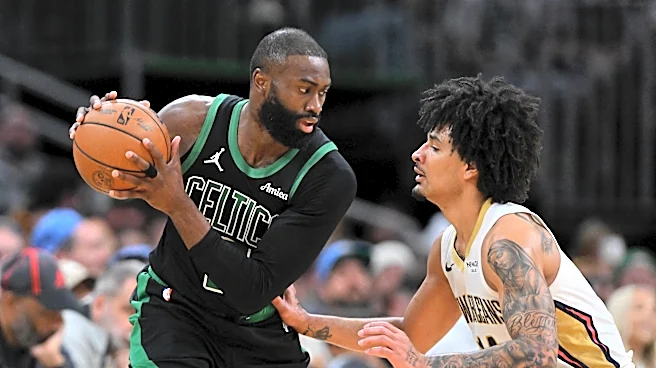
I left that conversation convinced, in large part because Pritchard, like Jaylen Brown (whom I spent time with in July), has a compelling, no-nonsense way of talking. The competitive character, as Joe Mazzulla often calls it, oozes out of him.
That spirit had been heralded by many. When I first started covering the Celtics, Pritchard’s college coach, Dana Altman, told me that few people in this world rival his competitive fire.
“I really admire him,” Altman said. “I’ve been able to do this for a long time, and he’s one of the most focused, hardest workers I’ve known. And he’s very competitive; he competes in practice, in games, and he hates to lose.”
Two months after Pritchard and I spoke on that hot summer afternoon, I penned a column: “The Celtics are going to be much better than you expect.” And, in 2000 words, I tried to justify why.
They’d play faster, I maintained. (That ended up being completely false — the Celtics have held the slowest pace in the entire NBA this season).
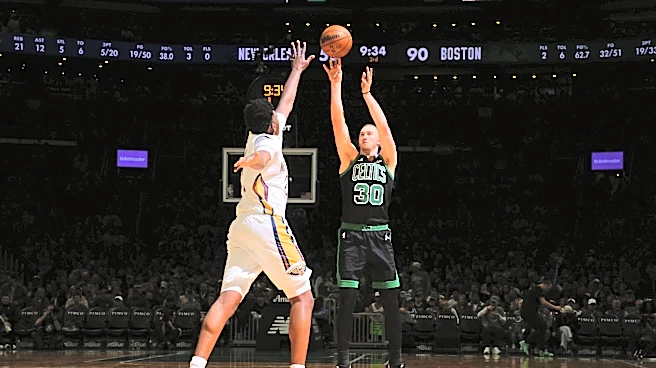
They’d lean on their three-point shooting efficiency, I wrote. That turned out somewhat true; the Celtics have hit 36.7% of their three-pointers this season, good for the 8th-best in the league. But Payton Pritchard, Sam Hauser, and Derrick White have all had down years from beyond the arc, and efficient three-point shooting is not the main driver of the team’s success this season.
More veteran players like Xavier Tillman and Chris Boucher were due for career years. That turned out wrong: neither player even survived the trade deadline.
Looking at the roster, I couldn’t quite make the basketball case for it. But a single conversation with the Celtics’ spark plug told me that the outside perception of the franchise’s incoming season was way off.
Then, the Celtics started 0-3
Three consecutive losses felt like 15 in a city so used to winning. First, the Celtics dropped a nail-biter at home to the Philadelphia 76ers. Then, they got blown out on the road by the same New York Knicks team that ended their season months earlier. And, two days after that, they got pounded on the boards in Detroit.
On October 26th, after the 119-113 loss to the Pistons, the basketball world almost definitively concluded what many had already speculated: the Celtics were poised for a season of losing.
Still, Pritchard walked off the Little Caesars Arena court alongside Mazzulla, as confident as ever.
“We said to each other: ‘This is only gonna make us stronger,’” Pritchard said. “We were going in the right direction. A lot of people didn’t think that, losing our third game. But I remembered it was like, ‘Okay, we were going to start turning the corner. And then, little by little, every day, we’re getting better and better.’”

Addressing the media after that loss to the Pistons, Pritchard sang the same tune.
Everything was going to be just fine.
The Celtics had to clean up their rebounding, and they would.
His open shots were going to fall (Pritchard shot an abysmal 17.4% from three-point range in October).
They just needed some time.
“I knew there was gonna be some adjustment period,” Pritchard told me. “A lot of people in different roles, and people seeing different matchups and different positions, really. It was gonna be an adjustment at first.”
Baylor Scheierman said the team’s togetherness was what stood out during that time.
“There was no separation in the locker room, regardless of what went on, ” he said. “There’s no separation. We stayed together. And that’s kind of how it was, through the ups and downs of the whole year.”
After the 0-3 start, the Celtics went on to win 56 of their next 79 games. Only three teams in the league — the Oklahoma City Thunder, San Antonio Spurs, and Detroit Pistons — have been better in that span.
How ‘competitive character’ became the name of the game
In the Celtics locker room on Friday night, after the Celtics earned their 55th win, Pritchard turned to Jaylen Brown.
“Great season, man,” he said. “Just a great season.”
Brown nodded emphatically.
The Celtics had just secured the No. 2 seed in the Eastern Conference for the second straight year. Another postseason run faced them, their fifth as teammates.
“That’s a great season,” Brown said.

Eight months have passed since Payton Pritchard assured me the Celtics would be great, after he rejected the notion of the Gap Year on that hot summer day in Roxbury.
The 2025-2026 Celtics were still that team, just as he said they would be, finishing with the fourth-best record in the league.
Last week, I sat down with Pritchard to reflect on that initial August conversation and his unwavering faith in a Celtics squad most had ruled out.
Was he psychic? Did he know something we didn’t? Was it a conversation he had with Joe Mazzulla? An off-season meeting?
It turns out it was never that complicated.
“The people that were returning,” Pritchard said, “had something to prove.”
For Pritchard, that’s always been the mindset: “I live in a state of trying to prove people wrong,“ he said.
And, he feels that the locker room is filled with those kinds of players.
Luka Garza and Neemias Queta were both 2021 second-round draft picks who got their careers started in the G-League. Both players were fourth-string centers last year, and both have worked tirelessly to become key rotation players, with Queta now establishing himself as one of the best young centers in the league.
Ron Harper Jr. went undrafted and bounced around the league on four two-way contracts before landing in Boston. Jaylen Brown carries a chip on his shoulder irrespective of circumstance. The list goes on and on.
“You’ve got to credit Joe for creating a culture of that, but also Brad [Stevens] picking players that have a chip on their shoulder, that love to play basketball,” Pritchard said. “A lot of us, besides JT and JB, were late round picks, and so you got to have a chip on your shoulder to make it.”
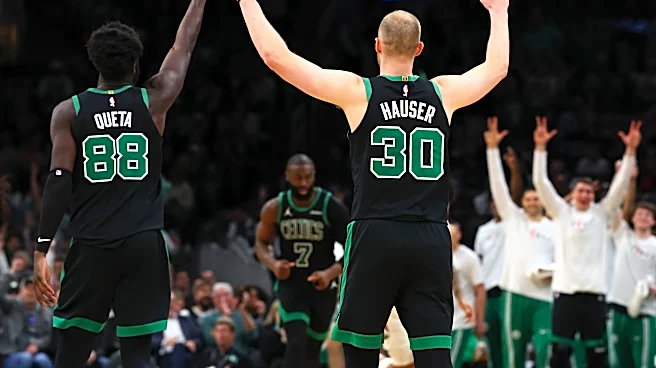
Sam Hauser, who also went undrafted and began his career in the G League, similarly carries that edge.
“Going undrafted and feeling like you were better than some of the guys who got drafted ahead of you definitely puts a little bit of a chip on your shoulder, and you just want to go in and try to prove yourself and try to prove that you belong,” he said. “I feel like, naturally, when people write you off as a human being, or, I guess as a player, I should say, naturally, you’re just gonna have a little extra motivation.”
All year long, Joe Mazzulla has deflected praise and credited the team’s ‘competitive character.’
Earlier this month, I asked him to define what the oft-used phrase meant.
“It’s just having a group of guys that care about winning, care about the process of that. Every practice, film session, every shootaround, everything’s important,” Mazzulla said. “They just compete every single minute. That kind of defines every guy we have.”
“Guys in this locker room, every time they get a chance to play, they want to come out and prove that they’re worthy of being a rotational player, starter, or whatever it is,” Pritchard said.
When did Pritchard know it was all beginning to click?
He points to a December 1st win in Cleveland as a turning point in the season. They entered the game with a 10-9 record after dropping a close game in Minnesota. And, they were without Derrick White and Neemias Queta on the second night of a back-to-back.
Pritchard took it upon himself to lead the group to a win over one of the East’s premier teams, dropping a season-high 42 points. The Celtics, despite being shorthanded, pulled out the victory.
“That’s when I started noticing, like, ‘Okay, the pieces are coming together a little bit,’” Pritchard said.
Payton Pritchard decided to lead by example
Before the season, Pritchard and Mazzulla discussed how the team was going to approach the challenges that lay ahead.
“We talked about my mindset going into it, and how we were gonna lean on how I approach everything day-to-day, and being a leader for those young guys,” Pritchard said. “The mentality of showing up, game in, game out, and trying to prove yourself every night. That was the thing that we talked about the most – the culture of this team, how we wanted to be.”
Pritchard made a concerted effort to lead by example, handling his own fluctuating role with grace. He finished the year averaging a career-best 17 points and 5.2 assists, but his night-to-night production varied.
He started the first 49 games of the season, but was moved to the bench after the trade deadline. And, anytime he was asked, he downplayed the sacrifice that came with moving to the bench midyear: with Anfernee Simons gone, leading the second unit was simply what made sense.
A hallmark of the Celtics’ success this year has been that different players stepped up every night. Sam Hauser started 49 games. Jordan Walsh started 25. Baylor Scheierman started 20. And, for a stretch, Hugo Gonzalez looked like one of the most impactful rookies in the league.
Players cycled in and out of the rotation — but largely handled it with grace because they always knew they’d get another chance.
“It just helps everybody in the locker room to understand their moment could come,” Pritchard said. “To never get too far down and frustrated, because you might get called up in the next game.”
Pritchard, who has fallen out of the rotation plenty of times during his career — and racked up DNPs during Mazzulla’s first season at the helm — became a chief disseminator of that message.
“Keep working on your game, be a good teammate, and then, when it is your moment, everybody’s gonna be happy for you,“ he told his teammates. “And, if it’s not your moment? Be happy for the other person.”
Last year, Neemias Queta benefited from Pritchard’s guidance firsthand.
“He always preached the view of perspective – trying to see outside of the moment that you’re living in,” Queta told me. “It might not be right now, but [this time] is for you to get better and work on other stuff. You might not be getting repetition on the court, so you just want to attack your workouts with a different type of mindset, whether it’s working on your jump shot, working on defense, working on stuff that can help you right away, or eventually later on down the line. It was huge for me. Back in those days, I really took that to heart. He was able to do [those things] to get himself on the court. And I think when he told me that and [gave me] that type of assurance, it just made my life so much easier.”
On Friday night, Pritchard was awarded the Celtics’ Red Auerbach Award, an honor bestowed upon the Celtics player who best embodies the spirit of being a Celtic “through exceptional performance both on and off the court.”
Mazzulla said the 28-year-old had earned the award through his five years with the organization: “It’s been an honor to coach him.”
“He’s been with us for some time,” Mazzulla said. “It’s just what he’s grown into and where he’s been over the course of his time. You just take a look at a guy that was constantly having to compete with other guards and not getting a ton of time — a 9th, 10th man to come in and come off the bench and spark us, and then [he entered] the starting lineup, and then back off the bench, and he’s just kind of playing.“

Pritchard feels like he’s always been a natural leader. But, in his first few years in Boston, he was far from the loudest voice in the room.
“You’re maybe not gonna speak in the locker room and hear your voice, but you can still be a leader in the way you approach every day,” he said. “You can tell a leader from the first day he walks in.”
Others have taken notice.
“In the locker room, he’s one of the most vocal guys,” Queta said. “He’s pretty much been able to communicate with all types of personalities that we have — he’s just a great teammate.”
Last week, when Pritchard reflected on our August conversation, he emphasized how much of his unwavering confidence came from being a part of the Boston Celtics.
“Boston lives in a state of — a championship is the only goal,” he said. “A championship organization is, top to bottom, [about] the work ethic everybody puts in. It’s the little things. It’s the custodian at the practice facility; he shows up on time. He puts in his work. The front office does the same thing – they’re there early. The training staff, the weight room. Everybody is held to a standard of work ethic. Obviously, the players work hard, and they’re held to that standard, but it’s everybody.”
Pritchard looks at the disappointment of last year as a building block, rather than a setback. And before the year began, he decided to use it as fuel.
“Maybe that helped us for this year. If you live in that mindset of always going for it,” he trailed off. “If it doesn’t happen this year, it could happen the year after, or the year after that. It’s all building for the future.”
The Celtics’ playoffs will begin on Sunday. What their future holds remains to be seen. But one thing was certain: regardless of personnel, regardless of how the offseason went, he was right about one thing.
These Celtics were still that team.