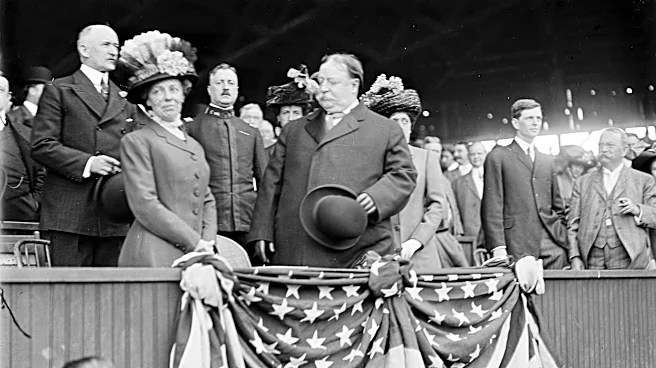


On April 14, 1910, William Howard Taft, the 27th President of the United States, made history, as he became the first US President to throw out the ceremonial first pitch. While attending Opening Day alongside his wife, Nellie, and Vice President James S. Sherman, the President threw the ball from the stands to Washington Senators starter Walter Johnson, officially opening the 1910 season. While this was an important moment in the history of baseball, affirming the importance of baseball to American
culture and unofficially christening the game as America’s pastime, the attention that this act draws covers up the fact that Opening Day in 1910 was a weird and wacky day of baseball.
And so, 116 years later, let us dive deep into the New York Times and Baseball Reference archives and showcase what has been long been hidden by the Presidential first pitch.
Washington Senators 3, Philadelphia Athletics 0
Entering his age-22 season, Washington Senators ace Walter Johnson took the mound for his first of 14 Opening Day starts, and to say that his performance was worth the price of admission all by itself would be an understatement. The future Hall of Famer tossed nine scoreless innings, striking out nine, walking three, and allowing just one hit. According to most discussions of the game, albeit unreported in the Times recap from the next day, that one hit occurred when a fan fell onto the field in the seventh, causing right fielder Doc Gessler to trip.

I’m going to be honest, as a historian, this is where the Baseball Reference archives can be a tad frustrating, as they don’t do a great job citing their sources on their “This Day in History” pages. From what I can gather, pretty much every single reference to this event cites this page directly, as they tend to use the same verbiage — “Doc Gessler tripping over a fan who had spilled out of overflow seating,” but since the site does not cite its sources here, I can’t go any further back. Unfortunately, the New York Times appeared more focused on President Taft’s reactions during the game than it did on this one now-infamous event.
Fortunately, this is a prime example of why it’s important to collaborate in your research. While the primary sources I have access to did not discuss this event — my school libraries have access only to NYC-based newspapers — Andrew sent me the Washington Post article from that day, which not only confirmed the historicity of the event, but got us a quote from a disappointed Gessler: “Walter, I’m awfully sorry I could not get that fly, for I wanted you to let them down without a hit, but I couldn’t make it because I fell.”
For his part, “The Big Train” took it in stride, satisfied with the win; though it would take another decade for him to get his no-no.
Chicago White Sox 3, St. Louis Browns 0
Walter Johnson was not the only starter to flirt with an Opening Day no-no. At South Side Park in Chicago—in its final half-season before the yard that would be named Comiskey Park opened its doors—Frank Smith of the White Sox spun a complete-game shutout of his own. He struck out five, walked two, and allowed a singular, solitary hit: a leadoff single in the third off the bat of Ray Demmitt.
How did the White Sox score those three runs, you might ask? Well, the first came in the bottom of the fifth, courtesy of a Fred Payne single thorugh the left side of the infield. The second, meanwhile, was the result of a bases loaded hit batter, a situation which presented itself after a walk, single, and an E1 on a sac bunt attempt loaded the bases with nobody out. And the last, in the ninth, when Patsy Dougherty laced a two-out double to right and Billy Purtell drove a single up the middle.
Cincinnati Reds 1, Chicago Cubs 0 (10 innings)
Fred Beebe of the Reds and Orval Overall of the Cubs traded zeroes for 10 innings at the Palace of the Fans in Cincy, as the two pitchers combined for eight hits, eight strikeouts, and three walks. Frank Schulte was the only Chicago batter worth anything, as he recorded all three of his team’s hits; the rest of the lineup combined for just two walks.
The game, mercifully, came to an end in the 10th, as Mike Mitchell singled to center, reached second on an E5, advanced to third on a fly ball to right field, and scored on a Tom Downey single to left.
New York Highlanders 4, Boston Red Sox 4 (14 innings)
Twenty-five thousand people descended upon Washington Heights in what the Times described as “the largest and noisiest crowd that ever set aside all earthly cares to attend a ball game at American League Park.” And boy, was that crowd in for a treat. The Red Sox got the scoring going early, as Tris Speaker doubled in Amby McConnell, who had reached on an E5, in the top of the first, then tacked on two more in the third courtesy of a Harry Lord triple and a Speaker fielder’s choice. But down 4-2 heading into the bottom of the eighth, the Highlanders put together a rally that drove Eddie Cicotte from the game and tied things up at four apiece.
And there the score would stay, forever. Boston reliever Smoky Joe Wood and Highlander starter Hippo Vaughn—who wound up pitching all 14 innings for the not-yet-Yankees traded zeroes—with the Red Sox in fact managing to get just one run into scoring position in total after the fifth inning. Eventually, when “it was so dark that a ball sent into the air could hardly be seen, then Mr. Connolly, he’s the umpire, turned to the crowd and called the game on account of darkness.”

And so the game sits in the Baseball Reference archive, forever a tie. According to the BR Bullpen, this game saw the Red Sox wear “laced collars,” becoming the final team in baseball history to wear a collared uniform on a normal, not-throwback basis. It would also not be Vaughn’s last memorable extra-inning pitching performance, as his most famous game came in 1917 with the Cubs, when he and Cincinnati’s Fred Toney had dueling no-hitters through nine.
New York Giants 3, Boston Doves 2 (11)
The future Rivalry was not the only the matchup between New York and Boston that day. Up in Beantown, the Giants took on the Doves (the future Braves), in a game that went 11 innings. Giants starter Red Ames allowed just two baserunners — a hit-by-pitch in the first and a walk in the third, both of which put leadoff hitter Herbie Moran on first, and which was immediately followed up with Moran stealing second — until Bill Sweeney led off the bottom of the eight with a single. The Giants rapidly tied the game at two apiece, first by plating Sweeney when Fred Liese grounded into an E6-turned double play in the eighth, then stringing together a walk and two singles in the ninth. Dave Shean, however, stopped that rally in its tracks, by trying, and failing, to steal home.
The game then went into extras, with Herbie Moran working a walk to lead off the bottom of the 11th, then being advanced to second on a Peaches Graham bunt, to third on a Fred Beck groundout, and finally scoring on a Dave Shean single, as the he made up for his boneheaded attempt to steal home in his previous at bat.
Rather interestingly, the New York Times article on this game was written by Fred Tenney, identified as the “First Baseman of the Giants.” That was, technically speaking, true, as Tenney was with the team at the time, and had been the Giants’ first baseman the previous two seasons. However, he would never take the field with the team, wound up released in early May, and spent the majority of the season as the player-manager of the Lowell Tigers. According to SABR’s biograpy of Tenney, the first baseman was an avid writer, regularly penning articles for Baseball Magazine, the Sunday Post, and the Times.
There you have it! April 14, 1910: three extra-inning games, three shutouts, two one-hitters, a failed attempt at a walk-off steal of home, laced collars, and, assuming we believe the stories, a fan falling into the stands. Talk about a crazy day of baseball!