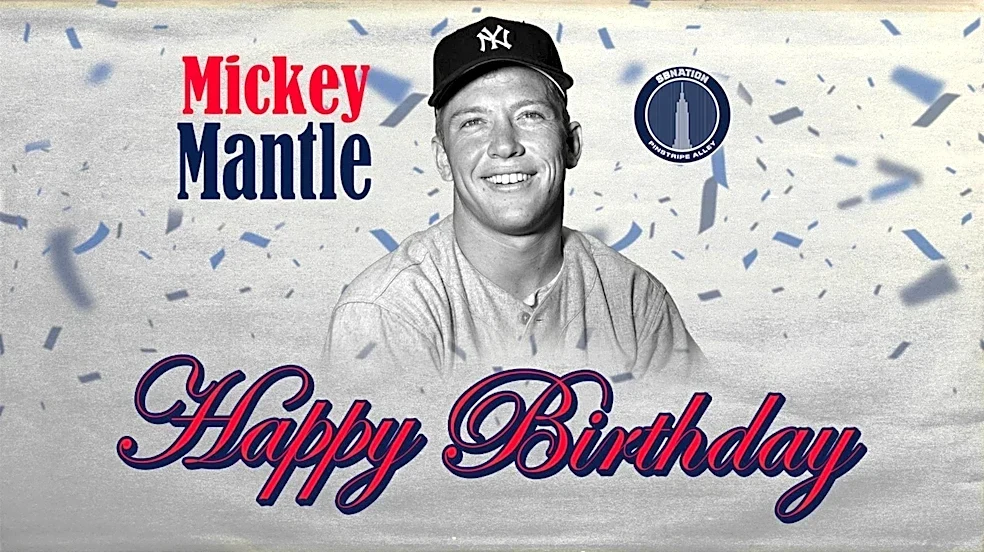




Aura. Charisma. Whatever it was, Mickey Mantle had it. Anyone can put up numbers, but no one looked as good in the process of doing it as The Mick.
He was so much better than his peers that not even osteomyelitis in his left shin and a rough ACL injury in his rookie season, not to mention a myriad of other health and personal issues, could stop him from becoming the best switch-hitter who has ever stepped foot on a baseball field.
Mickey Charles Mantle Born: October 20, 1931 (Spavinaw, OK) Died: August
13, 1995 (Dallas, TX) Yankees Tenure: 1951-68
Named after Hall of Fame catcher Mickey Cochrane, Mickey Charles Mantle was born in Spavinaw, Oklahoma, on October 20, 1931. He was the son of Elvin Charles “Mutt” Mantle and Lovell Thelma (née Richardson; previously Davis). He grew up in Commerce, Oklahoma, where he moved with his family when he was just four years old.
His father, a tough man, was a miner but also a former semi-pro baseball player. When Mantle was sent down to the minors in his rookie season and threatened to leave baseball because he thought he couldn’t compete, old Mutt told him: “I thought I raised a man. I see I raised a coward instead. You can come back to Oklahoma and work the mines with me.” That was a wake-up call for Mantle, who caught fire and never looked back.

You could say that Mutt raised Mickey to be a baseball player and, specifically, a switch-hitter. His childhood and adolescence went by playing baseball in the sandlots and hitting off his father and grandfather, but Mantle was also a multi-sport star at Commerce High School, where he excelled at football and basketball.
After penicillin saved his leg from amputation as a teenager, he gave up football and focused on baseball. Yankees scout Tom Greenwade offered the 16-year-old phenom the chance to sign for the Bombers, but he had to wait until he graduated high school a year later. He joined the Yanks’ Class D team in Independence, Kansas, and had a brilliant minor league debut in 1949. After the season ended and he went back to Oklahoma to work on the lead and zinc mines with his father, Mantle met Merlyn, a high school senior, who would later be his wife.
Even though he didn’t make his MLB debut until 1951, the Yankees called Mantle up in September of 1950. He got to witness what it was like to be a major leaguer from up close, traveling with the squad and even taking batting practice with stars such as Joe DiMaggio and Yogi Berra, among many others.
After enduring his early-1951 slump and coming back to the majors that year, Mantle hadn’t hit his ceiling yet, but the world saw glimpses of what he would eventually become: the person in charge of carrying the torch after DiMaggio. Those were some big shoes to fill.
No, Mantle wasn’t as classy as the ‘Yankee Clipper’, but he was a better player and a charismatic leader in his own way. Perhaps more importantly, he took the Yanks to a whopping seven World Series titles. The first one would come in that 1951 campaign, when he blew out his knee in Game 2 while giving DiMaggio room to make a play.
That knee injury would shape everything that was to come, but Mantle of course found a way to excel, even with a bad knee. From 1952 to 1965, Mantle made the All-Star Game every year. He added two more Midsummer Classics to his resume in 1967 and 1968. His most impressive individual achievements, however, were the three AL MVP Awards he won in 1956, 1957, and 1962.

Mantle was one of the very few ballplayers who notched at least one 200-wRC+ season and one 10-fWAR campaign. He had two of the former and three of the latter.
Mantle’s true peak was between 1956 and 1962, when he slashed a mind-blowing .316/.448/.617 with 283 home runs and a 186 wRC+. The Yankees won four World Series over that span: 1956, 1958, 1961, and 1962. Oh, and he took home the 1956 Triple Crown in the American League.
Additionally, Mantle gave us a memorable home run record chase together with his teammate and friend Roger Maris. A severe septic infection on his hip resulting from a shot he took to improve multiple health conditions knocked him out of action in September, though, giving Maris the crown and the record. Mantle still finished with 54 round-trippers, a career high.
His playing career continued until 1968, when he hit a rather disappointing .237, but with 18 homers and an excellent .385 OBP that gave him the foundation for a still-impressive 145 wRC+. Even in his last campaign as a major leaguer, he was an elite offensive performer.
Mantle retired with a .298/.421/.557 line, 536 home runs, 153 stolen bases, 1,509 RBI, and 2,415 hits. Those who watched him in his early years say he could have stolen many more bases if it weren’t for the two major leg injuries he suffered.

Mantle was a 20-time All-Star, a seven-time World Series champ, a three-time AL MVP, a Gold Glover in 1962, a batting champion in 1956, led the junior circuit in homers four times and in RBI in 1956. His number 7 is deservedly retired by the Yankees, and he has been a member of the National Baseball Hall of Fame since 1974. You can say with confidence that Mantle is one of the best players ever to play the game, and you can argue he might’ve finished even closer to the top of the list if it weren’t for injuries.
According to the Society for American Baseball Research, “Mantle struggled to find a new career after retiring from baseball. He served as a Yankee first-base coach in 1970, but abandoned that rather quickly. He invested in a hotel and a restaurant chain, both of which eventually failed. In 1983, he was given a job in public relations with the Claridge Hotel and Casino in Atlantic City.” The booming baseball memorabilia industry gave his finances some much-needed life in the eighties.
Unfortunately, he had to fight some demons during his life. He told family members and friends that he suffered from sexual abuse by his sister, Anna Bae, when he was a child. He had severe drinking problems, which eventually resulted in him being diagnosed with hepatitis and cirrhosis of the liver. It took him nearly his entire life to get sober, and shortly afterward, he was sadly diagnosed with liver cancer. “The Commerce Comet” passed away in August 1995, and the Yankees wore black armbands and a No. 7 on their sleeve to commemorate their fallen legend for the rest of the season.

Mantle is, simply put, one of the greatest Yankees of all time. Maybe he wasn’t always a role model, but boy, could he play the game.
See more of the “Yankees Birthday of the Day” series here.