


The Royals have employed several underrated players in their history, but in my opinion, none have been as overlooked on a national level as Kevin Appier. The Royals drafted the California native with the 9th pick of the first round of the 1987 draft. The ’87 draft had some players. Ken Griffey Jr. went number one. Jack McDowell (we’ll talk about him later) went with the fifth pick. Craig Biggio and Albert Belle went later in the first and second rounds respectively. Other notables were Travis Fryman,
Reggie Sanders and Steve Finley. The Royals picked up Jeff Conine in the 58th round. The draft is a crazy crapshoot.
Appier quickly made his way through the Royals minor league system and made his major league debut on June 4th, 1989, at the age of 21. He bounced between Omaha and Kansas City for parts of two seasons before becoming a mainstay in the Royals rotation.
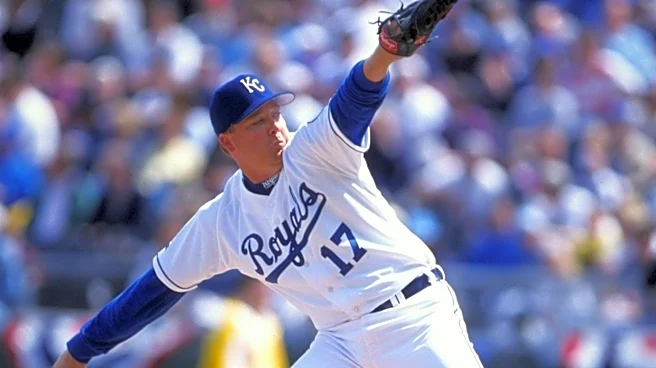
Appier was listed at 6’2 and 180, though he looked bigger. He had a distinctive motion, reminiscent of Bob Feller and Goose Gossage, two other guys who could bring the heat. During his windup, Appier would drop his right arm low with left shoulder high, then violently deliver the pitch. He had an excellent fastball, especially in his younger years, complemented by a terrific slider and forkball. Batters had to work to get a hit off Appier.
Appier had a nice rookie season and ended up winning the Rookie Pitcher of the Year award. He should have won the Rookie of the Year award, but ended up in third, behind Sandy Alomar and Kevin Maas. This wouldn’t be the last time Appier got screwed over by the voters.
His best season would have been 1993 when he posted an 18 and 8 record. He made 34 starts that summer and threw almost 239 innings while posting an ERA of 2.56 to go along with five complete games. It was good for a 9.3 bWAR season, which was tops in the American League by a wide margin.
Jack McDowell (remember him?) and his 22-10 record and 3.37 ERA, won the American League Cy Young. Randy Johnson with a 19-8 record, 308 strikeouts and a 3.24 ERA took second. Appier, in one of the most criminal oversights in recent history, took third.
Unfortunately, WAR was not around at the time to illustrate just how badly the voters mangled the Cy Young.
The MVP race was nearly as bad. Frank Thomas won the award thanks to gaudy home run and RBI numbers. Appier finished way down the ballot, at #24, which was unbelievably behind two teammates: Jeff Montgomery at #13 and Greg Gagne at #22!
Look, I understand that bWAR is not a perfect measurement but one thing it has done is illustrate just how badly the award voters have done in past years.
Speaking of statistical measurements, one that I’ve always thought was pretty sold was pitching game score. In Appier’s 16-year career, he had 23 games where his game score was 80 or better. Of those 23 games, his won-loss record was 16 and 7.
Do you know how hard it is for a team to lose a game when the pitcher throws an 80 or better game? It’s almost impossible but the Royals somehow found a way to do it! All seven of those losses came by one run. Six of them came by the score of 1-0.
This illustrates a second point. Appier had the misfortune of playing for some absolutely horrible Royal teams. Because of this, he only made one All-Star team, that came in 1995.
Think about that for a moment. The guy was one of the top three or four pitchers in baseball over the decade of the 1990’s and only made one All-Star team!
It’s also important to remember that the ‘90’s were a decade of offensive firepower. Steroids. Juiced baseball. You name it, the ‘90’s had it.
During his career, Appier threw two 2-hitters and two 1-hit games. When he was on, he was a threat to throw a no-hitter any time he took the mound.
On July 7th, 1990, in a game at Tiger Stadium, Appier gave up a clean leadoff single to Lou Whitaker. That was it. He did walk four Tigers to go along with six strikeouts. The Royals won that game, 4-0. The walks kept the game score at just 87.
He was even better on July 27th, 1993, in a game against the Rangers at Kauffman. On that hot evening, Appier held Texas hitless until the 7th inning, when alleged juicer Rafael Palmeiro somehow pulled a low and away slider over the right field wall.
Appier only walked one and struck out 11, going the distance in the 1-0 loss. The game scored 91. The Royals collected nine hits off Kenny Rogers that night, including three by Gary Gaetti, but went 1 for 6 with runners in scoring position and in the most Royal of fashion, somehow couldn’t plate a single measly run.
His highest game score came on September 15th, 1995, in a homecoming game at Anaheim when Appier struck out 13 Angels while only walking one, part of a three-hit complete game. That masterpiece scored a 93. The Royals won that game 5-0. Joe Vitiello (remember him?) stroked a home run.
Appier missed almost all the 1998 season with a torn labrum. When he realized the Royals were not serious about winning, he requested a trade and was obliged. In July of 1999, the Royals sent him to former rival Oakland for Jeff D’Amico, Brad Rigby and Blake Stein. Not a memorable trade on the Royals’ behalf for an organizational legend. Appier was 31 at the time and post-surgery was heading into the tail end of his career, but he still could summon the magic. He pitched two seasons in Oakland followed by one in New York with the Mets and two more with Anaheim before returning home for one last injury plagued stint with the Royals.
Appier made the postseason twice, once with Oakland in 2000 and again with Anaheim in 2002. He picked up a ring that year as the Angels bested the Giants in the World Series.
Over his career, Appier finished with a record of 169-137 with almost 2,600 innings of work. He recorded 1,994 strikeouts with an ERA of 3.74. That was good for almost 55 bWAR. His name still dots the Royals top ten single season and career pitching record books.
He was inducted into the Royals Hall of Fame in 2011. He made seven opening day starts in his 13 years with the club and was their pitcher of the year on three occasions.
I’ve always felt like Royal fans appreciated Appier, then and now. It’s a shame he wasn’t given his due on a national stage because during his peak, he was one of the very best in the game.