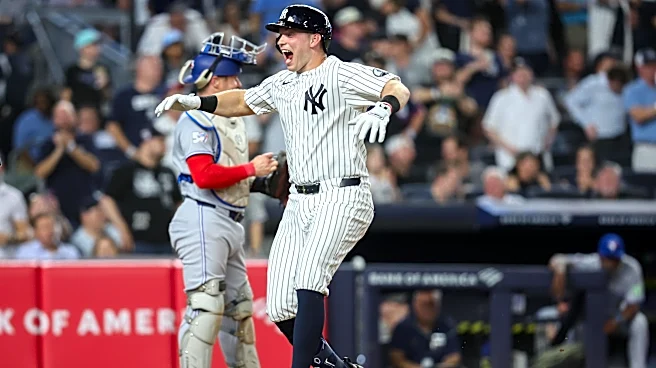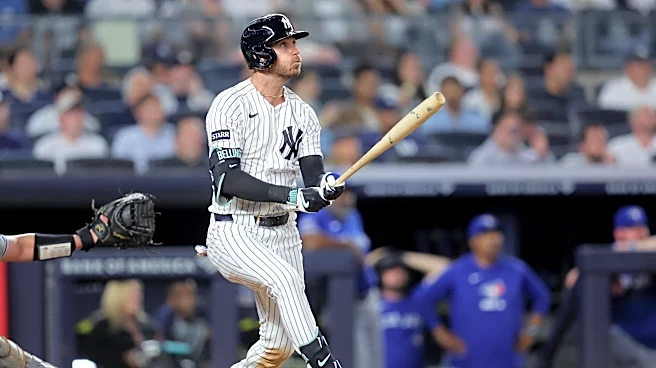

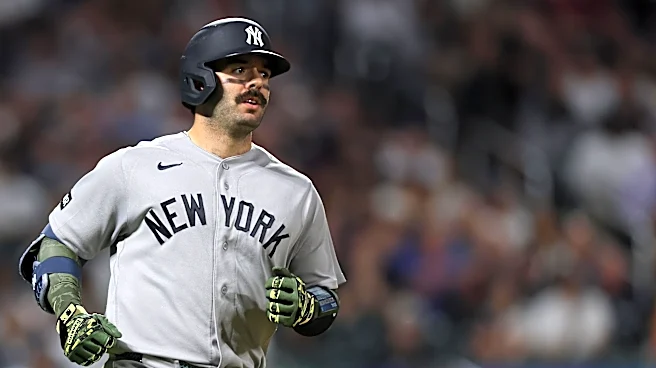
One of the most common critiques leveled against the Yankees’ 2025-26 offseason was that they were simply running it back, and to those critics, no move was as emblematic of that than the re-signing of Cody Bellinger. Although the 2019 NL MVP had a stellar year in 2025, hitting .272 with 29 homers and accumulating 4.9 WAR, many were wary, myself included, of how his offensive approach of eschewing walks and making contact, coupled with his low bat speed, would hold up over the duration of his contract.
Well, looks like I’m having crow for dinner tonight. After Monday’s action — a game in which Bellinger drilled a game-tying two-run homer — his wRC+ is sitting at a healthy 141. What’s truly surprising, though, is how he’s doing it — his walk rate is sitting at an elite 15.2 percent, up 6.5 percent from his 2025 mark. That’s the eighth-highest increase among all qualified batters in MLB.
While we’re still in small sample size season, walk rates for batters tend to stabilize earlier than other metrics, at around 120 plate appearances; Bellinger’s now at 204. If he can maintain this clip for the rest of the year, it would be a new career high for him.
Am I getting ahead of myself here? Maybe — there’s still a lot of baseball to be played. But I’m confident that Bellinger’s revamped approach will stick, for two main reasons: one, he’s doing it without becoming overly passive and letting hittable pitches go by, and two, he’s shown the ability to drastically change his offensive profile before in his career. Without further ado, let’s dive into the data.
In a vacuum, taking walks is great. Doing so allows you to get on base more, increasing your team’s chances of scoring. However, there are drawbacks to being too passive. Big league pitchers don’t throw many meatballs; being too committed to taking pitches might result in letting some middle-middle fastballs go right by you. The ideal approach is to be selectively aggressive — knowing which pitches you can do damage on, swinging at those, and laying off the rest.
It’s difficult to quantify this skill to a T, because the “right” pitches to swing at vary between hitters. However, one statistic makes a valiant effort — SEAGER, developed by Robert Orr of Baseball Prospectus, and named for noted hitting extraordinaire Corey Seager, attempts to put a number on how selectively aggressive a certain hitter is, with the league leaders generally scoring in the mid-20s, and the laggards posting marks close to zero.
For our purposes, we’re interested in how 2026 Bellinger stacks up against his 2025 self. If the current version of Bellinger is drawing walks at the cost of letting hittable pitches go by, we can expect his 2026 SEAGER to be lower than his 2025 mark. Conversely, if he’s maintained or even increased his SEAGER, we can conclude that he isn’t just hunting for walks; he’s hunting meatballs too.
At first glance, Bellinger’s raw SEAGER number suggest he’s slipped a bit: while his 2025 SEAGER was 13.4, his 2026 mark to date is 11.0. However, once you contextualize his numbers against the rest of the league, they tell a different story. In 2025, Bellinger’s 13.4 SEAGER placed in the 56th percentile among all qualified hitters. In 2026, his 11.0 clip places him at… the 56th percentile, yet again. For all intents and purposes, Bellinger is just as aggressive when he needs to be now as he was in 2025. That’s truly impressive, given that he’s taking walks at a career-high clip.
Even given these encouraging underlying stats, though, some might say it’s still too early in the season to declare that Bellinger has truly changed. And for basically any other hitter, I would agree. But Bellinger? I’m willing to give him the benefit of the doubt. After all, he’s no stranger to drastically changing his offensive profile.
When Bellinger first burst on to the scene in 2017, his age-21 season, he was a classic three-true-outcomes slugger: lots of homers, walks, and strikeouts. In 2019, a sudden decrease in strikeouts, coupled with the juiced ball, allowed him to post the best offensive numbers of his career en route to an MVP award, but his core approach remained the same — swing hard and hit the ball far. For the first three seasons of his career, Bellinger ran hard contact rates above 40 percent.
After regressing to a 112 wRC+ in the pandemic-shortened 2020 season, the bottom fell out for Bellinger in 2021. He hit just .165/.240/.302 over 350 plate appearances, for a wRC+ of 47. His strikeout rate ballooned to his pre-MVP levels, but his walk rate and power deserted him completely. While Bellinger “rebounded” to a 83 wRC+ the following year, many were convinced that his days as an impact bat were over.
However, Bellinger did not fade quietly into irrelevance. He underwent one of the most striking transformations I have ever seen, completely transforming himself as a hitter. He nearly halved his strikeout rate, slowed down his swing, and essentially became a contact hitter with pull-side power. The change paid off handsomely, rejuvenating his career with a 4.4 WAR season in 2023. And while he had a down year in 2024, we all know what he did in 2025.
My point is this: Bellinger has already shown himself to be extremely malleable as a player. Who’s to say he isn’t learning new tricks at this stage in his career? We’ve already established that the quality of his swing decisions hasn’t suffered as a result of his walk-taking ways. Neither has the quality of his contact; in fact, that’s improved. Bellinger’s hard contact rate slipped below 30 percent from 2023-2025; this year, he’s at 36.7 percent. The last three years saw his actual wOBA far outstrip his xwOBA; this year, he has a .376 wOBA against a .383 xwOBA. It’s like Bellinger heard every concern fans had about his signing, and made it his personal mission to alleviate all of them.
I know better than to declare a five-year contract a big win in just its first year. But I’d be lying if I said Bellinger’s stellar start hasn’t considerably improved my outlook. If he can just keep on what he’s been doing, the Yankees have a third elite offensive weapon behind Aaron Judge and Ben Rice.