

Welcome to the 2026 edition of Ranking the Rockies, where we take a look back at every player to log playing time for the Rockies in 2026. The purpose of this list is to provide a snapshot of the player in context. The “Ranking” is an organizing principle that’s drawn from Baseball Reference’s WAR (rWAR). It’s not something the staff debated. We’ll begin with the player with the lowest rWAR and end up with the player with the highest.
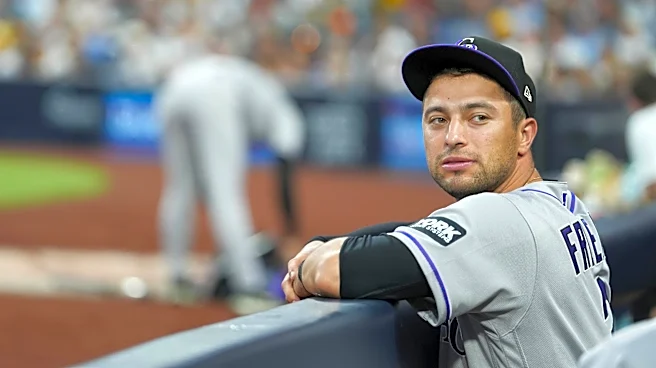
No. 53, Tyler Freeman (-2.0 rWAR)
Tyler Freeman’s second season with the Colorado Rockies had its
moments.
He could put the bat on the ball. His throwing arm created outs from right field. There were games when Freeman reached base repeatedly, drove in runs, and helped the Rockies manufacture offense.
There just were not enough of them.
Injuries interrupted his season; his production fell off sharply during the summer; and his range in right field gave back much of the value created by his arm. By late August, Freeman was back in Triple-A. In September, the Rockies outrighted him off the 40-man roster.
The numbers
Freeman’s major-league production fell well short of what Colorado needed from a regular, and the -2.0 rWAR reflects how quickly his overall value disappeared once the offense cooled. His Triple-A finish was considerably better, although the production still came mostly through contact, walks, and doubles.
What actually happened
Freeman technically began the season on the injured list, but he did not miss much time.
Colorado placed him on the 10-day IL on March 25 and activated him April 1, just a few games into the regular season. Freeman missed the opening portion of Colorado’s first road trip before joining the club in Toronto.
His first few months contained enough productive stretches to keep him involved regularly.
One of Freeman’s best games came April 30 in Cincinnati. Brenton Doyle was aboard with two outs in the first inning when Andrew Abbott left a 92.3 mph fastball over the middle of the plate.
Freeman drove the pitch 357 feet to right field for a two-run homer, giving Colorado an early 2-0 lead. He finished the afternoon 2-for-4 with two RBI and a run scored. The homer was his first of three in 2026.
There were other good games along the way. Freeman went 3-for-5 with an RBI on April 16, and he collected three hits, including a double, on May 31.
Even some of Freeman’s stranger offensive contributions fit the way he produced runs. He was hit by 15 pitches, more than he walked all season. One of those HBPs came with the bases loaded in the ninth inning against the Mets on May 6.
Sean Manaea caught Freeman with an 89.2 mph sinker, forcing Mickey Moniak home. The Rockies were too far behind for the run to change the result, but the plate appearance fit Freeman’s season: another way to reach base without doing damage with the bat.
The first half also brought more time away from the lineup. Freeman went on the paternity list May 15 and returned May 19. On June 9, Colorado placed him on the seven-day concussion IL. He returned five days later.
Freeman then put together one of his best games of the season on June 24 against Boston.
The Rockies trailed 5-2 in the fourth when Freeman came up with a runner in scoring position and two outs against Ranger Suárez.
Freeman lined a 91.2 mph fastball into the outfield for an RBI single, trimming Boston’s lead to two. He later scored as Colorado continued to work its way back into the game.
By the eighth, the Rockies had tied the game at six. Mickey Moniak opened the inning with a single, and Freeman came to the plate with the go-ahead run aboard.
Freeman dropped a bunt in front of the plate and Moniak raced home, giving Colorado a 7-6 lead. Freeman finished 2-for-3 with two runs and two RBI in an 8-6 Rockies win.
June 24 also became a pretty clear dividing line in Freeman’s season.
From the end of the June 24 game through the remainder of his major-league season, Freeman drove in only one more run and scored only twice. He hit .175/.203/.175 in 57 July at-bats and .182/.182/.182 in 11 August at-bats. Freeman had three extra-base hits in June and none during the rest of his time in the majors.
Freeman’s bat had almost no thump, and the lack of power left almost no cushion when the singles stopped falling. His contact ability remained, but contact without damage could only carry the offensive profile so far.
The season took another turn in August.
Colorado placed Freeman on the 10-day IL on August 10, retroactive to August 9, with lumbar pain. He began a rehab assignment with Albuquerque on August 20. Three days later, the Rockies activated him from the injured list and immediately optioned him to Triple-A rather than returning him to the major-league roster.
On September 5, Colorado outrighted Freeman to Albuquerque and removed him from the 40-man roster.
A strange collection of tools

Freeman’s bat-to-ball ability remained excellent. He struck out in only 11.8% of his plate appearances and whiffed on 12.8% of his swings, but the contact rarely carried much impact.
Freeman finished with an 87.7 mph average exit velocity, a 36.1% hard-hit rate, a 1.4% barrel rate and a .353 expected slugging percentage, producing only three barrels all season. He can hit the baseball; he just does not hit it very hard very often.
His defensive season followed a similar pattern, with useful tools that did not translate into enough overall value. Freeman logged 429.3 innings in right field in 2026, more than any other Rockies player. He made 49 starts in right field, did not commit an error, and recorded six assists.
His arm was a legitimate weapon, and one of the best examples came April 11 in San Diego, when Fernando Tatis Jr. stood at third with one out and Manny Machado lifted a fly ball into shallow right.
Freeman made the sliding catch, came up throwing and cut down Tatis at the plate to complete the inning-ending double play. The sequence showed both the athleticism and arm strength capable of making Freeman an asset in right field.
The arm showed up in other ways, too. On July 17 against Cincinnati, JJ Bleday ripped a 104.8 mph liner into right field with Sal Stewart trying to advance.
Freeman came up firing and threw Stewart out at third to end the inning, another example of how much value his arm could create when the play developed in front of him.
The throws were real. But so were the range problems.
He finished at -8 OAA overall, including -6 in right field. Statcast’s directional data showed negative value both coming in and going back, while the jump numbers pointed most strongly toward his reaction and initial burst rather than his routes.
The contrast was easiest to see on balls in front of him. Against Tampa Bay, Freeman got a good enough read on a sinking ball to close the gap and make the catch.
Tampa Bay challenged the play, but replay confirmed the catch. Freeman got a good enough jump to close the gap and make the catch before the ball hit the grass.
A similar play against the Cubs ended differently. Michael Busch lifted a soft fly into shallow right, with Edouard Julien also ranging out from second base.
Julien ranging out from second complicated the play, but Freeman never got himself into position to make a real attempt before the ball dropped between them.
The issues going back were even more noticeable. Freeman looked more comfortable when he had time to get underneath a deep fly, as he did on this ball from Brandon Marsh.
Freeman tracked the ball cleanly, reached the warning track and made the catch.
As the ball got closer to the wall, though, Freeman could become noticeably more hesitant. Tyler Tolbert gave him another deep drive in Kansas City.
He was close enough to make a play, but he never quite got himself into position. His approach became more tentative as he neared the wall, and a catchable ball fell for a double.
Freeman’s defensive season was not defined by errors. The larger problem was the number of catchable balls he nearly reached but did not convert into outs.
Where does Freeman stand heading into 2027?
Freeman’s September outright changed his place in the organization. The Rockies still have a player who puts the ball in play, owns a strong arm, can run, and can move between the outfield and second base. He also spent 2026 as Colorado’s most-used right fielder, giving the club a long look at him in a regular defensive role. His strong finish in Albuquerque gives the Isotopes an experienced player who can raise the level of the Triple-A roster.
Finding a path back to regular playing time in Denver is harder. Colorado’s outfield is crowded, and the infield is fairly set. Freeman’s positional flexibility still gives the organization useful depth, but any return to the majors would first require a 40-man roster move.
His collection of tools makes “what if?” tempting, yet his career has provided little evidence of another offensive level waiting to emerge. The contact ability is established, and so is the lack of power. His defensive range and baserunning have not supplied enough secondary value when the batting average falls.
Freeman’s clearest role heading into 2027 may be in Albuquerque, if he doesn’t become a free agent, helping stabilize the Triple-A roster while remaining available as experienced depth. Freeman had useful moments in 2026, but there were too few of them.
Join the conversation!
Sign up for a user account and get:
- Fewer ads
- Create community posts
- Comment on articles, community posts
- Rec comments, community posts
- New, improved notifications system!
Download the SB Nation app on iOS or Android.
Please keep in mind ourPurple Row Community Guidelines when you’re commenting. Thanks!