


The New York Giants are set to receive a boost in 2025 with the return of star wideout Malik Nabers. The team also added Darnell Mooney and Calvin Austin III, while retaining Isaiah Hodgins. Meanwhile, Wan’Dale Robinson has followed head coach Brian Daboll to Tennessee. Veteran Darius Slayton remains under contract through the 2026 season, and New York continues to show some interest in a potential reunion with Odell Beckham Jr.
Now under the guidance of wide receivers coach Chad Hall, the group is
serviceable but far from settled—particularly in the long term. Both Mooney and Austin signed one-year deals, and the Giants could move on from Slayton next offseason, freeing up $10 million in cap space while absorbing just $3 million in dead money. As a result, Nabers stands as the only clear long-term fixture in the room for quarterback Jaxson Dart beyond the 2026 season.
Will the Giants add another option to the room? Here are the names on each day of the draft that the Giants should consider.
Day 1
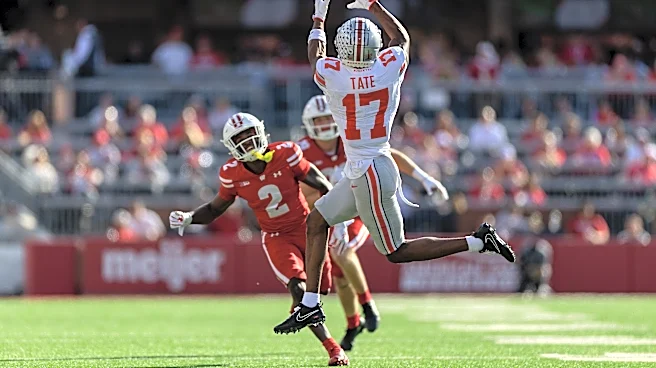
Carnell Tate, Ohio State
Carnell Tate meshes well with what the Giants need at wide receiver. Tate caught 51 of 66 targets for 875 yards with nine touchdowns in 2025, and finished his college career with 121 catches on 161 targets (75.2%) for 1,872-yards with 14 touchdowns:
The 2024 National Champion averaged 17.2 yards per catch in his junior season, and he caught 12 of 14 contested catches (85.7%). Tate was one of the best deep threats in college football, and he averaged an INSANE 3.02 yards per route run in 2025 with zero drops on 66 targets (55 catches). He aligned mostly out wide throughout his college career with just a 12.5% slot rate.
Carnell Tate is one of the more technically sound route-running wide receivers to come into the NFL draft process – no surprise since he was coached by Brian Hartline. Tate has a comprehensive understanding on how to attack a variety of different leverages exercised by defensive backs. He’s quick to sink his hips and explode out of his breaks; this allows him to create sufficient separation against man coverage, and he uses excellent spatial awareness and savvy to find vulnerabilities in zone coverage.
Tate won over 85% of his contested catches in 2025. His ability to win vertically and attack the football at its highest point – with those massive mittens – will give his future quarterback a reliable downfield weapon that understands how to maximize his ability to win 50/50 balls. Tate is spatially aware along the sidelines and possesses elite tracking/concentration when the football is in the air.
Tate will be a good wide receiver in the NFL – and he would complement Malik Nabers well. Still, he’s not perfect. He’s a little lighter than receivers who typically possess his skillset, and he is not overly dynamic after the catch. Still, he is a technically sound, sufficient, albeit not difference making, athlete who can create separation, is exceptional as a route runner, and understands how to win in one-on-one situations. He is a year-one starter who will have an early impact.
Makai Lemon, USC
The Giants had Lemon in for a Top-30 visit. The predominant slot receiver caught 79 of 108 targets for 1,156 yards with 11 touchdowns, while securing 71.4% of his contested catches in 2025 (10 of 14). Lemon catches nearly everything thrown in his direction.
Lemon is a smooth, polished route runner who attacks leverage well and consistently creates separation against both man and zone coverage. He’s strong when playing through contact, and he showcases good athletic ability to win at each level of the field, although he’s not technically a burner. Lemon is a quarterback’s best friend and a special teams asset. I have no interest in Lemon at five, but if the Giants trade back, he’s a name to keep in mind.
Day 2
KC Concepcion, Texas A&M
I don’t think Concepcion is getting out of the first round of the draft, but crazier things have happened. The talented receiver caught 61 balls on 101 targets for 919 yards with nine touchdowns, and finished his college career with 186 catches on 294 targets for 2,224 yards with 25 touchdowns.
The Consensus All-American in 2025, and he won the Paul Hornung Award. He was the ACC Rookie of the Year in 2023. He’s secured 48.6% of his contested catches in college, but secured 66.7% in 2025 (10 of 15). He forced a total of 39 missed tackles through college, 14 in 2025 with Texas A&M, where he had a career high 2.46 yards per route run.
He aligned 65.3% of his 2025 snaps out wide, but rarely did that at NC State. He is interchangeable when it comes to slot/wide snaps. His aDot jumped in 2025 with the Aggies; he averaged 12.3 yards per target in 2025, and just 6.9 in 2024 and 8.5 yards in 2023.
Concepcion was a Consensus All-American in 2025 and he won the Paul Hornung Award. He was the ACC Rookie of the Year in 2023. He’s secured 48.6% of his contested catches in college, but secured 66.7% in 2025 (10 of 15). He forced a total of 39 missed tackles through college, 14 in 2025 with Texas A&M, where he had a career high 2.46 yards per route run.
He aligned 65.3% of his 2025 snaps out wide, but rarely did that at NC State. He is interchangeable when it comes to slot/wide snaps. His aDOT jumped in 2025 with the Aggies; he averaged 12.3 yards per target in 2025, just 6.9 in 2024, and 8.5 in 2023.
Chris Brazzell II, Tennessee
Brazzell II caught 61 of 86 passes for 1,007 yards (16.5-yards per catch) with nine touchdowns. It was his only season with more than 30 catches and 400 yards receiving. He started his college career at Tulane and transferred to Tennessee after the 2023 season.
The soon-to-be 23-year-old was a First-Team All-SEC in 2025, where he averaged 16.5 yards per catch on a 15.7-yard aDOT, and an impressive 2.57 yards per route run. Brazzell II aligned primarily out wide (93.2%) throughout his career. He dropped only two passes in 2025 and had an 8.2% drop rate throughout his college career. He secured 40.8% of his contested catches throughout his career, catching 7 of 17 in 2025 (41.2%). His father, Chris, played wide receiver and was a sixth-round pick by the Jets in 1998, and his brother plays defensive back at Tennessee.
Brazzell II possesses a dangerous combination of deep speed and long strides that threaten defenses vertically. His presence softens the defense, which provides space for underneath targets and the rushing attack – he has that effect! He’s an explosive athlete with an impressive catch radius, who will immediately be a problem for defensive backs on the vertical plane. Despite his leggy nature, it doesn’t really affect his route running much; sure, he would be quicker in and out of cuts if his hips weren’t so high, but he’s fluid for a player – even with his body type, which is rare.
Brazzell II has the “MOSS” ability at receiver; he makes acrobatic catches look easy and times his jumps well to win one-on-one matchups, even when he is out-leveraged; he achieved this against Georgia, where he went off for 6/6 125-yards with two scores. He doesn’t have the YAC ability that is desired from most receivers that will likely be taken as high as Brazzell II, but he presents more than enough to be a true difference maker for an offense. He isn’t a completely polished wide receiver, but he can be a dangerous threat at the next level.
Malachi Fields, Notre Dame
Fields is a big-bodied wide receiver who mostly aligned out wide. His career yards-per-route-run was 1.94, but his 2025 number was 2.20 with Notre Dame. Fields had an average aDot of 14.1 (16.4 in 2025) and his yards per reception was 15.1 (17.5 in 2025). Fields has only had three drops over the last two seasons. Fields forced 29 total missed tackles in his career, and he caught 47.2% of his contested catches (34 of 72).
Fields caught 165 passes on 278 targets across his five seasons of college football — four of which were played at the University of Virginia. He finished his one season at Notre Dame with 36 grabs on 62 targets for 630 yards with five touchdowns and a 17.5-yard per catch number.
He profiles as a prototypical X receiver, offering an excellent blend of size, strength, athleticism, and ball skills. He shows impressive fluidity for a player of his build and consistently attacks the football in the air, making acrobatic, high-degree-of-difficulty catches with strong concentration. Fields did a better job in 2025 of using his massive frame to his advantage at Notre Dame, particularly at the catch point.
Once he opens up his stride, Fields eats up ground vertically and can generate adequate separation on deep posts. That said, questions about his ability to consistently separate against NFL-level coverage are fair. His pre-draft testing will be important in clarifying that projection. Ultimately, Fields is a physical, aggressive “baller” at the position, and he would be an excellent X option for the Giants.
Day 3
CJ Daniels, Miami
Daniels almost reached Van Wilder status in college. He spent four years at Liberty and then transferred to LSU for one season before finishing his college career with the Hurricanes. He caught 50 passes (67 targets) for 557 yards and seven touchdowns in 2025 with Carson Beck. In his career, he secured 198 balls on 295 targets for 2,988 yards and 28 touchdowns.
Daniels caught 11 of 17 contested catches in 2025 with the Hurricanes, with 1.73 yards per route run and a 13.8% slot rate. He ended his college career with a 62.3% contested catch rate and a 2.00 yards per route run number, with just nine drops (4.3%). He forced 31 missed tackles in college. Daniels averaged 15.1 yards per catch with a 13.6-yard aDot.
Daniels is a very good route runner with a release package, who is one of the older prospects in the 2026 NFL Draft. He wins with his movements up the route stem, and due to his exceptional ball skills/contested catch ability. He is a try-hard blocker, who is a tough, effective player. Still, his lackluster vertical ability and average athletic traits, plus his injury history and age, cap his upside. Overall, he can be an effective player who can contribute as an X, Z, or slot. He could be a day three target for the Giants, if he’s still around.
Skyler Bell, UCONN
The 23-year-old had an elite 2025 season, catching 102 of 141 passes for 1,282 yards with 13 touchdowns. He spent two seasons at UCONN after transferring from Wisconsin, where he had two productive seasons (2022 & 2023) and one season in which he was mostly a special-teams player. Bell was a consensus All-American in 2025. Not only did he secure 102 catches for 1,282 yards, and 13 touchdowns, but he also averaged an insane 3.13 yards per route run with just four drops and 15 forced missed tackles. His slot percentage was 36.4% in 2025.
Skyler Bell is an explosive athlete who wins with burst, speed, and natural movement ability., Bell threatens defenses vertically with strong build-up speed and solid twitch, while taking advantage of his ability to quickly threaten off coverage. His foot quickness and fluidity stand out on tape — he’s smooth in and out of breaks, dangerous in short areas, and capable of creating chunk plays after the catch.
Bell tracks the football well downfield and has shown the concentration to finish difficult throws, producing several highlight-reel catches during a productive college career. However, his slender frame shows up against physical coverage, where his release timing can be disrupted and his overall strength limits his ability to play through contact. He has a solid release package, but could benefit from added refinement and variation. Coming from a lower level of competition and entering the league as an older rookie, Bell will need to prove his traits translate, but his athleticism and vertical playmaking ability give him intriguing upside.
Josh Cameron, Baylor
Cameron spent five seasons at Baylor, where he caught 170 of 261 passes for 2,230 yards and 19 touchdowns, with a 13.1-yards per catch number. Cameron is often compared to Deebo Samuel (lite) for their playing styles, build, and ability to create yards after the catch.
Cameron averaged 1.59 yards per route run with an 88.7% wide alignment rate. He dropped seven footballs on 261 targets and averaged 13.1 yards per catch in college; he only dropped one pass in 2025. Cameron was a two-time First-Team All-Big-12 (2024 & 2025). Cameron was an accomplished punt returner in college. He had 45 punt returns for 630 yards (14-yard average) with three muffs and zero touchdowns.
Cameron possesses an important blend of short area explosiveness in a dense frame. Cameron uses his frame well at the catch point with solid adjustment ability outside his frame, especially on throws behind him on the horizontal plane. He’s crafty after the catch with the necessary physical traits to run through arm-tackles. Baylor often used Cameron on deep overs and crossing routes and his football IQ allowed him to find vulnerabilities in zone coverage.
Cameron is also an elite special teams asset as a punt returner; he averaged 20.7 yards per punt return in 2024 and finished his college career with a 14-yard return average. Cameron’s baseline special team traits will provide value to any team. His upside as a receiver, though, remains questionable due to his lack of elite athletic traits and questions about his ability to defeat press and run a multitude of routes. Still, there’s enough to roll the dice on when it comes to Cameron.