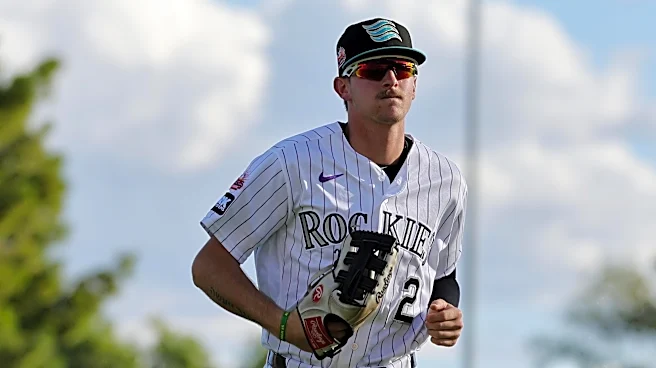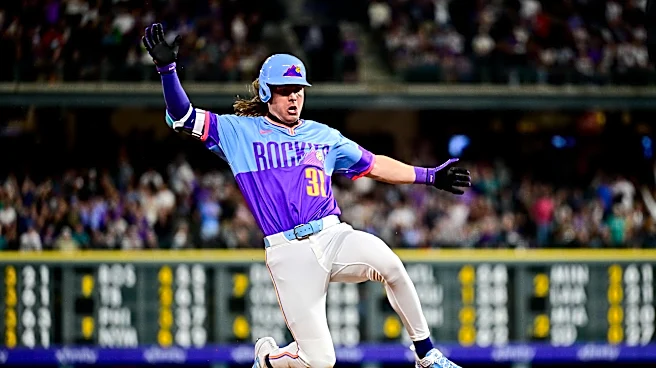


The Colorado Rockies have plenty of work to do this offseason, and their most pressing need is hardly a secret. Starting pitching should be at the top of the front office’s shopping list. In fact, it would be absolutely forgivable, reasonable and perhaps even commendable if all the Rockies focused on this offseason was pitching.
But what about the position-player side of the roster?
The Rockies made significant strides on the offensive side of the ball in 2026, and much of their position-player group
appears fairly well established heading into next season. Still, a closer look at the numbers reveals some interesting opportunities.
A look around the diamond
Colorado Rockies positional production, 2026
FanGraphs team batting leaderboards, using production accumulated while playing each position.
Shortstop, designated hitter and the corner outfield stand out, but not every position necessarily needs an outside addition.
Ezequiel Tovar is signed long-term and finished 2026 on an encouraging note, hitting .285/.323/.447 with a 98 wRC+ over his final 45 games.
Connor Norby and Adael Amador provided excellent production down the stretch, posting 123 and 119 wRC+, respectively, from August through September. Both should get plenty of run at second base and also figure into the designated hitter rotation.
But what about the corner outfield?
Trouble in the corners
Jake McCarthy certainly didn’t look like a player contributing to the 27th-ranked left field in baseball. He hit .292/.333/.462 with a 104 wRC+ and accumulated 1.2 fWAR in 278 plate appearances while playing the position.
Mickey Moniak was even more productive offensively, posting a 118 wRC+ and 0.8 fWAR in 163 plate appearances in left field.
McCarthy also contributed 0.6 fWAR in just 56 plate appearances while playing right field.
Yet Colorado finished with just 0.3 fWAR in left field and -1.0 in right, ranking 27th and 29th, respectively.
So what was dragging down the overall production?
The right-handed disparity
Separating the corner-outfield results by batting side reveals a pretty striking difference.
Rockies corner-outfield production by batting side, 2026
FanGraphs positional splits. Excludes 11 left-field plate appearances by Willi Castro and two right-field plate appearances by Cole Carrigg, both switch-hitters. Rankings reflect total fWAR rather than playing-time-adjusted rates.
Colorado’s left-handed hitters actually ranked 10th in left-field fWAR. Meanwhile, Jordan Beck accounted for all 73 right-handed plate appearances there, hitting just .134/.192/.179.
In right field, Beck and Tyler Freeman combined for -1.1 fWAR in 302 plate appearances.
And the right-handed struggles weren’t limited to the corners.
Across all three outfield positions, Colorado’s right-handed hitters combined for just four home runs, a 54 wRC+ and -2.5 fWAR in 499 plate appearances. Both the wRC+ and fWAR ranked dead last in MLB.
Of course, handedness doesn’t tell the whole story. McCarthy, a left-handed hitter, batted .319/.372/.524 with a 133 wRC+ against lefties in 182 plate appearances. But the rest of Colorado’s left-handed outfield options struggled in smaller samples, with Moniak, Troy Johnston and Zac Veen posting wRC+ marks of 39, 43 and -60, respectively, against left-handed pitching.
Some of that poor right-handed production is already off the roster. Freeman and Brenton Doyle have both departed, with Cole Carrigg taking over in center field.
Carrigg produced 1.1 fWAR while playing center and another 0.7 in limited opportunities at shortstop. His value at those premium positions makes a full-time move to a corner seem counterintuitive, at least without another dependable center fielder.
That leaves Beck as the Rockies’ most obvious remaining right-handed outfield option. He’s still young and hit 16 home runs in 2025, but his 2026 performance hardly makes a compelling case for handing him another starting job. Even against left-handed pitching, he managed just a 98 wRC+ with a 34% strikeout rate and an unusually high .455 BABIP.
Keeping Beck around is defensible. Relying on him simply because there aren’t many alternatives is another matter.
The left-handed tilt extends beyond the outfield. Colorado had just 12 plate appearances from right-handed hitters while playing first base in 2026.
The more you look at this roster, the more it seems like there’s a player down in Triple-A who might fit rather nicely.
A Condon-sized hole
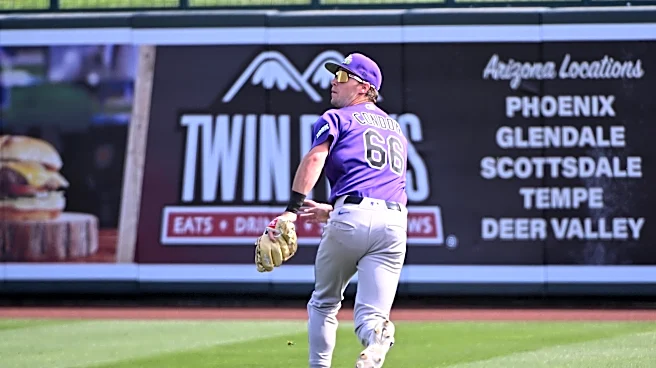
Charlie Condon (No. 2 PuRP) certainly looks capable of helping.
The former No. 3 overall pick hit .273/.390/.514 with 27 home runs, 98 RBI and 79 walks in 130 games at Triple-A Albuquerque in 2026.
Condon also happens to be a right-handed hitter with experience in the corner outfield and at first base, with designated hitter offering another possible fit.
It’s a pretty tantalizing combination given Colorado’s current roster.
I expect we’ll see Condon in the majors sometime in 2027, and there’s plenty of reason to be excited about what he could contribute. But he’s yet to make his MLB debut and isn’t currently on the 40-man roster.
And while an impressive spring could change the equation, I’m not convinced beginning the season in Colorado would necessarily be the best move unless the Rockies are prepared to give him regular playing time.
That uncertainty makes exploring the free-agent market worthwhile.
Finding the right fit
The Rockies aren’t likely to pursue an established outfield star like Randy Arozarena, but there are more modest options worth exploring.
One approach would be adding a right-handed corner outfielder who can punish left-handed pitching.
Austin Hays fits that description. Over the past two seasons, he’s produced a .952 OPS in 158 plate appearances against left-handed pitching, compared to .672 against righties. Injuries remain a concern, but his experience in both outfield corners and strong throwing arm make him an interesting, potentially inexpensive option.
Another approach would be improving the outfield through contact, speed and defense while creating more flexibility for Carrigg.
Myles Straw hit just .241/.304/.342 in 2026, but struck out only 13.3% of the time and ranked in the 97th percentile in sprint speed. He also recorded four Outs Above Average after posting 10 in 2025.
Straw’s offensive limitations are obvious, but his range could be particularly valuable at Coors Field. A dependable center fielder would also allow Carrigg to play right field or elsewhere without sacrificing defense in center.
Jake Meyers offers a similar possibility, recording 13 Outs Above Average in 2024 and nine in 2025. His offense declined in 2026, and injuries complicate his outlook, but he could be worth a look on a minor-league deal with a spring-training invitation.
Neither Straw nor Meyers would solve Colorado’s offensive shortcomings on his own. But defense, baserunning and roster flexibility offer other ways to improve the outfield beyond simply adding another power hitter.
What happens next?
These are just a few names I find interesting, and there are certainly other possibilities worth exploring.
Maybe the Rockies stick with Beck until Condon is ready. Maybe they make a trade, or perhaps they’re comfortable moving forward with a predominantly left-handed outfield and Carrigg providing some balance.
There are plenty of ways this could play out.
But given just how little value Colorado received from its right-handed outfielders in 2026, I’d like to see the Rockies bring in some competition. It doesn’t have to be an expensive signing or a long-term commitment. Just someone capable of raising the floor while the younger players work to earn their opportunities.
Join the conversation!
Sign up for a user account and get:
- Fewer ads
- Create community posts
- Comment on articles, community posts
- Rec comments, community posts
- New, improved notifications system!
Download the SB Nation app on iOS or Android.
Please keep in mind ourPurple Row Community Guidelines when you’re commenting. Thanks!