
At the advent of free agency 50 years ago, there was a stark divide between the large and small market teams across MLB. While small market teams could afford to underpay their stars due to the reserve
clause that prevented them from exploring other opportunities, a Pandora’s Box was opened when free agency allowed stars to enter the open market.
George Steinbrenner, just a few years into his ownership of the Yankees, was the first to use the rich capital of the Yankees to lure the best talent to the Bronx. After successfully poaching both Catfish Hunter and Reggie Jackson from the Oakland Athletics and bringing home the franchise’s 21st World Series title, and first in 16 years, in 1977, the Boss went back to the well, bringing in a (second) star closer in his latest splurge.
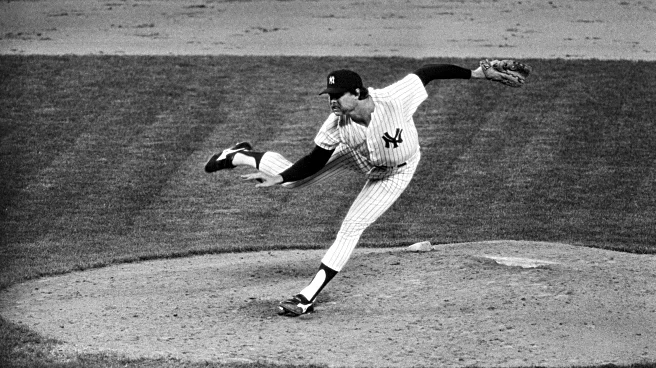
Goose Gossage
Signing Date: November 23, 1977
Contract: Six years, $3.6 million
Rich “Goose” Gossage was a ninth-round pick by the Chicago White Sox in 1970 out of Roy J. Wasson High School in Colorado Springs and it wouldn’t take long for him to debut, appearing in relief for the ChiSox on April 16, 1972. Right out of the gate, Gossage was used as a multi-inning reliever, struggling with command and posting an ERA north of four. After a disastrous 1973 season saw him throw under 50 innings and post an ERA above seven with a midseason minor league demotion, he looked to be nothing more than a regular reliever.
That was until 1975, when he increased his strikeout rate and got significantly better at preventing runs. He would end with a 1.84 ERA in 141.2 innings out of the bullpen, posting a career high strikeout rate and breaking the all-time record for rWAR in a single season by a reliever (8.2). He made his first All-Star team and came sixth in Cy Young voting, as his triple-digit fastball was finally under control.
The next year, he transitioned to a starter, but his strikeout rate declined and his ERA jumped to 3.94 in over 220 innings. It was enough to make him an All-Star, but he was returned to the bullpen for 1977 when he was traded to the Pittsburgh Pirates for Richie Zisk and Silvio Martinez. After arguably topping his 1975 season with a career-high 151 strikeouts in 133 innings, he hit free agency and elected to don the pinstripes.
A rookie’s salary in 2026 will be $780,000, so it might not seem like a deal with a $600,000 average annual value is that much, but it truly was back then. The largest contract in the league in 1977 was Hunter making $650,000 a year. Between Hunter, Jackson, and Gossage, the Yankees had a trio making a combined $1.85 million, making more than 10 teams’ total payrolls by themselves. It was no small decision to sign Gossage either and many were shocked, as the Yankees already had a well-regarded closer in defending AL Cy Young Award winner Sparky Lyle. It was a tough bit of business but ultimately proved prescient, especially because Lyle was seven years older with Gossage and quietly nearing the end of the road.
It did create an awkward situation though, and very early on, Gossage didn’t endear himself to the fans, surrendering five homers across his first 11 outings with four losses and three blown saves. Goose got back on track in time to make his fourth consecutive All-Star team, and in fact ended up leading the AL with 27 saves while finishing fifth in 1978 AL Cy Young voting thanks to a 2.01 ERA in 134.1 innings — a testament to how he was deployed in the closer customs of the time.
Goose was entrusted in the big moments come playoff time, finishing the AL East tiebreaker at Fenway Park with 2.2 innings after Bucky Dent’s heroics, Game 4 of the ALCS to clinch the team’s third consecutive pennant, and then the final two innings of World Series Game 6 to secure a second consecutive championship. After allowing two runs in the eighth inning of ALCS Game 3, Gossage finished the postseason with eight consecutive scoreless innings.
The 1979 campaign was much rockier, as Gossage couldn’t stay out of The Bronx Zoo. Some playful banter after a game in April between Reggie, Goose, and Cliff Johnson escalated quickly, and an ensuing fight saw Gossage tear ligaments in his right thumbs and missed three months. He would never play another game with Johnson, who was traded in June.
It took awhile after he returned to find his footing (he allowed five runs in a blown save on July 14th), but Gossage finished the season with a 1.59 ERA across his last 28 appearances. Despite this, the three-month absence of the team’s All-Star closer hurt the Yankees, as they hovered around .500 for several months until Bob Lemon was canned in mid-June. The second stint of Billy Martin wasn’t enough to salvage the season, as the Yankees missed the playoffs and finished fourth in the AL East.
Gossage and the team rebounded in 1980, with Goose recording a career-high 33 saves to lead the majors with a 2.27 ERA and 103 strikeouts in just 99 innings, his lowest full-season workload since 1974. That season, he finished third in MVP and Cy Young voting, the best finishes of his career.
Despite winning 103 games, the Yankees were taken down to the wire for the AL East crown and when they hit the playoffs, they ran into a Royals team hungry to avenge earlier losses. In Gossage’s only appearance of the ALCS, he gave up a towering, series-clinching, three-run homer to George Brett in Game 3, securing the sweep for Kansas City.
In 1981, Gossage’s role was reduced to pitching no more than two innings at a time, as the Yanks capitalized on the emergence of All-Star setup man Ron Davis to lessen his workload. Gossage also battled a nagging shoulder injury throughout the season, limiting him to just 32 extremely effective appearances in the strike-shortened season, posting a 0.77 ERA in 46.2 innings.
The lesser workload paid off, with Gossage picking up six saves and throwing 14.1 shutout innings with 15 strikeouts in the postseason. While the Yankees lost to the Dodgers in six games in what would be their last World Series appearance for 15 seasons, it wasn’t for lack of a stellar performance by their closer.
The last two seasons of Gossage in New York were still effective, with him posting a 2.25 ERA with 192 strikeouts in 180.1 innings combined over the last two seasons, but the team stumbled to a 79-83 record in 1982 and came third in the division in 1983, missing the playoffs in consecutive seasons for the first time since the mid-1970s and beginning the longest playoff drought in franchise history.
Gossage’s final iconic moment as a Yankee came in July 1983, when he was the pitcher who gave up the infamous home run to Brett in the Pine Tar Game.
Despite only being 32 and clearly one of the best closers in the game, Gossage was not re-signed after the 1983 season. His relationship with Steinbrenner soured over the years, beginning with the fight that cost the closer several months in 1979 and a spring training spat between the two over Gossage’s beard led to his now-iconic look. By 1982, Gossage was publicly insulting The Boss, calling him “the fat man upstairs” and was disgruntled with his usage under Billy Martin, who Steinbrenner had already rehired on two separate occasions.
Gossage would get paid a pretty penny to move across the country to San Diego, signing the richest contract in league history for a pitcher to that point, making $9.5 million over the next five seasons. He’d put together two more strong seasons, including aiding the Padres to the 1984 NL pennant, before the aging curve hit and he began to regress.
Goose would play for the Cubs in 1988 and the Giants in 1989. He even got a brief 11-game cameo back in pinstripes in 1989 after he was claimed off waivers in August. He remained in the league through the 1994 season, remaining a solid reliever through his final season with the Mariners at the age of 43.
Gossage’s contract was a big success for the Yankees, even if it feels like they left some meat on the bone in terms of playoff success. He recorded a then-franchise record 151 saves and had a 2.14 ERA across 533 innings in his six seasons, making four All-Star teams and finishing top-five in Cy Young voting on three different occasions. The 2008 Hall of Famer was part of a generation of closers that truly defined the position and made high-leverage relievers some of the most important players on a roster.
See more of the “50 Most Notable Yankees Free Agent Signings in 50 Years” series here.