



NBA history spans 80 seasons, and as CelticsBlog readers well know, the Boston Celtics have won a league-high 18 championships. This month, we are recapping each of those title years.
In the beginning
For the first ten years of their existence, the Boston Celtics were an average team at best. They won 330 regular season games, lost 328, and never won a division title. They made the playoffs seven times, compiled an 11-19 won-lost record, and advanced to zero Finals. Meanwhile, the Minneapolis (not
yet Los Angeles) Lakers won five titles.
Boston’s best player was point guard Bob Cousy, who was a New England icon after his All-American career at Holy Cross, which he led to the NCAA championship in 1947. “The Cooz” was the NBA’s perennial assists leader, and he once scored 50 points in a postseason game. Nevertheless, head coach Red Auerbach was still searching for elite big-man talent that would make the Celtics legitimate championship contenders.
He found him in the 1956 NBA Draft.
Bill Russell was a two-time All-American center who had led the University of San Francisco to a 55-game win streak and back-to-back NCAA titles. He would surely be selected before Boston could take him with the sixth overall pick. But Auerbach and Celtics owner Walter Brown worked some magic that resulted in the most impactful trade ever seen.

The Rochester Royals (today’s Sacramento Kings) had the first pick and planned to take All-American guard Sihugo Green. To ensure that the Royals didn’t reconsider Russell, Brown reportedly offered Royals owner Les Harrison the rights to book the popular Ice Capades into his Rochester arena. In those early years of the league, ticket sales that contributed to financial survival were more important than potential titles.
The second overall pick belonged to the St. Louis (now Atlanta) Hawks. Auerbach offered Boston’s all-star center Ed Macauley (a St. Louis native) and rookie Cliff Hagan in exchange for the pick, and the Hawks went for it. Why? Here’s how Dan Shaugnessy explained it in the Boston Globe in 2020:
“Red was the first NBA executive to draft a Black player, Duquesne forward Chuck Cooper in 1950. Six years later, Auerbach exploited racism in the St. Louis Hawks front office, trading two white players for the Hawks’ No. 1 draft pick. Red used the pick on Bill Russell. He knew St. Louis had no interest in building its franchise around a Black center.”
Macauley and Hagan both had Hall of Fame careers, but Boston won 11 titles with Russell, so there’s no disputing who won that trade. Furthermore, Auerbach used the Celtics’ own sixth overall pick to choose Tom Heinsohn of Holy Cross as a territorial selection. Heinsohn won eight rings as a player and two more as the Celtics’ head coach, making the Hall of Fame in both roles. (Of course, Heinsohn also became the beloved homer on Celtics local market TV broadcasts and, honestly, he could be in the Hall of Fame for that work, too.)
A footnote to the ’56 draft is that it produced a third future Hall of Fame enshrinee for Boston. Point guard K.C. Jones was picked in the second round, 14th overall, but didn’t join the team until 1958 due to military service. Like Heinsohn, Jones won eight rings playing on the parquet floor of Boston Garden and coached the team to two more. Boston’s 1956 selections were probably the greatest draft haul of all time.

The regular season
Opening Night of the 1956-57 season was in late October, but Russell’s Celtics debut was delayed until just before Christmas. He missed the first 24 games while winning an Olympics gold medal in Melbourne, Australia, then played in all of the Celtics’ 48 remaining games. Russell led the NBA in rebounding average with 19.6.
Cousy had one of his finest seasons, averaging 20.6 points per game and leading the league in assists for the fifth straight season at 7.5 per game. Heinsohn added 16.2 points and 9.8 rebounds per game and guard Bill Sharman averaged 21.1 points, joining Cousy on the All-NBA first team. All three were chosen to play in the All-Star Game. Cousy was named the NBA’s Most Valuable Player and Heinsohn was Rookie of the Year.
Finishing at 44-28 (.611), the Celtics won the Eastern Division for the first time and had the best record among the league’s eight teams. Six squads qualified for the playoffs; notably, the Royals were not one of them.
Eastern playoffs
Boston received a bye for the first round, then took on the Syracuse Nationals (today’s Philadelphia 76ers) in a best-of-five Eastern Division finals. For the first time ever, the Celtics advanced via a 3-0 sweep, and only the third game was close. In a good omen for the NBA Finals, the rookies were key: Heinsohn averaged 20 points and 10 boards, while Russell delivered 15 and 28.
In yet another first, the Boston Celtics were moving forward to play for the NBA championship.

NBA Finals
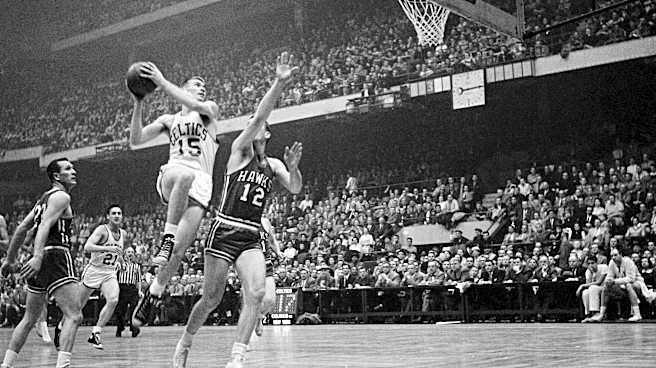
The Celtics quickly learned that getting their first title would be anything but easy. Their opponents were their off-season trading partners, the St. Louis Hawks, with Ed Macauley, Cliff Hagan and the league’s best power forward, 6-foot-9 scoring machine and future Hall of Famer Bob Pettit.
Sure enough, the Hawks stole Game 1 in Boston, 125-123, in double overtime, behind Pettit’s 37 points and 14 rebounds. Macauley added 23 and 9. The Celtics recovered in Game 2, winning by 20 at home with seven players scoring in double figures.
In St. Louis, Game 3 was wild even before tipoff (see sidebar), ending in a Hawks victory and a 2-1 series lead.
Don’t mess with Red
During warmups for Game 3 in St. Louis, some of the Celtics told Red Auerbach that the basket appeared higher than the standard 10 feet. Officials measured and found the rim was precisely at 10 feet. Hawks owner Ben Kerner thought Auerbach was pulling a bush-league trick to rattle the Hawks. The confrontation grew heated until Auerbach ended it by punching Kerner in the mouth.
The Celtics coach was not ejected or suspended, but he was fined $300 by the NBA. (How times have changed.) Auerbach later regretted the punch, especially since a few years earlier he’d been hired by Kerner to coach the Tri-Cities Blackhawks, a team that eventually became the St. Louis Hawks. But the incident illustrated Auerbach’s competitive fire in defense of his players.
Down 2-1, Game 4 was a must-win for Boston, and MVP Cousy came through with 31 points and 8 assists to even the series. The Cs returned to the parquet to win the pivotal Game 5 behind their all-NBA backcourt. Sharman emerged from a shooting slump, making 13 of 24 field goals and scoring 32 points, aided by Cousy’s 19 assists. Back in St. Louis, Game 6 was excruciatingly tight, with no more than two points separating the teams at each quarter break, but Pettit had his own superstar performance, scoring 32 with 16 of 22 free throws, and adding 23 rebounds.
With both franchises still alive to win their first championship, the series returned to Boston for Game 7. It turned out to be a classic double OT battle with a stunning ending.
Once again, Bob Pettit led the Hawks with 37 points and 19 boards in 56 minutes. Meanwhile, Boston’s veteran backcourt of Cousy and Sharman were ice cold, shooting a wretched 5 of 40 combined. Fortunately, the rookies proved to be clutch: Heinsohn grabbed 23 rebounds and dropped 37 points while shooting 17 of 33. Russell added 19 points and 32 rebounds, and made a chase-down block that saved the game.
It wasn’t over until…
…Literally the final buzzer of Game 7, after 356 minutes, including two double OT games, when a Pettit tip-in attempt rolled off the rim. Boston escaped, 125-123. In the video below, Heinsohn called it the greatest game in NBA history, and Russell’s block the most memorable play ever.
The heroes we needed
Heinsohn and Russell made all the big plays throughout the 1957 Finals, securing Banner Number One and setting the tone for their vital roles in the Celtics dynasty of the Fifties and Sixties. If the Finals MVP award had existed then, choosing between them for a winner would’ve been a tough task.
Notable facts and stats
Bill Russell’s first experience with Game 7 occurred in the Hawks series. As one of the most clutch competitors in sports history, Russell compiled a 10-0 record in Game 7s during his 13-year career. According to research from Stat Muse, here are his statistical averages for those 10 games:
- 48.8 minutes
- 18.8 points
- 29.3 rebounds
- 3.7 assists
- 44.7% field goal shooting
Banner Years continues tomorrow with a review of the 1958-59 season and the road to winning Banner #2.