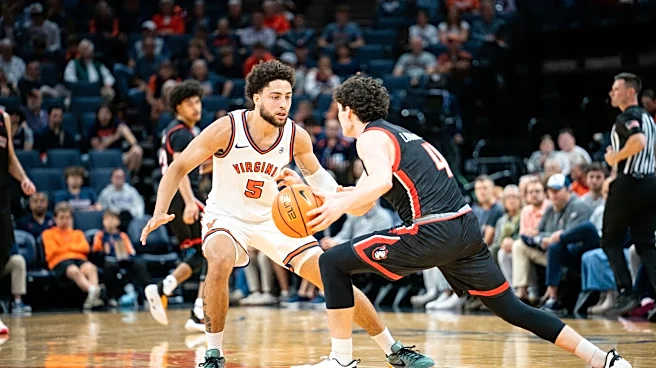



Virginia is continuing its breakneck pace to start the season with the second of three games this week. This was the second of its “warm-up” games before the big one this Sunday against Arkansas.
However, for the first eight minutes Friday, it did not look like a mismatch. Virginia shot 2-of-10 from the field, missed its first seven threes and turned it over four times. Northeastern, picked 11th in the CAA preseason poll and coming off a 93-85 loss at Boston University, led 7-4 at the 14:32 mark,
and Virginia did not take its first lead until Chance Mallory’s steal and layup with 8:23 left in the half. This was alarming given the hot start that carried Virginia against Drexel just a few days before.
Then the No. 9 Cavaliers woke up in front of 12,620 at John Paul Jones Arena. They outscored the Huskies 22-11 over the final nine minutes of the half to lead 38-31 at the break, shot 61.3 percent after halftime and scored 59 second-half points. The lead peaked at 27, and Ryan Odom emptied the bench for the final six minutes.
Virginia is 2-0 heading into Sunday’s showdown with No. 12 Arkansas in Washington.
Here are my six takeaways.
The Virginia offense can be electric, but the lulls are becoming a pattern
When Virginia’s offense is rolling, it is hard to stop. It finished with 97 points, 34-of-63 shooting (54 percent), 12-of-31 from three and 26 assists on 34 made field goals. Those 26 assists were Virginia’s most in a game since its 84-71 Sweet 16 win over Iowa State on March 25, 2016, when it also had 26, according to ESPN Insights. It scored 44 points in the paint to Northeastern’s 22 and won fast-break points 23-15. After its 0-for-7 start from deep, it went 12-of-24 from three the rest of the way.
That said, it took Virginia more than five minutes to make its second field goal. Its only points between the first basket and the 14:32 mark were a pair of Sam Lewis free throws. That is the second straight game with an extended dry spell. Against Drexel, it was the first seven and a half minutes of the second half, when Virginia scored seven points. In the exhibition loss to Vanderbilt, a 17-3 run decided the game.
These droughts often look similar: Virginia resorts to isolation basketball, settles for threes and hesitates in ways that often lead to turnovers and poor-quality shots. During these periods, it often feels like Virginia lacks a clear plan.
Last game, it seemed like Thijs De Ridder would be the go-to option, and he still is. But he occasionally goes through lulls, like early in this game, when he is not searching for his shot or being aggressive enough. He had three points on two shots at halftime.
The core four showed out again
Thijs De Ridder, Sam Lewis, Johann Grünloh and Chance Mallory scored 69 of Virginia’s 97 points. Through two games, they have 132 of the team’s 186, 71 percent.
Friday, Mallory was a standout. Against Drexel, he looked rusty after missing time with an ankle injury this preseason: eight points on 2-of-7 shooting and six turnovers, two of them to open the second half. In my opinion, Mallory looked tight, possibly from internalizing the immense preseason expectations and accolades he had received. Three days later, he looked like a different player. He scored a career-high 20 points on 7-of-12 shooting, 3-of-7 from three, with five assists, four steals and just one turnover in 27 minutes. His previous high was 17 in the double-overtime win at Notre Dame last January.
He also set the tone when Virginia needed it. His steal and layup gave the Cavaliers their first lead, and his personal 7-0 run in the first half is what finally pulled them out of their hole. Early in the second half, after Northeastern cut it to 43-38, his three started the 7-0 answer that put the game away. That is the version of Mallory Virginia will need Sunday.
Lewis added 20 for the second straight game, going 8-of-8 at the line. His shooting prowess from all three levels of the floor is invaluable to this team. De Ridder had only three points at halftime but finished with 16 on 7-of-9, six rebounds, four assists and four steals. Grünloh had 13 points and two blocks in 21 minutes while playing on an injured right ankle.
If I had to make one note, it would be Lewis’ six turnovers. Last game it was Mallory, this game it was Lewis. Virginia’s ball security in its half-court offense should be a focus for Odom before Sunday.
The Elijah Gertrude breakout is here
Gertrude had 10 points, five rebounds, a steal and a block in 17 minutes. He shot 3-of-5 from the field and 3-of-4 from three, and his three offensive rebounds led the team. He finished plus-19, second on the team behind Lewis’ plus-24.
The three made threes are a career high for a regular-season game. But this is emblematic of the increased level of play that Gertrude has been showcasing this entire season. Gertrude has been one of Virginia’s most productive players in all five games it has played this fall:
- Vanderbilt (exhibition): 10 points, a team high, 1-of-2 from three
- Richmond (exhibition): 11 points, 3-of-5 from three
- at Villanova (exhibition): 16 points, 5-of-6 from three, five steals
- Drexel: eight points, three steals, a block
- Northeastern: 10 points, 3-of-4 from three, five rebounds
That is 55 points in five games, double figures in four of them, and 13-of-21 from three. Before this season, he was 3-of-29 from three in his college career, and many questioned if this deficiency would be the Achilles heel for him, especially in an Odom system that prioritizes shooting from three.
Moreover, he led Virginia’s bench in minutes Friday and leads it through two games with 32, after averaging just 6.4 a game last season. During the offseason, Odom talked about the development of returners like Gertrude, Martin Carrere and Silas Barksdale. For most of the offseason, many fans doubted their potential impact, focusing instead on new faces from the transfer portal, overseas and high school.
After the game, Odom said Gertrude was Virginia’s player of the game. “He is an excellent shooter,” Odom said. “He’s confident in that, and he’s getting the right ones.” Odom also praised his hustle on a dive for a loose ball: “He was Superman diving towards the bench.”
Two games into the season, it appears Gertrude is fulfilling the potential he once had as a top-40 recruit and looks poised to be the sixth man.
The new faces are still finding their footing
I just lauded the leap Gertrude has made to become a key rotation player. By contrast, Virginia’s newcomers have struggled to open the season. Virginia’s six scholarship newcomers combined for nine points on 4-of-12 shooting Friday. Nolan Adekunle led them with three.
Adekunle started and played 25 minutes. He continues to play good defense and had five rebounds and two assists but took just three shots and picked up four fouls. Jurian Dixon (2 points, 1-of-3), Kalu Anya (2, 1-of-2) and Jan Vide (2, 1-of-3) all scored once. Christian Harmon missed his only shot, and Favour Ibe did not attempt one.
Meanwhile, the core four, Gertrude and Carrere combined for 84 of the 97 points. This is not a shock to Virginia faithful, especially with all the resources Virginia invested to keep them together for another year in Charlottesville. That said, it is a heavy load on just a few players, and worrisome given all the production and key pieces that were lost from last year’s team.
There are reasons for optimism down the line. After struggling in the first few exhibitions, Dixon has looked better overall in the last two games, scoring seven against Drexel and looking especially scrappy on the defensive end. Harmon was third-team All-Sun Belt at Arkansas State just a year ago but missed time this preseason with an injury, so he should improve as time goes on. The same goes for Favour Ibe, who is a very raw freshman.
Adekunle has been valuable as a big wing defender, rebounder and three-point shooter when called upon. Still, he is one player I hoped would be able to translate a little quicker on the offensive end given his age, experience and pedigree coming from a difficult league overseas.
There is still time, as these players have spent only a few months in Odom’s system. But Virginia built a much tougher nonconference schedule this year, so the additions will need to learn fast if Virginia is to take the leap many hoped for over the next few months.
The rotation is taking shape
In the preseason, we covered many of the players we thought had the chance to get game time this year. I believed there were 13 credible candidates for minutes. Two games in, the pecking order is beginning to take shape.
Gertrude, Dixon and Anya are the first three off the bench. They played 17, 15 and 12 minutes Friday and lead the bench through two games with 32, 27 and 28 respectively. Martin Carrere and Vide come next. Carrere had five points in nine minutes and hit a three, and Vide played eight.
Behind them, Harmon, Ibe and Silas Barksdale look buried for now. They played two, two and three minutes Friday, and eight, eight and seven through two games. Carter Lang, someone we did not preview, also got minutes at the end, but barring an injury, I do not see him factoring into the lineup.
Potentially the most telling detail about how Odom views his rotation is in the frontcourt. Grünloh played just 21 minutes, the fewest of any starter, on a bad ankle. The injury may date back to the Drexel game, when he went to the tunnel to be checked out in the first half.
Despite Grünloh’s unusually low minutes, Odom did not turn to Ibe or Barksdale. Instead, he chose to go smaller with Anya and De Ridder playing down low. The jury is still out on how this will work against bigger, more physical teams, but it is an important data point as Virginia enters the heart of its nonconference schedule.
Takeaways continue to be the focus of the defense
After a record-setting night in the opener, Virginia forced 19 turnovers and finished with 12 steals, four each from Mallory and De Ridder. It turned those turnovers into 22 points to Northeastern’s 13.
Through two games, Virginia has 30 steals and has forced 40 turnovers, turning them into 47 points. For context, it averaged about 6.3 steals a game last season. This is a different defense, built to force mistakes and run.
The blocks are a different story. Virginia had four Friday, two from Grünloh, after three against Drexel. A year ago, Virginia led the nation with 6.4 per game thanks to its twin towers, Grünloh and Ugonna Onyenso.
Virginia’s press was effective in generating turnovers, but it was not without drawbacks. Despite the gap in talent, the Huskies were relatively efficient, shooting 46 percent from the field, including 18-of-29 inside the arc.
Bonus: Virginia has not played its best and is still winning by 25-plus
In part due to the two offensive droughts, many, myself included, feel Virginia has played far from its best game. That is reflected in the betting market, where Virginia failed to cover against Drexel (closed at -31.5) and Northeastern (opened and closed at -33.5 on DraftKings).
Despite the lack of a complete performance, Virginia has won its first two games by 29 and 25, and the fact that those feel even a little disappointing shows how much is expected of this team. The encouraging part is that the ceiling has barely been tested.
Bonus: Rashad King and Louis Bond were impressive
King scored 26 points on 8-of-14 shooting and a perfect 9-of-9 at the line. Bond, a sophomore transfer from Idaho State who averaged 4.9 points last season, scored a career-high 23. Together they scored 49 of Northeastern’s 72 points. The rest of the Huskies went 7-of-22 from the field.
King’s story is a unique one. He was first-team All-CAA at Northeastern in 2025, then transferred up to the SEC to spend last season at LSU. After a court order granted him another year of eligibility, he decided to return to Northeastern. He was a preseason All-CAA first-team pick, and Friday he looked like it.
What’s next
Sunday is the big one, as Virginia faces No. 12 Arkansas at 1 p.m. at Capital One Arena in Washington (ESPN). The Razorbacks went 28-9 last season, won the SEC Tournament and reached the Sweet 16 under John Calipari.
This is the first real test. To stay unbeaten, Virginia will need a fast start, a healthy Grünloh and some production from beyond the core four.