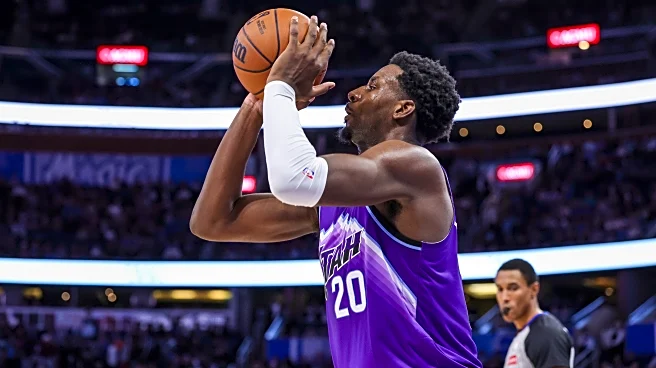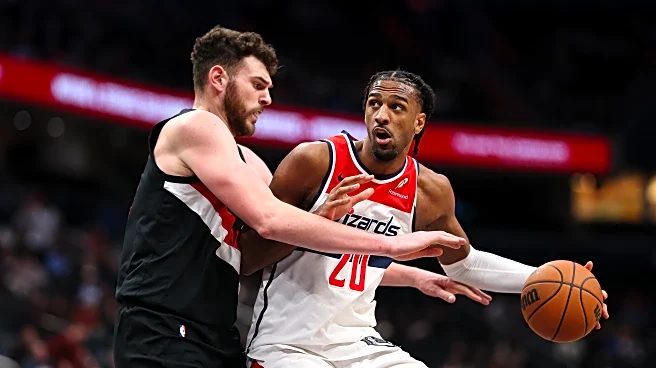


The Wizards ended a nine-game losing streak by beating the Portland Trail Blazers, 115-111, in a chippy and kinda entertaining game, despite being nearly devoid of offensive competence.
Some of the fun was delivered by the return of Deni Avdija, who’s much improved and might be an All-Star this season. He’s been limited a bit lately with a back injury but still flashed what’s made him special for Portland — rocket-propelled transition pushes, physical drives that draw fouls, crafty (yes, crafty!)
moves inside to get buckets or trips to the free throw line, and some accurate three-point shooting.

One thing I’ve liked about Avdija this season was on display last night. Some players seem to drive with a singular purpose. They’re either looking to score, or to get fouled, or to pass. It seems like their end decision is made before they put ball on deck. Avdija seems not to have made up his mind until he gets into the paint and the defense reacts, at which point he’ll try to score or kick to an open teammate. This is a good thing, and it gave his teammates several open looks. They missed a lot of them, but Avdija made some good basketball plays.
The biggest weakness of his game was also on display — six turnovers. For the season, he’s over five turnovers per 100 team possessions, which is high. His overall offensive efficiency is still very good (+5.5 points per 100 possessions relative to league average) and on a career-high 29% usage rate. This is quite good considering the dearth of offensive talent on the Portland roster.
Shaedon Sharpe is probably the best hope for an offensive helper, and he had a good game against Washington. For the season, his offensive efficiency is also nearly nine points per 100 possessions below average. Jerami Grant and Jrue Holiday might help — Holiday is finally healthy and playing. Grant has been coming off the bench because of significant limitations in his overall game.
That’s more Trail Blazers stuff than I meant to write given that the Wizards won. They pulled off the victory despite giving up 29 offensive rebounds and an offensive rebounding percentage of 47.5%. Yes, Washington allowed Portland to get back nearly half their missed shots.
Big man Donovan Clingan sent a Trail Blazers franchise record with 13 offensive rebounds.
Washington won because they made threes (17-39, 43.6%) and free throws (18-21), and avoided turnovers (just 13 turnovers in 106 offensive possessions), and Portland didn’t (14-38 on threes, 13-23 from the free throw line, 20 turnovers). Portland shooting their “normal” free throw percentage would have given them 4-5 more points, which could have been interesting.
The Wizards starting group was bolstered by the returns of Khris Middleton and Bilal Coulibaly, and they won the minutes their starters played. Their bench was rough, and gave back most of the advantage the starters earned.
From the Notebook
- Avdija on brand — drove on the game’s first possession.
- Coulibaly maybe attempting to establish a brand, attempted a transition dunk on Avdija barely a minute into the game.
- 10:41 of the first quarter — Coulibaly, Alex Sarr and Middleton did a nice job defending a pick and roll set. Coulibaly chased Avidja over a strong screen and stayed connected. Sarr switched onto Avdija and corralled the drive. Middleton rotated from the “low man” spot to pick up the roller and arrived in time to break up Avdija’s lob attempt. That’s good stuff.
- Wizards ball and player movement was good in the early going. One example was on a Coulibaly drive. He touched the paint and kicked to Middleton in the corner. Portland closed out well, and Middleton passed it back to Coulibaly. He turned and hit Sarr, who was open at the weakside elbow. Sarr turned down the open midrange shot to drive. He got fouled and turned it into an and-one.
- A theme throughout was Sarr turning down open threes. In the second half, I jotted, “If Sarr took all the threes Portland was conceding to him, the Wizards would never run halfcourt offense.”
- 1:51 of the first quarter: Jamir Watkins stripped Avdija’s dribble and got a transition dunk out of it. I like the play, though in fairness, I thought Watkins fouled Avdija multiple times on the play. Wasn’t called though.
- In the second quarter, Anthony Gill utterly wrecked an offensive possession by turning down a conceded three. Left undefended at the three-point line, he had two good choices — 1) take the shot, or 2) attack the space and force someone to defend him. He chose to stand there and wait for a teammate to come get the ball.
- Sarr had a career-high 29 field goal attempts, making just 11. He struggled throughout the night against Clingan’s size. It was a marked contrast when Hansen Yang was in the game. Sarr seemed to do a little better shooting over Clingan in the second half.
- One defensive possession I liked in the second quarter — Tre Johnson directed a Holiday drive to the baseline where Sarr loomed. Sarr’s presence prevented a Holiday layup and cut off easy passes. The result: a Holiday turnover.
- 3:32 of the second quarter — Avdija hit the turbo button in transition while Kyshawn George jogged back. George was behind the play from that moment on. This should be a teachable moment about what it means to play hard in the NBA. There’s no reason for the guy with the ball to outrun an unencumbered defender.
- Around 1:42 of the second quarter — this is the push-and-shove portion between Sarr and Clingan. The Portland broadcast showed replays that left Sarr’s umbrage taking inexplicable. The preceding second or two made it clear that Sarr was rightfully torqued at Clingan “boxing out” by throwing an elbow. The two got tangled up a few minutes later. I don’t think they like each other much.
- Despite taking just two shots in 28 minutes, this was a pretty strong return to action for Coulibaly. He defended well, coming up with 2 blocks and 2 steals and forcing multiple turnovers. He also got some rebounds and produced 6 assists.
- George shot just 5-16 but still had a very good game — 9 rebounds, 5 assists, 3 steals, 2 blocks, and just 1 turnover. He committed just two fouls — one of them a semi-intentional “one to give” foul in the game’s final minutes. He went hard for a steal and ended up fouling, which was perfectly fine.
- Middlton had one of his better games, in part because Portland kept fumbling the ball in his direction (three steals).
- Sarr had 6 blocks to go with 6 offensive rebounds. He’s gotta get stronger. At one point in the third quarter, he got overwhelmed by Clingan’s size and physicality and did the NBA equivalent of tapping out. To his credit, he came right back and battled the rest of the way. The Wizards will want to add a physical presence to play alongside him in future seasons, I think.
- Tre Johnson has become a lethal shooter. The Wizards didn’t seem to run as many actions to shake him loose last night as they have in the previous few games. I’d like to see them show more patience in the halfcourt so they can run off-ball actions for him. Too many of the team’s possessions end in stepback threes early in the shot clock. They can get that same shot 5-7 seconds later — after working to get a better shot.
- The 29-year-old Skal Labissiere — freshly signed to a 10-day contract — made his Wizards debut last night.
Four Factors
Below are the four factors that decide wins and losses in basketball — shooting (efg), rebounding (offensive rebounds), ball handling (turnovers), fouling (free throws made).
The four factors are measured by:
- eFG% (effective field goal percentage, which accounts for the three-point shot)
- OREB% (offensive rebound percentage)
- TOV% (turnover percentage — turnovers divided by possessions)
- FTM/FGA (free throws made divided by field goal attempts)
Stats & Metrics
PPA is my overall production metric, which credits players for things they do that help a team win (scoring, rebounding, playmaking, defending) and dings them for things that hurt (missed shots, turnovers, bad defense, fouls).
PPA is a per possession metric designed for larger data sets. In small sample sizes, the numbers can get weird. In PPA, 100 is average, higher is better and replacement level is 45. For a single game, replacement level isn’t much use, and I reiterate the caution about small samples sometimes producing weird results.
POSS is the number of possessions each player was on the floor in this game.
ORTG = offensive rating, which is points produced per individual possessions x 100. League average so far this season is 115.1. Points produced is not the same as points scored. It includes the value of assists and offensive rebounds, as well as sharing credit when receiving an assist.
USG = offensive usage rate. Average is 20%.
ORTG and USG are versions of stats created by former Wizards assistant coach Dean Oliver and modified by me. ORTG is an efficiency measure that accounts for the value of shooting, offensive rebounds, assists and turnovers. USG includes shooting from the floor and free throw line, offensive rebounds, assists and turnovers.
+PTS = “Plus Points” is a measure of the points gained or lost by each player based on their efficiency in this game compared to league average efficiency on the same number of possessions. A player with an offensive rating (points produced per possession x 100) of 100 who uses 20 possessions would produce 20 points. If the league average efficiency is 114, the league — on average — would produced 22.8 points in the same 20 possessions. So, the player in this hypothetical would have a +PTS score of -2.8.
Players are sorted by total production in the game.