
Before I was fully admitted into the escape-proof prison of hate that is the Louisville-Kentucky rivalry (ages 0-4, basically), there was Indiana.
My father and my two older brothers were my unassailable
sporting guides through the vastly underrated preschool formative fandom years, and their stance on IU was pretty clear: Bob Knight was a mean guy and the Hoosiers wouldn’t play Louisville anymore because the Cardinals used to beat them too much.
Incivility (especially with regards to the media) and a lack of respect for U of L was an unholy combination in the Rutherford household of the late ‘80s. My outlook on the Hoosiers was fixed before I even knew what was happening.
I would never describe my dad as a spiteful sports fan. At least not back then. But there was one massive exception: The Bobby Knight Indiana teams of the late ‘80s and early ‘90s.
The head of the Rutherford household would, with ill-intentions, seek out Hoosier games on the television. He would watch, he would cheer audibly, and he would become angry if the likelihood of good trumping Knight appeared bleak.
Once, fueled by a kinder core I wish I could claim more of today, I implored my mother to root for the Hoosiers. Sure, the head coach might have been a bad man, but that only made me feel bad for the people under his watch. “Just cheer for the players,” I suggested. Even she knew better.
While Indiana basketball has had a minimal impact on my existence as a Louisville fan since those halcyon days, there’s still a slight, but uncontrollable, disdain that rises whenever I get a glimpse of Assembly Hall or see those candy striped warm-ups. Sometimes when the seeds get planted early enough, the roots become too deep to ever fully unearth. Time and experience are going to allow you to better rationalize the issue at hand, but your first thought is always going to be related to your original stance. Because of this, for me, the Hoosiers are always going to be the bad guys.
Louisville and Indiana have met on the hardwood 14 times in my life. Not an overwhelming the number, but the gravity of the games have always made it feel like the series has been more extensive.
On the night of March 25, 1993, I was at Mother of Good Counsel (RIP) attending some type of program which was supposed to be preparing those of us who were about to take our First Communion. The Cards and Hoosiers were tipping off in the Sweet 16 in less time than it was going to take to complete the ordeal.
The man in charge of running the program began with an introduction, which very early on included a joke about basketball and priorities and the big game. The artificial laughter that tends to dominate these types of gatherings expectedly followed. I turned to my father, and I will never forget the undeniable look of a man questioning his ability to suppress his inner fury for two more seconds, let alone two more hours. In the history of mankind, there has never been a person less amused than he was at that moment.
The program ended and we rushed home, where we were greeted with the unsurprising news that the Cards were trailing the top-seeded Hoosiers, and that All-American Calbert Cheaney was in the early stages of going off. IU was shooting an unreal percentage, but Louisville was still very much in the game.

Trailing 47-43 with 10 seconds to play in the first half, U of L had a chance to make it a single possession game at the break. Instead, the Cards lost the ball out-of-bounds, giving IU 1.9 seconds to extend their lead.
In my mind, the shot will always be from halfway between midcourt and the 3-point line. In reality, Damon Bailey came off a screen and buried an uncontested buzzer-beater from just inside the NBA arc. What I’ll never forget is the mood in the room absolutely deflating, and the sense of hope that had been so present since we’d gotten home leaving to begin its offseason. The Cards lost by 13.
Any semblance of revenge wouldn’t come until almost a decade later when I was a senior in high school.
In just his second season at the helm, Rick Pitino had Louisville fans adequately convinced that not only were the glory years coming back, but that the prodigal period was returning even sooner than anyone had expected. The Cardinals were 16-1 and ranked in the top 10, but in dire need of a significant test after an underwhelming slate of opponents had defined the first half of their conference season.
Indiana, the reigning national runners-up, did the trick. The Hoosiers were ranked in the top 20 and had beaten U of L by 15 the season before. All these factors pushed together resulted in 20,086 fans packing into Freedom Hall, which at the time was the largest crowd ever to see a Louisville home game.
You’re likely familiar with the basic game summary. Louisville fell behind big early, CBS cut away to cover the Space Shuttle Columbia disaster, the Cards outscored the Hoosiers 60-33 in the second half, ended the game on a 17-0 run, and won by 19 points. It was the first, “oh my God, we might be really, really good…good enough to win it all” moment that I can remember having.
Because CBS had cut away from its coverage, they replayed the game again about an hour after it had ended. Naturally, my dad and I watched it. I went to a party at a friends house later that night, and we heard that they were showing the broadcast one more time after the local news. Instead of trying to talk to girls or meet new friends, we watched the game again. Keystone Light was sipped, and we pulled the “oh no Bracey Wright just hit another three, there’s NO WAY we win this game” routine so much that it kept all non-Louisville fans out of the room. It was pretty great.
And then, suddenly, Louisville and Indiana were back to not playing each other again.
If I had to guess, I would think that the majority of folks on both sides would have preferred to see the regional series continue. But it’s not like either program was hurting in the rival department, a factor which certainly made it easier to cut ties.
Louisville and Indiana wouldn’t play again until 2014, when Pitino and Tom Crean — already an established rival from his time at Marquette — would face off inside Madison Square Garden. Louisville won by 20.
The teams have played five games since then, and each one has been significant for a variety of reasons.
2016 was the Donovan Mitchell breakout game, a 15-point Louisville victory in Indianapolis where the future NBA superstar came off the bench and lit up the Hoosiers, jumpstarting his sophomore season in the process.
2017 was the first signature victory for interim head coach David Padgett — a man thrust into the job because of (PERHAPS) the actions two years prior of a handful of powerful folks directly employed or associated with Indiana University — who had seen his team narrowly bested by Purdue and Seton Hall the week before.
2018 was Indiana finally getting over the hump and beating Louisville for the first time in 17 years.
2023 was the Hoosiers’ second-straight win over the Cards, and the infamous “he tricked me” Kenny Payne postgame quote.
2024 was Pat Kelsey’s first marquee victory as Louisville’s head coach, a 28-point beatdown in the first round of the Battle 4 Atlantis that provided an all-time cathartic afternoon for a tortured Cardinal fan base.
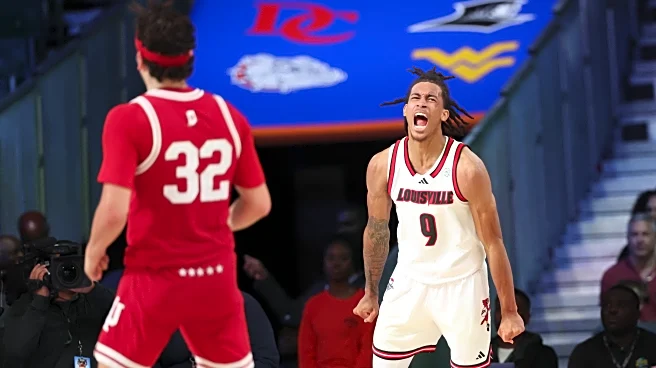
This brings us to Saturday, a “neutral court” showdown in Indianapolis featuring a pair of top 25 teams looking to bounce back from their first losses of the season. The Hoosiers are looking to have the same type of momentum-building season under their first year head coach (Darian DeVries) that Louisville had a year ago under Pat Kelsey. The Cardinals, meanwhile, are looking to take that next step towards normalcy, which means chasing a national championship in Kelsey’s second season.
There are legitimate reasons on both sides to harbor feelings of ill-will — A competitive history, Indiana recently canceling its football series with Louisville, Kenny Johnson, the rumors about what actually happened in 2015, fans on both sides having to deal with each other, etc. But this still feels like a “rivalry” where neither side has a full grasp on how to feel about the other.
That’s fine.
The more important thing as far as the immediate future is concerned is that this series has a history of producing extremely memorable contests. Furthermore, the team that wins the game (which has almost always been played in the first month and-a-half of the season) has pretty much always gone on to have a better year than the loser.
The stakes will be high on Saturday afternoon, even if the level of contempt isn’t what it used to be.