



And he never had the sense of home so much as when he felt that he was going there. It was only when he got there that his homelessness began.
– Thomas Wolfe, You Can’t Go Home Again
I don’t know what I’m searching for
I never have opened the door
Tomorrow might find me at last
Turning my back on the past
But, time will tell, of stars that fell
A million years ago
Memories can never take you back, home, sweet home
You can never go home anymore.– The Moody Blues, You Can Never Go Home
After too long
away, he’s finally back as a member of the New York Giants.
Welcome home, Jason Pinnock!
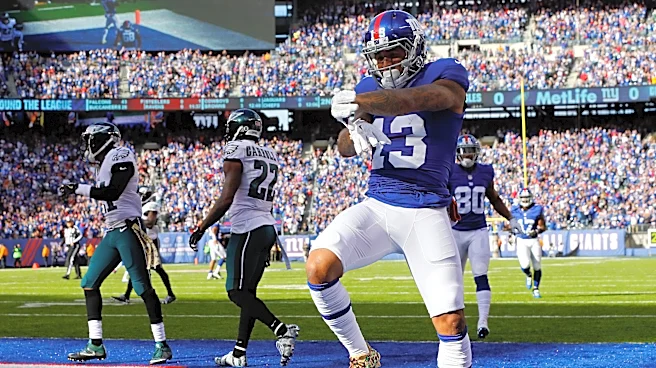
Oh, you thought I meant the other guy? OK. After an offseason, and really several years, of speculation, Odell Beckham Jr. returned to the Giants after being traded away in 2019. It’s a wildly popular move among Giants fans, who remember the four 1,000-yard receiving seasons, the three seasons with at least 10 touchdowns, the seemingly impossible one-handed touchdown reception against Dallas on Monday Night Football in 2014, the slant to the house on fourth down to beat John Harbaugh’s Ravens in 2016, and even the 57-yard touchdown pass to Saquon Barkley in Carolina in 2018.
The fact, though, is that Beckham is now 33, and has two major ACL tears in his left knee in his past. The OBJ Giants fans remember no longer exists. The question is whether he still has enough left to make the 53-man roster this summer and what he can contribute if he does. It turns out that there are quite a few examples of New York professional athletes coming home for a last hurrah, sometimes to their original team and occasionally to a different New York team. What can we learn from these? Let’s look at a few, starting with two notable former Giants.
Brandon Jacobs

Jacobs had a seven-year Giants career during which he was one of the league’s best and most physically imposing running backs, putting together two 1,000-yard seasons. By 2011 he was slowing down, though, and was no longer the lead running back. The Giants released him a month after their second Super Bowl victory over the Patriots. He signed with San Francisco for the 2012 season but only appeared in two games, with five rushing attempts, 7 yards, and 1 TD. After complaining about his lack of playing time the 49ers released him. Jacobs re-signed with the Giants in 2013. He had 58 carries for 238 yards and 4 TDs in seven games. Jacobs retired after that season, although by 2021 he was lobbying for a return to the NFL…this time as a defensive end.
Mario Manningham

Manningham was never the Giants’ WR1, but he emerged as a key figure in the offense in the years between their first and second Super Bowl runs during the Eli Manning era, putting together 822- and 944-yard seasons with 14 TDs. He is etched into Giants lore for one of the best and most important catches in Super Bowl history. Manning signed with the 49ers after the 2011 season and had one productive year with them before tearing his ACL and PCL in 2013. He re-signed with the Giants in 2014, but after straining his calf in the preseason he went on injured reserve and was ultimately released without ever playing again.
Honorable mention: Victor Cruz never played for any other NFL team except the Giants. However, after his brutal 2014 patellar tendon tear in Philadelphia, he not only missed the rest of that season, but also the entire 2015 season after requiring surgery for a calf injury during his rehab. Cruz finally returned for the 2016 season, catching 39 passes for 586 yards and 1 TD. The Giants released him the following offseason, a move that saved them $10M against the cap. Cruz signed with the Chicago Bears in 2017, but his speed was gone and he was released after the preseason. Cruz hoped to re-sign with the Giants, but it never came to pass.
The Giants weren’t the only local NFL team to bring back a former star for Act II:
Darrelle Revis

Hall of Fame cornerback Darrelle Revis played six years with the New York Jets but suffered a torn ACL (are we seeing a pattern here, Giants fans?) in 2012 and was traded to Tampa Bay in 2013. Revis was one of the rare comeback success stories. He started for the Buccaneers in 2013, made the Pro Bowl, and was ranked 37th of the NFL’s top 100 players. After a coaching change, he was released and signed with the Patriots, where he made the Pro Bowl and was voted All-Pro in 2014. He returned to the Jets and played two more seasons, the first landing him another Pro Bowl selection, but he did not have a good 2016 and was released. He signed with Kansas City but only played six games before being released and retiring.
Baseball is probably the sport where second acts are most common, because declining athleticism can be masked by judicious usage of players. Still, Father Time catches up with players pretty quickly.
Willie Mays

The baseball New York Giants, long since having decamped to San Francisco, traded a fading Wille Mays to the New York Mets so he could finish his career in the city where he began his career and first made his name as an all-time great. This was purely a sentimental gesture by Mets ownership. Mays dramatically hit a home run in his first Mets appearance but only batted .267 with 8 HRs and 19 RBI. Mays returned in 1973, but things did not go well. He showed up late for spring training, then left without notifying Mets manager Yogi Berra. Mays was fined when he returned, one writer jokingly saying that half the fine was for not showing up and half was for coming back. The 1973 season was no better than 1972 and Mays retired late in the season.
Andy Pettitte

Pettitte is the rare example of a player returning to his original team while still being in his prime, or at least being close to it. Pettitte had left the Yankees for the Astros after 9 seasons as a key starter for four World Series Championship teams and for two other Yankees World Series teams. After three seasons in Houston he returned to the Yankees even though Houston made him a fair offer to stay. Pettitte remained a Yankee on a series of one-year contracts, playing a significant role in the starting rotation. In 2009 he beat the Angels to clinch the ALCS for the Yankees. He then won Game 3 and the clinching Game 6 of the World Series against the Phillies at age 37. Pettitte played another season before retiring, but then he returned in 2012 and pitched – effectively – for two more seasons before retiring for good.
Rickey Henderson

Henderson wasn’t a home-grown Yankee, but in his fifth year in the major leagues the A’s traded him to the Yankees, where he was a four-time All-Star but never made the playoffs. He was eventually traded back to the A’s, where he got a ring with the 1989 team in the Earthquake Series. Eventually Henderson was traded again, bounced around several more teams, and was eventually traded to the Mets in 1999, where he won Comeback Player of the Year and got to the NL Championship Series. The Mets lost that series to the Braves, and Henderson and Bobby Bonilla took flak for playing cards in the clubhouse after they were removed from Game 6. He was gone early the following season.
Mark Jackson

Jackson was drafted by the New York Knicks in 1987 and was a starter for a Knicks team that made the playoffs for five consecutive years before he was traded to the LA Clippers. Jackson bounced around with several other teams and eventually worked his way back to the Knicks via a trade from the Toronto Raptors in 2001. Jackson started for the Knicks for a season and a half. The Knicks were the fourth seed in the NBA playoffs the year he was traded to them but were eliminated by Toronto. The following season the Knicks collapsed and Jackson was traded once again after the season, this time to the Denver Nuggets, where he had also had a previous stint.
Jason Kidd

Hall of Fame point guard Jason Kidd, who began his NBA career with the Phoenix Suns, was traded after five seasons to the New Jersey Nets. he was instrumental in turning the perennial losing Nets into a playoff team for five consecutive seasons, including an appearance in the NBA Finals in the 2001-2002 season, where they lost to the Los Angeles Lakers. The Nets returned to the finals in 2002-3 but again lost, this time to the San Antonio Spurs. Kidd eventually was traded to the Dallas Mavericks, where he spent five seasons and won his only NBA Championship. In 2012 Kidd signed with the New York Knicks. He led that team to its first 50-win season since 1999-2000, but the 39-year-old Kidd was worn down by the time the playoffs began and the team was bounced out of the playoffs by Indiana, after which Kidd retired.
Mark Messier

Messier, one of the greatest players in NHL history, made his name as part of the duo with Wayne Gretzky that won five NHL Stanley Cups for the Edmonton Oilers. The cost-cutting Oilers eventually traded him to the perennial bridesmaid New York Rangers, who always found a way not to win a Cup amid derisive “1940” chants from New York Islander and New Jersey Devils fans. Messier basically willed the Rangers to the Cup in the thrilling 1993-94 playoffs, most notably promising “We’ll Win Tonight” on the front page of the New York Post when the Rangers faced elimination against the New Jersey Devils and then backing it up with a hat trick. He followed that up by scoring the winning goal in Game 7 to defeat Vancouver for the Cup. Messier had a couple more very good seasons before leaving for Vancouver when the Rangers GM, Neil Smith, decided not to re-sign him. Messier’s time in Vancouver was unsuccessful, and new Rangers GM Glen Sather, who had coached Messier in Edmonton, brought him back for the 2000-2001 season. Messier played well that year but declined over the next three years and eventually retired.
Alexei Kovalev, another member of that Rangers Stanley Cup team, followed a similar path, being traded from the Rangers to Pittsburgh in 1998 and then returning for a second stint in 2002-2004.
What does this all mean for OBJ?
We don’t know yet whether Beckham is even going to make the Giants’ final 53-man roster. He must have shown them enough in the mass audition that led to three wide receiver signings last week to think he at least has something left in the tank. How close the gauge is to “E” rather than “F” at age 33 is impossible to know right now. It’s not unprecedented for wide receivers in their 30s to thrive in the NFL. Here are some of the receiving leaders from the 2025 season:

The good news is that it’s possible to be a productive wide receiver at and beyond age 30. The bad news is – that’s it for the top 100 wide receivers (by number of receptions) in 2025. Still, if OBJ could put up numbers in Act 2 anything like any of the stat lines above, you’d have to say that would be a big plus for the Giants’ fortunes.