




Welcome to our Phoenix Suns Season in Review series, where we revisit every player who suited up during the 2025–26 campaign through the lens of expectation, reality, and what it ultimately meant.
Player Snapshot
- Position: PG/SG
- Age: 29
- 2026-27 Contract Status: $57.1 million
- SunsRank (Preseason): 1
- SunsRank (Postseason): 1
*SunsRank is based on Bright Side writers’ ranking.
Season in One Sentence
Devin Booker stabilized a transitioning Suns team by sacrificing efficiency for structure, leadership, and relevance.
By the Numbers
The Expectation
To understand the expectations for Devin Booker entering the season, you have to go back to September, when the general belief was that the Phoenix
Suns were going to be a 30-win team and Booker would once again find himself on an island offensively.
As Holden Sherman wrote in Devin Booker’s preseason player preview:
I think Booker will have a strong season, averaging around what he usually does, having a slight uptick in scoring, but his impact will go beyond the scoreboard. His influence on rookies Khaman Maluach, Koby Brea, and Rasheer Fleming will be what makes it a great year for him, not how many 40-point double-doubles he has.
In a time of retooling and realignment for the Valley, Booker needs to spearhead the way, and will do so for the 2025-26 season, and in the process break Tom Chambers’ single-season record for points per game in a season he set at 27.2.
That was the expectation. Booker would be tasked with elevating the players around him while simultaneously carrying the burden as the team’s primary scorer.
The Reality
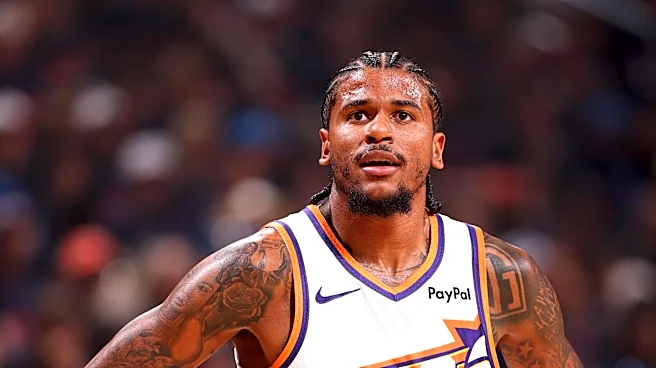
Truth be told, Devin Booker met expectations, even if he didn’t do it in the typical hyper-efficient fashion we’re used to seeing.
Compared to the previous season, his scoring numbers were actually up. He averaged 25.6 points per game in 2024-25 and bumped that to 26.1 points in 2025-26. At the same time, his field goal percentage dipped. His three-point percentage dipped. His assists, rebounds, steals, and effective field goal percentage all declined as well. The turnovers increased, too.
It was a strange season because the Phoenix Suns were in a transitional phase overall.
The expectation entering the year was that Booker would have to carry the offense and drag the team toward competitiveness. What ended up happening instead was the roster around him flourished because of his presence. Multiple players had career years, and a large part of that comes from the gravity Booker creates. His playmaking ability remains strong enough to manipulate defenses and generate open looks for teammates.
Even though he finished only 23rd in the NBA in assists per game at 6.0, he led the league in secondary assists with 1.2. His ability to collapse defenses and create passing sequences that eventually led to points is one of the more underrated parts of his game.
One thing I don’t think enough people appreciated this season was the reduction in his workload. Booker averaged 36 minutes per game in 2023-24 and 37.3 minutes in 2024-25. This season, he averaged 33.5. That feels like the sweet spot. That’s where Booker should be living, especially if the roster around him can consistently provide scoring support.
Booker was unquestionably the stabilizer for this team, and you felt it anytime he wasn’t available. The Suns went 37-27 with Booker in the lineup and carried a 115.9 offensive rating. Without him, they went 8-10, and the offensive rating dropped to 110.0.
Everything became easier when Booker was on the floor, even if it didn’t necessarily become easier for him individually. That’s where the real challenge existed this season. Especially late in games, opposing teams knew exactly where Phoenix wanted to go offensively, and there wasn’t much Booker could do to counter it. In clutch situations, he didn’t consistently perform like the max contract superstar the Suns needed him to be.
In 30 clutch games, Phoenix went 14-16. Booker posted a -7 plus/minus on 44/31/87 shooting splits. His assist-to-turnover ratio sat at 1.4, and the team carried a -4.0 net rating in those situations.

What It Means
What does it all mean? That’s the ultimate question, isn’t it? Devin Booker did not have a bad season by any means. When you factor in the transitional nature of the Phoenix Suns organization as a whole, he was more than a good soldier. He was the leader whom people sometimes fail to give credit for being.
That still doesn’t erase the feeling that continues creeping into the conversation, the realization that simply having Booker might not be enough.
I look at a team like the Minnesota Timberwolves. They reached back-to-back Western Conference Finals and still found themselves bounced in the second round this season. They’re good. Really good. They’re also not good enough. When that happens year after year, you start asking difficult questions about what actually leads to ultimate success, making the NBA Finals, and winning a championship.
As the seasons pass and opportunities slip away, the conversation naturally shifts toward value. What matters most? What can realistically be achieved? That’s where the Timberwolves are right now after three consecutive failed postseason runs, and that is where the Suns are heading with Devin Booker, although they won’t tell you as much.
He’s a max contract player who is one season away from his supermax kicking in. At the same time, stretches like the clutch performances this season create a more finite understanding of what he can individually elevate a team toward. And because the organization has boxed itself into such a difficult cap situation, there’s also a definable ceiling attached to what this roster can realistically become with Booker as the centerpiece.
That’s what this season ultimately represented from a perception standpoint. Booker is a star. I don’t know if he’s a superstar.
He’s absolutely someone you want on your team, and lord knows the fan base appreciates everything he has done and continues to do for this franchise. Still, the ultimate goal of winning a championship feels increasingly difficult to realistically envision.
In many ways, Booker’s season personified the internal struggle Suns fans are wrestling with. Is the most important thing winning a title at all costs, or is there value in appreciating the ride, the loyalty, and the connection along the way? Sometimes those things align. Most of the time, they don’t.
That’s why this season felt like a shift in mentality and reality. Maybe even the season where some fans quietly started stepping off the U.S.S. Booker.
Defining Moment
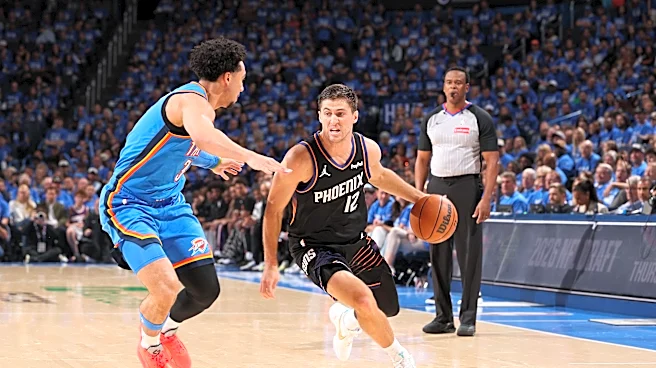
The best moment of the season for Devin Booker was also one of the defining moments of the season for the Phoenix Suns as a whole. Playing against the defending champion Oklahoma City Thunder, Phoenix had an opportunity to prove that, despite all of the questions surrounding the roster and the transition happening within the organization, they could still stand toe to toe with the best team in basketball.
And they did exactly that.
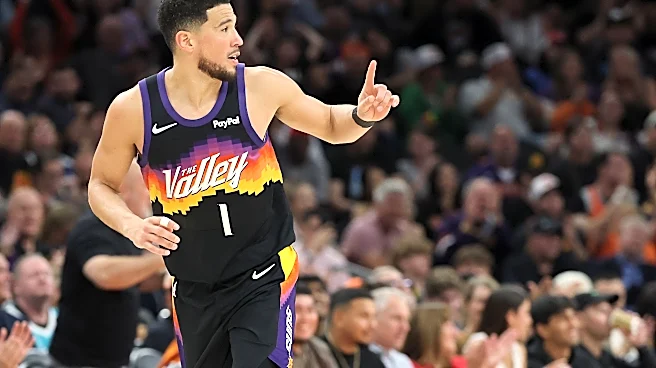
Booker closed the night by hitting a dagger game-winner over Oklahoma City, one of those moments that instantly reminds you why he still means so much to this franchise and fan base. It wasn’t simply the shot itself. It was the atmosphere surrounding it. The emotion. The realization that, for one night against the NBA’s measuring stick, the Suns looked capable of punching back.
Grade: A-
Despite the frustrations surrounding his late-game productivity, especially toward the end of the season, this was still a quality year for Devin Booker. Sure, some of the statistical efficiency dipped compared to his normal standards. Still, the Phoenix Suns thrived with him as the focal point. Even if the percentages weren’t always pretty, the team around him benefitted simply from his existence.
This team does not win 45 games without Devin Booker as its primary player. This team does not exceed expectations if Booker doesn’t sacrifice parts of his individual game for the betterment of the roster around him.
Yes, there are still questions. The hope is that next season provides answers not only about Booker but also about the organization’s ability to internally develop players and use continuity as a pathway toward more wins and a more competitive roster.
At this point though, I’m thankful Booker is still in Phoenix. I’m thankful the organization didn’t completely detonate everything and enter a full rebuild where fans spend the next two or three seasons hoping they someday draft a player capable of becoming what Booker already is.
The price-for-value conversation is absolutely valid, and as the supermax looms larger, those conversations only become more important. Still, what Booker brings to the Suns is something difficult to quantify. Relevancy.
And that matters more than people sometimes want to admit. Relevance changes the way a franchise is viewed nationally. It changes free agency conversations, television schedules, postseason expectations, and the overall energy surrounding the organization. Devin Booker dragged the Suns out of basketball purgatory years ago, and even now, as Phoenix tries to stabilize itself within a brutal Western Conference landscape, he remains the connective tissue between where this franchise was and where it still hopes to go.
Maybe he never ends up delivering a championship to the Valley. That doesn’t erase the reality that he has already helped change the franchise’s trajectory entirely.