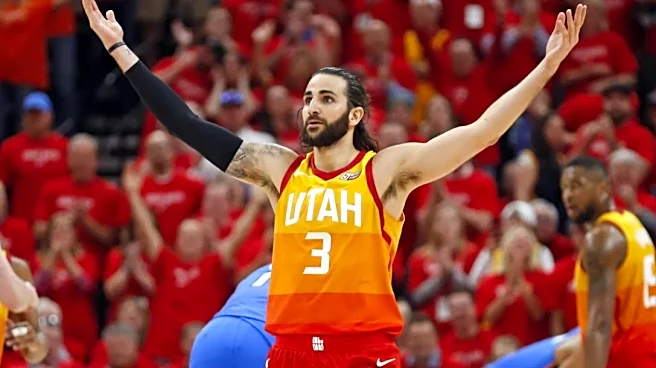







After reigning MVP and the runner-up for MVP in 2019, James Harden and the rest of the Houston Rockets gentlemen-swept the Utah Jazz 4-1 in April of 2019 and beat the Jazz for the second year in a row in the playoffs, the Jazz decided it was time to change it up and “upgrade” the roster. With a desire to improve their 3PT efficiency (10th & 12th in both 3PA/100 and 3PT% the prior two years), they moved on from two of their least efficient high-minute players, Ricky Rubio and Jae Crowder. Rubio’s
contract expired in free agency, and rather than re-signing him for roughly $17M per year — the deal he ultimately signed with the Phoenix Suns — the Jazz instead opted to trade for 31-year-old point guard Mike Conley, who was making roughly $30.5M annually.
On July 6th, 2019, the Jazz traded Crowder, Grayson Allen, Kyle Korver, the draft rights to Darius Bazley, and a future 1st-round pick (which ultimately became Walker Kessler) to the Memphis Grizzlies for Conley. That’s a hefty price for an aging guard who was already approaching the back end of his prime. Now, Mike Conley was a fantastic guard; Mike was an excellent facilitator, and despite being undersized, he still found ways to make opposing teams feel his presence on the defensive end in one way or another. Remember, the Jazz’s goal for the offseason was to help Donovan Mitchell with the scoring load while still not overtasking him with ball-handling responsibilities, and Mike Conley offered just that. Conley was joining the Jazz after shooting 37.4% from 3PT land on 4 attempts per game over the last 10 years of his career — it’s safe to say that he had a burner on him — and in that same span, he averaged 6 assists per game. There was no doubt that he could bring positive value and still carry an offense when Donovan Mitchell was off the floor — something Ricky Rubio didn’t do.
However, a question still lies: Did Mike Conley cover enough of the margins to be “better” than Ricky Rubio?

Excusing opponent 3PT data, there was still a +1.7 net point differential in favor of Conley. The Jazz successfully found a player who carried a more efficient offense

The switch from Rubio in 2018-19 to Mike Conley in 2019-20 was felt. The Utah Jazz jumped from the 13th-ranked offense in the NBA to #1 the following year. Conely boosting team TS% data was bound to happen when you supplant a career 41.7% eFG shooter (Rubio) for a player who shot ~11.0 eFG points better for their career (Conley). The offensive rebounding data is lineup noise due to playing with Gobert and Derrick Favors, who were one of the better off. glass crashing tandems in the NBA, but Conely brought a steadier offense with lower TOV rates, and because he left a larger 3PT footprint on games in both his passing and scoring.
When you’re comparing these two fantastic guards through the lens of a complementary role, I think it should be important how they’re complementing the players who were considered the best players on the team.

One thing I found interesting is that despite Rubio heavily favoring rim assists and how much he had the ball, Gobert’s FGA did NOT drop, and he still got his (relative to his average season & surrounding season FGA/FGA per 100 numbers):

Now let’s look at Conley & Rubio with Donovan Mitchell:

Now I find this SUPER interesting and there’s a lot to unpack here. While there is a +3 point differential in overall ORTG (in favor of Conley), there is only a marginal +1.6 difference in team TS%. It’s important to note that even while Rubio wasn’t efficient, he was still boosting the shot quality for everybody else on the basketball court at a high level.
It’s hard to say if the point guard context played a role in Donovan Mitchell’s overall efficiency numbers or if it was just a 3Y improvement like we typically see in budding young players, but if there’s one thing that’s certain regarding this side-by-side, it’s that Ricky improved Donovan’s overall shot quality more than Mike did. Now, because Donovan is a score-first guard whose offense is heavily slanted towards shot-making, he needs a real playmaking infrastructure around him. Donovan’s playstyle is largely complementary in a high-usage way. What I mean by that is that while he CAN pass the ball, he won’t do it at volume on a rate basis just due to the score-first nature of his game and how he operates. He is a high-volume second-side ball handler whose imprint on team offenses is boosting team TS% and TOV%, except he boosts each of those because he is efficient overall, and he takes a lot of shots (taking a lot of shots = less passes = ultimately lowering TOV%) — the ball falls a lot, but when it comes to enhancing his teammates and providing offensive ancillary goodness, that’s where he needs help.
Accounting for Donovan Mitchell’s style of basketball, and going back to Mike Conley vs Ricky Rubio, the player who complemented Donovan better overall while still increasing teammate productivity and providing ancillary goodness was probably Ricky Rubio.

I’ve talked about Mike Conley having better TO value over Ricky, but his worst years in passing TOVs were his years with the Jazz, which is highly uncharacteristic of him from an entire career standpoint.
The spacing was already an issue, but when you have a team that turns the ball over a lot, paired with NO playmaking outside of Rubio and Joe Ingles, it’s suboptimal for a lead guard! There is a real chance the Utah Jazz missed out on building WITH Ricky Rubio as the orchestrator and primary facilitator of the offense due to, primarily, just caring about “ball-goes-in” hoops. The Utah Jazz did the worst possible job when it came to maximizing Ricky Rubio’s talent and putting an optimal team around him.
Defense:
I’ve already stated that Conley found ways to make his presence known on defense despite his size, but his impact was incomparable to Ricky’s productivity on that end.
Ricky forced significantly more opponent turnovers, whether that be from drawing charges, fighting through, and drawing illegal screens, nabbing steals in the POA, or simply just using his IQ, reading the defense, and breaking up plays by defending in the passing lanes. He was widely used as a punching bag throughout the league because of how physical he was and how he annoyed players by simply being a pest; because he was such a nuisance on defense, the players would beat up on him even more.
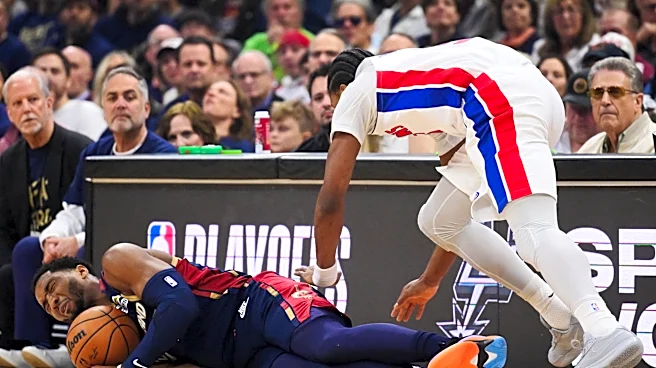
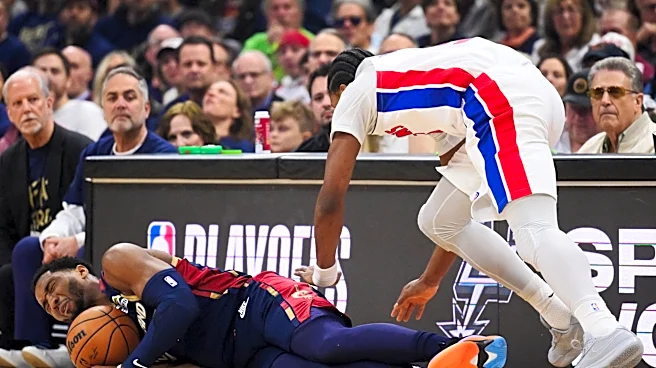
Jeff Teague shoves Ricky Rubio to the floor and into the stands:
Defense is what makes Rubio stand out in the lineup data; Rubio covered a lot of the defensive flaws that the Jazz and Donovan Mitchell had. After Rubio departed from the Jazz, Utah’s defense went from the 1st and 2nd-ranked defense in back-to-back years to the 13th, 3rd, and 10th-ranked defense in each season with the trio of Conley, Mitchell, and Gobert — and that difference says a lot when you have one of the best paint defenders ever to play the game on the back line.
Rubio also added great rebounding value to the team, averaging 4 rebounds a game and a dREB% of 13.1 for his career at 6’2 is valuable stuff.
While Ricky Rubio had his flaws, he covered so much on the margins where I conclusively believe that the Utah Jazz missed out on a path that could have brought them to greater heights than a second-round exit. However, I do think that Mike Conley did exactly what the Utah Jazz wanted him to do, and he did it very well. The Jazz were very blessed to have these two greats play in purple.
BRIEF ANALYSIS OF THE BOJAN SIGNING:
What has been deemed the 2nd-best free agent signing in franchise history, the Utah Jazz signed Bojan Bogdanovic to a 4-year, $72M contract (~$18M AAV). My belief is that the Utah Jazz were so hyper-fixated on “ball-goes-in” hoops that they didn’t realize he didn’t do much else. He was a very turnover-prone forward who had positional size whose role was to score, and that he did.


Bojan was an abysmal defender who did not rebound the ball well at all. Which is something you’d expect from an aging forward. (No wonder the Utah Jazz only got Kelly Olynyk and Saben Lee when they shipped Bojan to Detroit)
Though the Jazz got what they wanted, they lost a significant amount on the margins. My favorite saying in basketball is “if the ball isn’t falling, WHAT DO YOU DO?” and Bojan didn’t have much to offer when the ball wasn’t falling; in fact, he was a liability.
SIDE THOUGHT: The Utah Jazz could’ve had the same impact, and if not better, had they not traded Grayson Allen to the Memphis Grizzlies for Conley (just at a different position).
After signing Bojan and trading for Mike Conley, they took up $50M of the Utah Jazz’s $118M active cap, while they were already -$18M deep into the entire cap as a whole — Bojan and Conley took up ~42% of our active cap. With Rudy Gobert on the brink of a new max contract in 2021 and Donovan Mitchell approaching a rookie extension, along with losing both depth & additive players on the margins, the Utah Jazz were dead in the water before they even swam.
The 2019 Utah Jazz offseason will go down as one of the most detrimental offseasons in franchise history. Every dream of watching Donovan Mitchell in his prime while playing next to Rudy Gobert in a Utah Jazz uniform was killed in 2019.