





The year was 1948, and the Chicago Bears were having kicking troubles. So they tapped a source of athletic greatness that all NFL teams dip into now and again: semi-pro ball in Racine, Wisconsin.
And thus the legend of NFL placekicking pioneer Fred Venturelli was born.
“Fred Venturelli, Racine football and softball star, signed a contract to play with the Chicago Bears for the 1948 season,” reported The Journal Times out of Racine, Aug. 30, 1948. “The signing of Venturelli by George Halas, owner-coach
of the Chicago Bears, is regarded in the National Football League circles as a precedent breaking move because the Racine athlete was offered a contract only because of his kicking ability.”
Welcome to the story of the oldest rookie in Chicago Bears history, 31-year-old Fred Venturelli, the NFL’s kinda, sorta first specialist placekicker — and the only game he played in his NFL career.

“FIELD GOALS THING OF PAST” — how the Bears set the field goal bar, and then, with the league, fell below it
During the first three decades of NFL football, players had to be ready to play all three phases of the game. Most did. A team had its “starting 11,” and substitution rules were limited: entering the 1940s, when a player subbed out, he could not sub back in until the next quarter. These were the so-called “60-Minute Men,” versatile players valued first for their offense, then for either their all-around abilities or whatever they did that was elite, whether on defense or special teams.
Chief among those specialized elite players was a placekicking powerhouse for the Bears named Jack Manders. His nickname: Automatic Jack. Manders was a running back who was so exceptional as a kicker that in 1934, the UPI added an unprecedented 12th man to their All Pro team just to give Manders a spot.
Manders’s final game was the 1940 NFL championship, AKA 73-0, which showed the Bears as a placekicking-by-committee club, seven players attempting extra points. After Manders, quarterback Bob Snyder and tackle Lee Artoe became our top kickers, followed by left guard Pete Gudauskas, who hit a league-best 36 PATs in 1944, missing just one, and then going a perfect 27-27 in 1945. But the team attempted a grand total of zero field goals in ‘44, and only three in ‘45.
We weren’t alone in our field goal troubles. Midway through ‘43, the UPI published a widely syndicated piece on the problem; one Illinois paper ran it under the headline “FIELD GOALS THING OF PAST.”
“Not since 1940,” the author wrote, “when ‘Automatic’ Manders of the Chicago Bears completed eight seasons of football with a record total of 40 field goals to his credit has the art of the three-pointer been familiar in football.”
NFL teams hit 40% of their field goals in 1940; in 1943, they made just over 23%.
The Bears’ field goal problem saw a brief reprieve in the post-war title season of 1946, with halfback Frank “The Rhode Island Thunderbolt” Maznicki converting four of his nine attempts, while pairing with tackle Joe Stydahar to knock in 37 of 39 PATs. In ‘47, the kicking job went to halfback Ray “Scooter” McLean, who led the NFL in both PATs made and attempted (44-52).
But the field goal problem was back. McLean missed the team’s only attempt of the season, as their struggles intersected with one of the NFL’s hottest post-war debates: the substitution rule.
The league first loosened its sub rules in ‘43 to mitigate the loss of players entering the armed services; beginning in 1946, league leaders had annual debates over whether to completely eliminate substitution restrictions, while enacting these looser rules on a year-by-year trial basis.
This so-called “free substitution rule” was one of the biggest discussions around the game in ‘47, the same time that McLean retired. George Halas went into 1948 knowing two things about the team’s kicking game: he had to fix it, and he was willing to look anywhere to do so.

Meet the Racine Metal Parts’ finest: two-sport sandlot star Fred Venturelli
Fred Venturelli’s one NFL game is surely one of the greatest “I got a guy” stories in the history of pro sports.
By the time Venturelli showed up to Bears camp in the summer of 1948 for a kicking audition with George Halas, he was a Racine two-sport semi-pro legend. His long career in both football and the diamond sports started in high school, where he was a tackle and placekicker while also reportedly playing professional baseball at age 17 for the Cubs’ affiliate Eau Claire club. Despite scholarship offers to play football at a few schools, including Notre Dame, Venturelli skipped college to focus on baseball, spending the latter half of the 1930s playing softball and baseball for multiple company teams: electrical-device manufacturer Dumore Company and Allied Vans in 1937, and then Racine Western Printers in 1938.
Venturelli returned to the gridiron in 1939, signing with the semi-pro Cooper Cardinals of Kenosha and earning the nickname “The Golden Toe” from a sportswriter. In ‘39, Venturelli booted a 45-yard field goal, a remarkable distance considering that to that point, only two Bears kickers had ever made field goals from 45 or more yards: Dutch Sternaman hit from 45 in 1922, and Paddy Driscoll did him one yard better in 1927.
Still, Venturelli’s standout toe wasn’t enough to make NFL owners overlook his lineman limitations. His path nearly crossed with the league in 1941 when his Cardinals club played exhibition games against NFL teams, including the Bears. (It’s somehow perfect that Venturelli had to miss that game due to an ankle injury from softball season.) Despite that game, and despite both serving in the Navy during World War II, Venturelli wouldn’t connect properly with Halas for another seven years.
That’s when his business colleague Bud Esser, a long-time Bears season-ticket holder, met with his friend and business associate Halas and ribbed him about the sorry state of kicking for the Monsters of the Midway. Esser boasted to Halas that he knew a kicker playing semi-pro in Racine who was better than anyone on the Bears.
Halas bit. Show me.
Now the general manager of the Racine Metal Parts baseball team where he also played, and the kicker for the Racine Legion, Venturelli came to Bears camp in 1948 and impressed Halas enough to earn a preseason roster spot. His success grew. His brand?
Perfection.

In a Bears intra-squad game on Aug. 15 in front of 3,500 fans, Venturelli converted all four of his kicks: five PATs and a field goal. The preseason started a week later; the Bears beat the Steelers, and Venturelli — on his 31st birthday — was perfect once more, 4-4 on extra points including one after a 10-yard holding penalty, the Tribune speculating that Halas had told one of his players to purposefully draw the flag so that he could test Venturelli’s leg.
That performance raised Venturelli’s profile. “Mystery Man in Bear Camp” reported the Racine Journal Times. Noted the Tribune:
“Mr. Venturelli is trying to sell himself solely as a placement specialist to George Halas … who somehow can’t accept the developing idea that a football player should be paid only for this simple though vital chore. George still remembers the likes of Jack Manders, Bob Snyder and Joe Stydahar, who used to kick Bear points just for dessert, you might say.”
Venturelli’s stock rose again in the next game, against the Eagles. He made his only field goal and all three of his extra points, including a game-winning PAT to give the Bears a 24-23 victory.
“Fred Venturelli May Be Another Jack Manders,” read the headline in the Kenosha News for an Associated Press story published nationwide.
“You’ll scratch your head and wonder where you heard of Fred Venturelli after you read this fall that he’s the 31-year-old rookie who kicks extra points for the Chicago Bears,” the story began, ending with this endorsement: “Hopes are high in the Bear camp that Venturelli will turn out to be the best place-kicking specialist since ‘Automatic’ Jack Manders retired several years ago.”
Next up were back-to-back games against the Boston Yanks. The Bears won the first 42-7; Venturelli went 6-6 on extra points. They won the next 28-14; Venturelli went 4-4. The Bears were excited. Others were not. After the first Yanks win, columnist Guy Tiller of the Atlanta Journal took the team to task.
“The free substitution rule in football is being overdone to such a point that a pudgy, Racine, Wis., businessman kicks extra points for the Chicago Bears while high-priced halfbacks cool their heels,” Tiller wrote.
The pudgy businessman paid him no mind. Against the Giants on September 14, perfection ended for the Bears but not for Venturelli, who hit his only PAT in the 17-7 Bears loss.
The kicker, as it were, was the preseason finale.
Prior to their game against Washington, the Bears had 37 players on the roster and needed to cut two. Halas was leaning toward cutting Venturelli. Venturelli changed his mind.
With 50 seconds remaining in a 14-14 tie, Venturelli — who one newspaper would describe the next day as “a tubby, waddling, 31-year-old guard” — drilled a 17-yard field goal, giving the Bears a 17-14 win to close out the preseason. In six preseason games plus an intra-squad scrimmage, the Golden Toe was impeccable: 25-25 on extra points, 3-4 on field goals and two game-winning kicks.
Venturelli’s three made field goals in less than a month were more than the totals for four of the past five Bears seasons.
Halas had seen enough. Venturelli would be his placekicker for 1948.
But Halas still could not wrap his head around the notion of paying someone just to kick. No one in the NFL had ever done that. There was only one player in pro football paid just to kick, and he was in the competing AAFC league. So Halas asked Venturelli if he would play some offensive line too.
“I said no way,” Venturelli’s wife Marge recalled years later. “I wouldn’t allow it.”
Halas signed Venturelli anyhow, and that’s Venturelli’s claim to fame: the first NFL player to sign a contract strictly to kick.

The Golden Toe’s only NFL game
Fred Venturelli was “The Golden Toe.” Ben Agajanian was “The Toeless Wonder.”
Ask most football historians, “Who was the NFL’s first placekicking specialist?” and they’ll give you one name: Ben Agajanian. They are correct. That AAFC kicker I mentioned above? That was Agajanian, a remarkable story in his own right, a man who lost four toes on his right foot in a freak freight elevator accident in college. So he strapped on a special square-shaped shoe and went right on kicking, starting his pro career in 1945 with the NFL’s Eagles and Steelers. Though he only accumulated kicking stats, he did sub into games in ‘45 as both a back and an end.
Agajanian did not play in 1946, and in 1947 he joined the Los Angeles Dons of the AAFC, signed just as a placekicker. He returned to the NFL in 1949 with the Giants, and played until 1964 exclusively as a kicker. He is rightly credited as the first specialist placekicker in pro football, in so far as he did it in ‘47 with the Dons, and then held that position for a full career.
But if we’re being technical (and let’s face it, considering you’re reading 2,500 words about a one-and-done rookie placekicker from 1948, you seem like the technical sort), Fred Venturelli did in fact beat Agajanian to the NFL as a specialist placekicker.
His career lasted just one game.
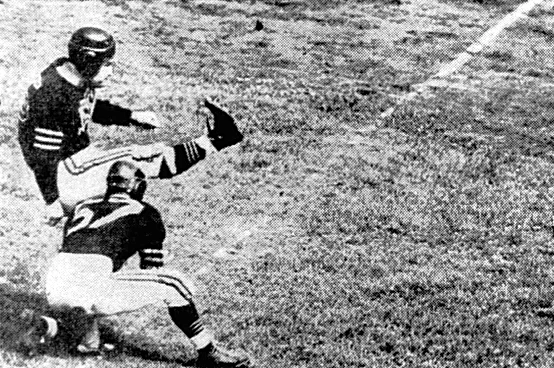
September 26, 1948, Week 1. The Bears traveled to Green Bay to face the Packers — and absolutely annihilated them. A 45-7 victory, Venturelli making all four of his PATs and going 1-2 on field goals.
One missed kick seemingly should not have mattered. But Halas was still not thrilled about using one of his precious 35 roster spots on someone with just one job. So in the second half, with the Bears up big, Halas called over prized rookie Johnny Lujack.
“Did you ever kick any extra points in college?” Halas asked. Yes, Lujack said, he tried one.
“Did you make it?” Halas asked. No, Lujack said, he didn’t.
“Well go in and kick this one.”
Lujack made the final two extra points of the blowout win. As Lujack later shared with Halas biographer Jeff Davis: “We came back to Chicago and, to save money, (Halas) fired our extra-point and field-goal kicker, Fred Venturelli.”

The next week, Halas put Venturelli on the inactive list; the big kicker watched from the sideline as the Bears beat the Cardinals 28-17. Lujack converted all four extra points. He would finish the season 44-46 on PAT, but 0-3 on field goals.
Venturelli stayed close with at least some of his teammates throughout the season, leading a group of them to a Racine outing in October. But he never played in the NFL again.
“He was a major jock, but he had heart,” his son, Fred Jr., told the Journal Times after Venturelli’s death. “He was enormously versatile — no matter what it was, he did it: golf, handball, basketball, baseball, football.”
In 1949, the Bears drafted their kicker of the future, George Blanda, who played here through 1958 and left the team as its all-time leading scorer, with an NFL record 156 straight made PATs. Offensive end John Aveni followed Blanda and kicked here for two years, ceding to tackle/linebacker Roger LeClerc, who controlled the job for most of the 60s, including the championship season of 1963.
On the eve of the 1967 season, the Bears claimed rookie placekicker Mac Percival off waivers. Percival, who stayed with the team through 1973, made the very history that Venturelli had for one beautiful September day: the first long-term placekicker in franchise history who did not have another position.
It was around this time that Venturelli developed hip problems from his years of athletics. Fortunately he knew someone who had just had hip surgery, someone he could turn to in a time of need: his old ball coach, George Halas.
“George thought that Fred was the greatest,” Marge Venturelli said. “They talked on the phone for about an hour.”
Fred Venturelli passed away in Racine on January 20, 1990, at the age of 72. That season, the highest paid kicker in the NFL, Morten Andersen, made $500,000. Bears kicker Kevin Butler was one of the most beloved and respected players on the team. Jan Stenerud was a year away from being the first pure placekicker inducted to the Pro Football Hall of Fame. I won’t be silly and say they owe Fred Venturelli for their kicking-only livelihood.
But if they read the Feb. 1, 1990 edition of the Racine Journal Times, I bet they would have appreciated the obit about the little known, high spirited 31-year-old “sandlotter” good enough at their craft to convince one of the greatest figures in NFL history to give him a contract to do one thing and one thing only.
They might have even been happy to know that The Golden Toe remained a dedicated member of the kicking fraternity.
“He carried that with him,” his wife said, “until the day he died.”

–
–
–
Jack M Silverstein is Chicago’s Sports Historian, Bears historian at Windy City Gridiron, a Pro Football Hall of Fame analyst and author of WHY WE ROOT: Mad Obsessions of a Chicago Sports Fan. Follow his 90s Chicago Bulls book research at readjack.substack.com.
This story was made possible by Pro Football Reference, Newspapers.com and especially the staffs of the 1930s, 40s and 1990 of the Racine Journal Times. Thank you to the great football historian Timothy Brown for confirmation on NFL substitution rules in the 30s and 40s. For more from Tim on sub rules, visit his great site! And thank you to John Turney for the discussion!
Want more NFL special teams history that intersects with our beloved Bears? Check out my 2020 story on George Burman, the first long snapper.
–
–
–
POST-SCRIPT
We love learning new NFL “firsts” here at Windy City Gridiron, especially when they involve our beloved Bears. And because the Bears were a founding member of the NFL, loads of NFL firsts ran through the Pride and Joy of Illinois.
The challenge with identifying any kind of “first” is that if you miss just one person, you’re completely wrong. Additionally, the notion of “first” sometimes depends on slivers upon slivers of arcane definitions. As I noted, Ben Agajanian deserves the moniker “the first placekicker,” which is why I included the “(Kinda)” in the headline. Venturelli gets it on a technicality.
But the Toeless Wonder is one of three placekickers who I had to really look hard at to decide Venturelli’s place in NFL history. Here is the rundown of my three judgement calls:
BEN AGAJANIAN
- Career overview: 1945-1964, across three leagues, with several breaks here and there.
- Why he could be the “first placekicker”: Agajanian is clearly the first kicker in the history of pro football to make his living just on his kicking. In 13 sporadic seasons of pro ball from 1945 to 1964, he only accumulated kicking stats. (He’s also the only player to have appeared in the AAFC, NFL and the best known version of the AFL! Meaning he played in two leagues that merged into the NFL, along with the NFL itself.) As I wrote, the best answer to “Who is the NFL’s first placekicker?” is Ben Agajanian.
- Why I ruled him out: He subbed into games in ‘45 as a back and an end.
- Was he ever “just” a placekicker? Yes, for most of his career, starting in 1947 with the AAFC’s L.A. Dons and then in the NFL beginning with the Giants in 1949.
PHIL MARTINOVICH
- Career overview: Played four seasons of pro ball, in the NFL with the Lions in ’39 and us in ‘40, and then in the AAFC with the Brooklyn Dodgers in ’46 and ‘47.
- Why he could be the “first placekicker”: Like Agajanian, Martinovich only accumulated kicking stats in the NFL. Of the four possible title holders for “first placekicker,” Martinovich had the earliest season where he was just a kicker.
- Why I ruled him out: He subbed in for both the Lions and Bears, as his NFL years pre-dated any version of the free substitution rule. He then made starts for the Dodgers in both ‘46 and ‘47.
- Was he ever “just” a placekicker? He was basically just a placekicker in ‘39 and ‘40, but again, he entered the league with full intention of being a position player as needed, unlike Venturelli.
KEN STRONG
- Career overview: Member of the Pro Football Hall of Fame and the 1930s All-Decade team, Ken Strong was a force of a fullback for most of his career, playing for the Staten Island Stapletons from 1929 to 1932 and then the Giants for eight seasons between 1933 and 1947.
- Why he could be the “first placekicker”: In his final three pro seasons, from 1945 to 1947, Strong only placekicked.
- Why I ruled him out: Two reasons. First, unlike Venturelli, he didn’t enter the league with the kicker-only status. That only came toward the end of his career. Second, though noted as a specialist in those last three seasons, the Giants media guide still listed him as a “back” (meaning, a part of the offensive and defensive backfield) in all three years.
- Was he ever “just” a placekicker? Yes, his final three seasons… just not on paper.
What about Lou Groza, you ask? It doesn’t feel right to not mention The Toe in this story. But I never had any questions about him, for two reasons. First, he came into pro football as both a kicker and a lineman. In Venturelli’s one-and-done season of 1948, Groza was a full-time Browns starter. Second, Groza played in the AAFC for his first four seasons; by the time he got to the NFL, Venturelli was long gone.
Want to learn more about the best NFL placekickers of the two-way era? The great historian Chris Willis wrote his top 10 list in 2017, starting with our main man, Automatic Jack!