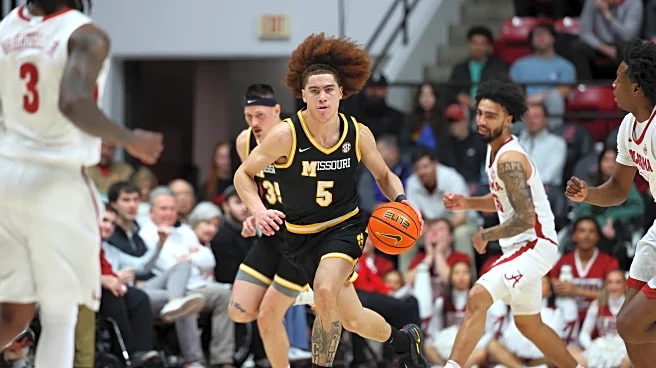



T.O. Barrett’s breakout moment is easy to spot.
It played out with five minutes left in regulation against Oklahoma. Missouri trailed by three. Barrett caught a ball reversal in the right slot and waited for Shawn Phillips Jr. to trot up and set a ball screen on the Sooners’ Tae Davis.
Barrett didn’t need it.
He threw a quick shoulder to the right, which put Davis off balance just enough for Barrett to drive left. For an instant, Davis looked like he cut him off, until Barrett spun off the forward’s
frame, finished at the rim and drew a foul. Not a bad capstone on a night where the sophomore marked his first start for the Tigers with a career-high 21 points.
In his last six games, Barrett has averaged 13.8 points, 5.0 rebounds, and 3.3 assists – a jump that came just as it was natural to wonder if his progress had stalled. More importantly, it’s helped Mizzou’s offense stay afloat during Anthony Robinson II’s ongoing slump.
Now comes the big question as MU rests up during a bye week: Will it last as the Tigers face a brutal closing stretch in their SEC schedule? Because if Barrett’s performance ebbs, so might the program’s chances of playing its way off the bubble and into the NCAA Tournament.
Those questions also come colored with a trace of skepticism.
Taking a deeper look at the trends behind Barrett’s improvement explains why those questions linger. Synergy Sports data shows that his touches are worth 0.905 points, and Barrett’s net rating (-0.141) is still running in the red for the season. The efficiency chart below shows that his performance remains mostly flat.
Comparing Barrett’s net rating to Robinson’s is also handy. The junior remains one of the SEC’s top on-ball defenders, but his offensive woes have forced his overall net rating into a steady decline. Barrett’s trajectory, on the other hand, only shows a slight improvement.
That stasis makes sense, though, once you analyze the types of plays MU uses to get Barrett involved.
Some of it reflects the circumstances surrounding Missouri’s half-court offense. Robinson’s regression is clear, but it followed Sebastian Mack seeing his minutes dwindle once non-conference play ended. The UCLA transfer’s problems stem from ongoing spacing issues, which have given opponents license to clog the middle of the floor.
In that environment, Barrett faces off against static defenses and conservative ball-screen coverages, leaving him little room to operate. Over the last six games, he’s averaged 0.816 points per possession in the half-court, according to Synergy data. That’s roughly equivalent to the 30th percentile nationally for Division I players. So, while his counting stats are up, his efficiency hasn’t experienced a similar jump.
The contrasts become sharp when breaking down Barrett’s possessions by play type. For example, we can see his isolation touches (1.5 PPP) do a lot of work to prop up his profile, papering over his modest returns attacking from pick-and-rolls or spotting up.
Barrett has also averaged 3.5 points per game in transition over this most recent stretch, which lifts his overall efficiency to 0.932 PPP. That would land almost exactly at the national average, but Barrett’s profile looks healthier compared to Robinson’s woes.
Put another way, Barrett’s surge is compensating for production MU expected elsewhere in the backcourt. Instead of elevating the Tigers, Barrett’s newfound productivity is mostly helping them tread water. But how is he doing it, and – more importantly – can he keep as MU closes in on March?
Answering that question means looking at how MU’s offense schemes up advantages that Barrett can exploit.
Barrett thrives playing isolations, but these plays aren’t the result of him freelancing or bailing MU out when a possession breaks down. That modest horns set, for example. Barrett averages 1.545 points per possession when MU runs it. Why does it work? It puts the defense in a dilemma from the start.
The alignment flips the floor by placing a pair of Tigers at the elbows, clearing out space below the free-throw line. Then, one of those players makes a hard cut to the opposite slot, pulling their defender along with them. The result: a double gap with a rim protector hanging out around the restricted circle.
It also plants a diverse decision tree. The Tiger in the slot might catch a ball reversal and lob an entry pass to a teammate for a post-up with no backside help. They could rip through and attack a gap off the catch. Or they could pivot and make a stationary handoff to another Tiger cutting from the corner.
Often, Barrett makes the simplest choice. He puts his head down, plunges into the middle gap, and uses his sturdy 6-foot-4 frame to absorb contact on his way to the rim.
Even if an opposing big man does rotate down, Barrett’s strength lets him go right at their chest. He doesn’t have to alter his finishing angle or try a complicated finish. And if nothing else, he’ll likely draw a foul and earn a trip to the line, where he shoots 84.4 percent.
These snippets also teach a critical lesson: Barrett’s best plays start with off-ball movement that forces defenders to chase, and puts an opponent’s defensive shell under strain.
Staggered screens and floppy action showcase this concept, changing the floor before Barrett even touches the ball. A guard starts under the rim, sprints around one or two screens, and pops out on the wing. When Barrett gets the ball, his defender might be trailing, creating space to attack. Sometimes, one of those screeners might also set a ball-screen for Barrett to use without worrying about a help defender rotating from the baseline.
Mizzou also uses staggered screens to clear one side before running floppy action. When Barrett ends up on the weak side, there’s still a chance for him to attack the rim if the ball moves quickly, since the defense can get overloaded.
That play led to Barrett’s signature moment against Oklahoma. There’s no question that floppy action sets have given him touches worth 1.222 points each during this recent stretch.
Yet we’re also seeing signs ($) that opponents are adjusting. Alabama started top-locking cutters that wanted to run off staggered screens, and their off-ball defenders cut through instead of locking and trailing Tigers guards around floppy action. Mississippi State also tried its hand at jamming up staggers in MU’s win this past Saturday.
However, quality scheme doesn’t work in a vacuum. How well it functions depends on who is on the floor with Barrett.
An assessment of lineup data ($) shows Barrett is most potent when he serves as Mizzou’s main ball handler. Sliding him down to play combo guard and sharing the job of lead guard with Robinson only leads to worse results. Put bluntly, changing his role strips out the structure he relies on to succeed.
That’s why Barrett’s surge is simultaneously real and unstable. Lineups anchored by Jayden Stone and Mark Mitchell tend to hold together, allowing actions like horns and floppy to flow smoothly. Removing those stabilizers – or shifting Barrett’s role – takes away critical guardrails.
While some plays in Mizzou’s playbook help Barrett succeed, others might be asking too much of him right now. Over the past six games, pick-and-rolls made up almost 30 percent of his half-court touches but only produced 0.41 points per play, including just 0.154 points per possession from ball screens in the middle of the floor.
These plays often use five-out alignments and simple reads. But in the process, are they taking away the movement and spacing that help Barrett play his best?
On film, these on-ball touches show Barrett turning the corner and facing drop or deep drop coverage, with a big defender in his way. If the main defender recovers, Barrett has to try a tough finish off two feet, and he isn’t a strong enough shooter off the dribble to punish a defender who goes under the screen on the perimeter.
But if you watch some of the later clips, you’ll see that the first ball screen rarely forces the defense to rotate. The Tigers might run through their secondary offense as the ball comes back to Barrett, but he still faces the same problem as before: a defense that’s set and waiting for him in the gaps.
Changing where the play starts isn’t a solution, because the same spacing issues remain. In the spread pick-and-rolls below, Barrett’s still plowing through a crowd before winding up too deep. When he goes to finish or drop the ball off, there are active hands ready to strip him clean.
In theory, Spain pick-and-rolls – where a guard sets a back screen for the roller before popping out – could alleviate that congestion. It clears two defenders from the paint and should free up the roll man for an easier feed, either a pocket pass or a lob. And if Barrett can’t score or make that passing read, he can pass the ball back to a shooter at the top of the key.
Instead, Barrett remains so committed to driving the ball that defenders switch once he’s in the lane. And usually, that second defender is another big man who stands his ground, walls up, and forces Barrett into a difficult shot.
That doesn’t mean Mizzou should abandon ball screens. They just aren’t an effective trigger for sets at this point. Until Barrett’s finishing and passing reads evolve, pick-and-rolls that arise during the flow of a set – after off-ball movement help warp a defense – work better.
It’s also notable that early-clock opportunities are creating drag, frequently ending in turnovers. A large share of those miscues are passing turnovers, occurring when Barrett is asked to play fast, either early in the clock or out of high pick-and-rolls, before the defense has been displaced.
And for all the strides Barrett has clearly taken, Mizzou remains somewhat shackled.
Robinson can function as a primary scorer from pick-and-rolls, but he’s keen to hunt pull-ups. That’s at odds with a coaching staff that covets rim pressure. Barrett is keen to supply it – except it’s a struggle for him to make it happen from ball screens. Yet the movement required to bend a defense and create the right conditions takes time.
Theoretical answers exist. Finding a way to make Mack useful is one of them. UCLA did it a year ago by spreading out the floor and using him in slot ball screens. Except that playing him alongside Phillips creates more headaches than it solves. Ideally, Gates could roll out Jevon Porter as a stretch five – except he’s still out with a bruised quad. And finally, lineup data shows that using Trent Pierce and Mitchell as a small-ball frontcourt results in negative returns.
For now, Barrett does just enough – largely through isolations – to buoy MU. But defenses are already adapting, and his turnover rate over the past six games remains north of 22 percent. Unless Barrett can find a way to squeeze out more efficiency, this feels less like a breakout than a short-term role swap.
And with more formidable opponents ahead, how long it holds is the only question that matters.