





On January 19, the Knicks got absolutely blasted by the Dallas Mavericks in an embarrassing game at home on Martin Luther King Jr. Day. In the postgame recap, I likened it to an extremely similar game in an extremely similar situation against the same opponent in the same arena a few years ago. That game led to the permanent benching of Derrick Rose and Cam Reddish and sparked a turnaround the next night.
Of course, the Knicks then emphatically ended their 2-9 nightmare slump with a 54-point blowout
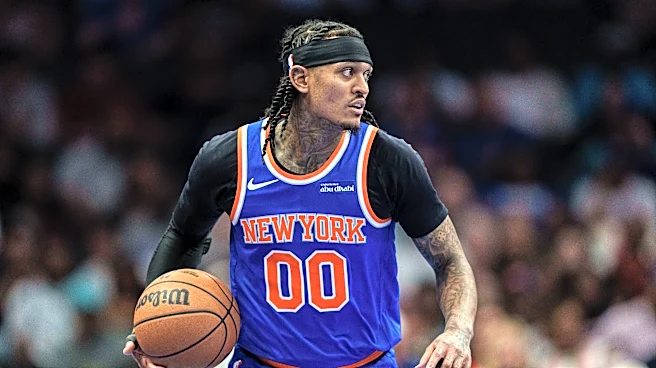
over the rival Nets that featured one big rotation change. Jordan Clarkson, who signed with the Knicks in July after agreeing to a buyout with the Utah Jazz, was now out of the rotation after several games of increasingly bad play.
After his NBA Cup heroics and microwave scoring potential sparked optimism to start the year, he had become the new Evan Fournier. While Fournier was benched nearly a month before the Mavs catastrophe, he shares more similarities to Clarkson than the divisive Reddish and ultimate vet Rose.
He played a total of seven minutes in the next five games combined, all in garbage time. But midway through that stretch, Deuce McBride went down with a knee injury that turned into a multi-month absence due to core surgery, and while Mike Brown initially decided to give his minutes to Tyler Kolek and a mix of more run for Landry Shamet and Mo Diawara, he eventually turned back to the veteran to get some run right before the trade deadline, where he performed admirably.
But when Jose Alvarado came into the fold in early February, he was once again pushed out of the rotation, as the Knicks’ bench took shape as Alvarado, Shamet, Mitchell Robinson, and a mix of Diawara and Jeremy Sochan.
That was until March 8 in Los Angeles, when the Knicks’ offense was being handcuffed by a fiery Lakers team without LeBron James. Needing a spark, Mike Brown called on Clarkson, who did his best in an eventual loss. While it didn’t immediately lead to re-entering the rotation, it was a start. A few days later, he took advantage of a Josh Hart injury for a memorable return to Utah.
From there, he was back. He played meaningful minutes in the team’s final 15 games of the season, emerging as Diawara endured growing pains and Alvarado struggled to entrench himself in the rotation, even when McBride returned as the season drew to a close. But it wasn’t the microwave scoring that had earned Coach Brown’s trust; it was a total reinvention of who he is as a player.
For much of Clarkson’s career, he’s only been known for scoring. He doesn’t pass, he doesn’t defend, he doesn’t do the little things. There’s a reason that Mike Breen was so disgusted with him when he played with Utah. He was there to do a very specific role, and since he wasn’t doing it, he was benched.
But what if he started to do those little things? That’s likely what went through Clarkson’s brain after he got benched, and you saw the change immediately.
All of a sudden, Clarkson was picking up full court. He was pressuring ballhandlers. The effort we were seeing was drastically different, and it looked like a player who knew he was playing for his job.
He was still taking a fair amount of shots, but the dumb shots were dwindling. He shot 52.5% from the field after being reinserted in the rotation after being a pitiful 42.8% into early March. He was also passing more, putting up multiple games with at least four assists.
And while this, coupled by him becoming a paint-scoring machine, is good enough to warrant consideration off the bench, he’s also decided to channel his inner Josh Hart and become a rebounding machine.
Offensive rebounds:
First 56 games: 41 (993 minutes)
Last 21 games: 30 (364 minutes)
He’s grabbed nine through five playoff games. He had at least four on two different occasions in the final month of the regular season.
He’s suddenly become a key part of a Knicks team that has championship aspirations, while being a completely different player than he has been his entire career.
The near-34-year-old looked doomed to be in Fournier’s shoes, out of the league once his contract expired, to suddenly looking like a desirable vet for a team next season. But that’s not what’s on his mind right now. He’s been given a new lease on life and, after a half-decade in the doldrums of a tanking Utah team, he’s finally somewhere that’s trying to win and has reinvented himself to do so. It’s certainly admirable.