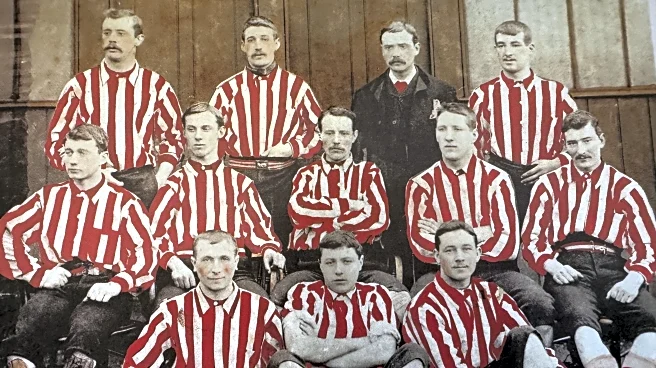

John Robertson Auld was born in Scotland in 1862. His early football career appears to have been fashioned playing centre-half for Lugar Boswell, a club based in the small Ayrshire town of Lugar where
he had moved to with his elder brother to open a Cordwainer’s (shoe-mender’s) business.
His determined and attacking performances brought him to the attention of famed Scottish side Third Lanark in 1883 and he seems to have played there for most of the period between 1883 to 1887, although there is record of him turning out for Queens Park during this period too. Both these clubs were within walking distance of his parents’ home in Glasgow, and it seems he spent weekends there, returning to his work in Lugar during the week.
In 1887/88 he signed for Queens Park, where his play was described as “a little rough”. He returned to play for Third Lanark in 1888/89 and it was in this season that the “Thirds” or the “Hi Hi” as they came to be known, won the Scottish Cup.
The winning of the trophy, as well as his three Scottish caps (two in 1887 and the other in 1889) all added to a burgeoning reputation for Auld in the game. He was an imposing centre-half who was adept at playing the more attacking Scottish version of his position and it was no surprise that clubs South of the border were showing interest.
In 1889 Tom Watson and Sunderland came North looking for talent. Top of their list was a captain and centre-half and Johnny Auld fitted the brief.
Sunderland were on the cusp of their first season in the Football League – indeed, they were the first team to join the league after its formation in 1888/89. Stoke had finished bottom and had failed to get re-elected. Sunderland had mounted a vigorous campaign to be elected, including a promise to pay the travel costs of all visiting teams, a not inconsiderable burden given every other team in the league was from the North West or Midlands.
Johnny Auld was one of the first of a raft of heralded players recruited from Scotland by Sunderland in these early years of the league. Fine players such as Johnny Campbell and David Hannah from Renton, Hugh ‘Lalty’ Wilson from Newmilns and Jimmy Millar from Annbank were part of that first tranche of Scots to join Sunderland as “the team of all talents” began its formation.
Aged twenty-eight, Auld made the move South to join Tom Watson’s project. His transfer included an agreement by the club to facilitate the establishment of a Cordwainer’s business in the town. Auld also received a signing-on fee of £20 and £150 for agreeing to turn professional. He also negotiated a whopping £300 in salary over two years. He was, without doubt, a major investment on the part of the club at this time, and his influence in attracting the best of talent North of the Border was probably part of the package he brought with him.
Sunderland finished a credible seventh in their first season and played their way to the semi-final of the FA Cup, with the capture of Ned Doig for £150 from Arbroath a key acquisition as the spine of ‘the team of all talents’ took life with Doig, Auld and Campbell/Millar.
The following season 1891/92 with the inspirational Auld as pivot and captain and the arrival of James “Blood” Hannah and Donald Gow from Glasgow Rangers, Sunderland won the league championship at only the second time of asking. It was a huge achievement and backed up by a colourful march to the FA Cup semi-finals again.
Auld’s influence and personality was a major factor in uniting and guiding these stars of the game into a team to be reckoned with.
The title was retained in 1892/93 and a runners-up spot in 1893/94, with the half-back line of Wilson, Auld and Gibson, with William Dunlop augmenting and eventually becoming a permanent member of this formidable line from 1892.
In 1894/95 the title was won again but by this point Johnny Auld was into his thirties and played only four games in the league campaign as he covered illness and injury in the half-back line. One game Johnny Auld did play in saw him captain the side and become the ‘World Champions’. Hearts, league champions in Scotland took on the English champions Sunderland on the 27th April 1895. Both teams were fully composed of Scottish players and a cracker of a game saw Sunderland and Johnny Auld lift the trophy, as they eventually triumphed by five goals to three, with Auld scoring one of the goals.
In 1896 Johnny Auld made the short but historic journey to Newcastle, becoming the first ever player to make that switch in the football league era. He only played a season before establishing a role that in its description resembles the modern day Sporting Director.
He became part of a three-man committee identifying players. His fame and influence were such that, similar to his time at Sunderland, a raft of good Scottish talent was signed. He was also instrumental in recruiting the innovative Scottish trainer John Quar McPherson. Consequently, by 1912, our closest rivals had three league titles and four FA Cup final defeats on their CV, eventually winning the cup in 1910.
Throughout his time at Newcastle Johnny Auld continued to reside in Sunderland and oversee his Cordwainers business in the town. And, despite his role north of the Tyne, Auld still remained a key person in the story of Sunderland AFC. He acted as a financial guarantor for the club as Sunderland fell on hard times during the First World War, and also paid for the funeral of his former teammate Johnny Campbell in 1906.
Auld was residing at 46 Roker Park Road in the town when he passed away after a fall from a tram at the age of seventy in 1932. He is buried in Mere Knolls cemetery in Sunderland.
Johnny Auld was without doubt one of football’s first pioneers as a player. A captain and leader, his influence and skill, not only in defence but in the initiating of attacks at which he so excelled saw unprecedented success for the ‘team of all talents’ and rightly affords him a place in the history of Sunderland AFC.