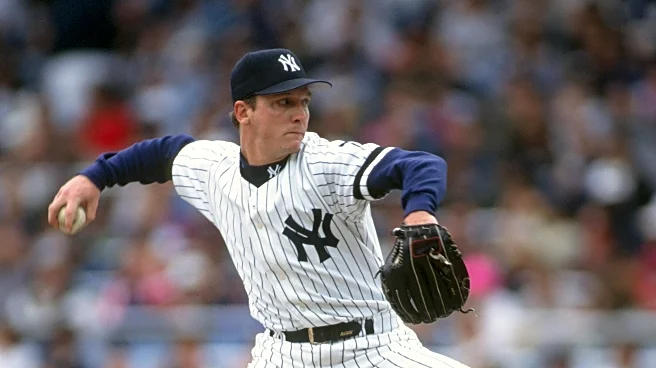


Before the Yankees brought in the right-hander with a bit of an odd wrist movement at the top of his pitching motion in 1995, he was making his rounds with other organizations. David Cone’s career began with the Kansas City Royals, pitching in 11 games before a trade to the Yankees’ crosstown rival, the New York Mets, where he spent the most seasons and became an All-Star. In the 1992 campaign, Cone returned to the American League after being dealt to the Toronto Blue Jays a couple months before their
championship run.
Fresh off winning his first World Series as a “hired gun,” Cone hit the open market for the first time. During this inaugural free-agent journey, Cone was in contact with the Yankees, who were trying to sign him along with the Atlanta Braves and MLB pitching legend Greg Maddux, but they ended up with Jimmy Key, who played an integral role in the 1996 World Series championship. The negotiation process for Cone, as he said to the New York Times, was chaotic with then-general manager Gene Michael.
“The chaos in the front office is self-evident,” said Cone. “The negotiations with the Yankees were rather strange, needless to say.”
Cone ended up signing back with the Royals, where he had two of his best seasons, but was ultimately traded back to the Blue Jays, who then moved him to the Yankees at the 1995 Trade Deadline. During the offseason that followed a welcome introduction to pinstripes, Cone finally signed a multi-year deal to remain in the Bronx.
David Cone
Signing Date: December 21, 1995
Contract: 3 years, $19.5 million
Before the Yankees were able to sit back and marinate in the feeling of having signed the pitcher they had tried to bring in three years earlier, they had to sweat. The Baltimore Orioles were also heavily involved in the negotiations for Cone. After having added Roberto Alomar to their roster — an appealing move for someone like Cone looking for a World Series — it was ultimately the Yankees and George Steinbrenner who made the most attractive offer. It was a back-and-forth race for the clubs to try and sign him, but the Yankees were able to add their late-season ‘95 ace to a rotation that needed an arm like his.
In his first full year with the Yankees in 1996, Cone started in just 11 games due to suffering from an aneurysm in his right arm, but returned just in time to attempt making the playoff roster. Following his miraculous comeback four months after surgery, Cone finished the year with a 2.88 ERA, including three straight outings of at least seven innings and three wins, a loss, and a no-decision in his final five games. Cone pitched in every round of the 1996 postseason and finished the year as a World Series champion against Maddux’s Braves, notably winning Game 3 on the road to help the Yanks avoid an 0-3 deficit.

In 1997, Cone pitched 195 innings, a return to form after rehabbing for the majority of ‘96, and posted an even better ERA than he had the year prior. His 2.82 ERA was the eighth-best in all of MLB, and his 6.7 bWAR was also the eighth-best among MLB arms at 34 years old.
And he didn’t stop there at 35 years old, either. Cone pitched over 200 innings and won 20 games with a 3.55 ERA in the Yankees’ historic 1998 season. He sat atop the wins leaderboard with then-Blue Jay Roger Clemens and Texas Rangers right-hander Rick Helling, despite not posting the best individual numbers as he had in the previous seasons. Those Yanks avenged an ALDS loss to Cleveland in ‘97 by winning it all, and Cone did his part with six strong in San Diego for World Series Game 3.
In 193.1 innings pitched as a 36-year-old, Cone had his last hurrah of an excellent season for his career and in a Yankees uniform, finishing with a 3.44 ERA and a bWAR just above 5.0. The 1999 season also saw him pitch the 16th perfect game in MLB history against the Montreal Expos, a career highlight that will never be forgotten given its confluence with Yogi Berra’s return to Yankee Stadium and 1956 perfecto artist Don Larsen throwing the first pitch.
Re-signed for another rodeo in 2000, Cone’s Yankees career unfortunately ended in a nightmare. He finished with a 4-14 record and, in 155 innings pitched, posted an abysmal 6.91 ERA. The Yankees saw a significant drop off in the once-ace’s arm, and Cone couldn’t find any kind of rhythm in the 29 games he started. Left out of the playoff rotation, he had to settle for a last-resort bullpen role, though he did get Mike Piazza out in a key situation in the Fall Classic. It was enough to help the Yankees win their third consecutive crown.
While Cone’s end to his Yankees career was not the kind of exit he probably would have liked, he still proved that the club’s pursuit of him was worth all of the blood, sweat, and tears. He was a huge part of those teams that brought the World Series trophy back to The Bronx, and his impact on the organization is a lasting one.
See more of the “50 Most Notable Yankees Free Agent Signings in 50 Years” series here.