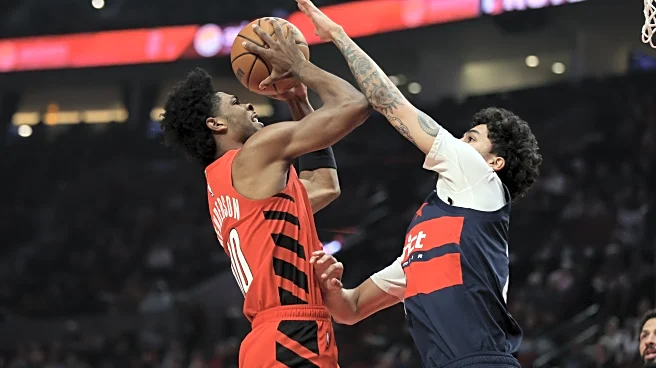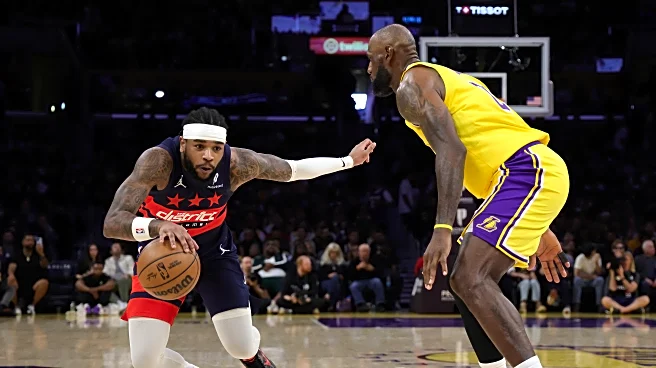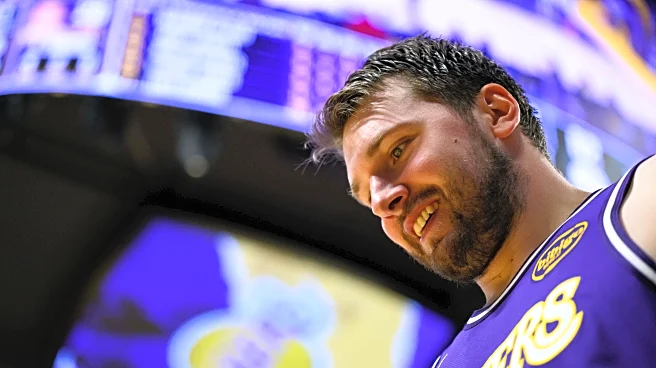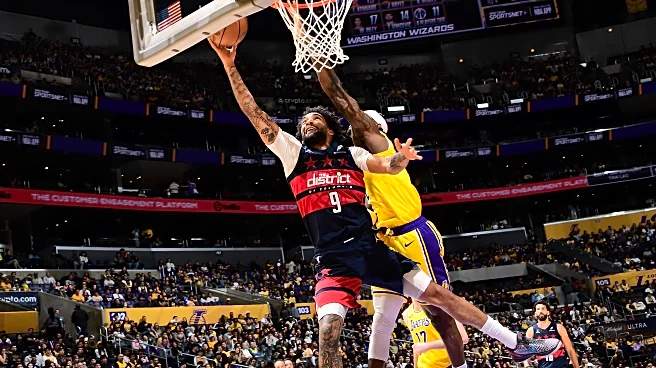

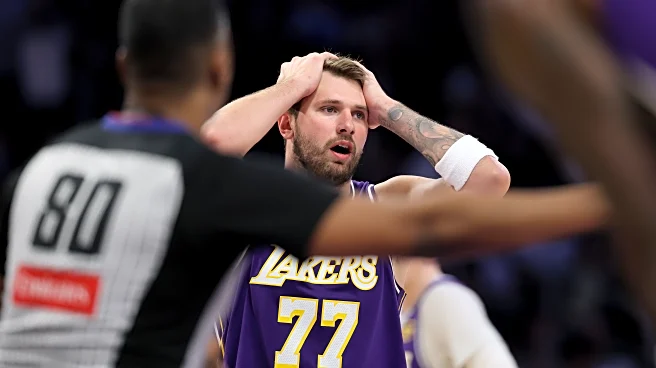
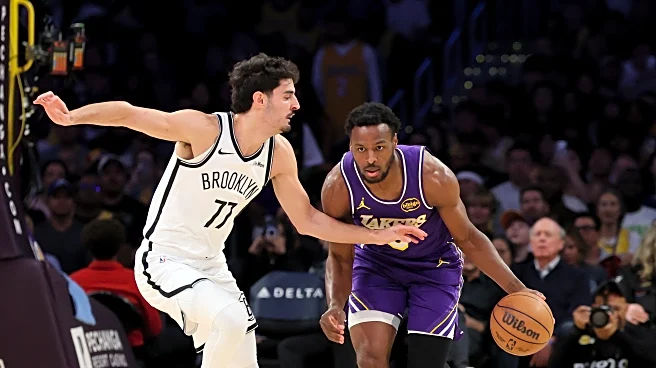
The Wizards final West coast trip of the 2025-26 season ended about the way you’d expect — with a blowout loss to the Los Angeles Lakers. The final margin was only 19. The game itself didn’t feel that close, which is pretty normal for the Wizards this season.
Both the Wizards and Lakers shot poorly from three-point range — Washington, a mind-numbing 20.0%; the Lakers a merely bad 29.2%. The Lakers won on the boards (+15 rebound advantage) and by making twos at a much better clip. LA converted 67.3%
of their shots inside the arc, and Washington just 58.6%.

The Lakers also won from the free throw line. They earned twice as many trips to the free throw line and outscored Washington 25-12 on foul shots.
The preceding should not be read as complaining about the refs. The Lakers drove frequently, and the Wizards are a group that struggles to defend without fouling. Which is to say, Washington gets beat at the point of attack and then does a lot of reaching and grabbing and swiping, which often draws whistles. They’re also antsy, which in this case is a euphemism for man do they bite on ball fakes a lot.
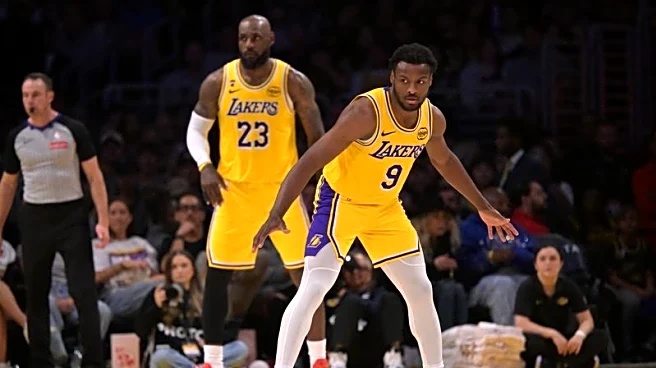
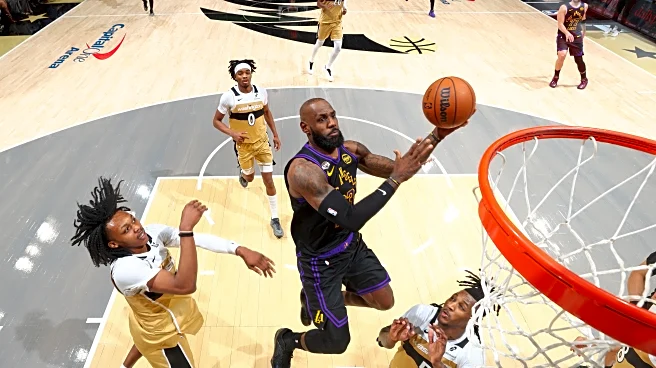
To be honest, in a lot of ways it felt like the Lakers had some mercy (or perhaps a different agenda) on the offensive end last night. Washington was utterly incapable of doing anything to slow LeBron James and Austin Reaves pick-and-roll actions. In fact, they had a difficult time handling James setting ball screens for anyone.
As an aside, what James is doing this season is impressive. He’s spent his entire life with the ball in his hands. He’s been the guy others set screens to get loose. Now in his 23rd season, he’s setting ball screens (something he rarely did in his previous 22 years in the NBA) and playing as a third option when Luka Doncic is on the floor.
As for the Wizards, Justin Champagnie made shots. There’s a cranky old man vibe to his game, which seems to morph into bemusement when things get physical. He also tends to play hard, and he has a kind of sneaky Jeff Green-esque athleticism. It seems like he’s just kinda gliding along like a normie NBA athlete, and then suddenly he’s throwing down a dunk over a seven-footer or blocking a shot above the box. He was pretty good last night — 18 points on 12 shots.
Tristan Vukcevic notched a decent PPA score, though I did not think he played well. He ended the night with four steals and a block in 20 minutes, which is a lot. His overall defensive effort wasn’t good, in my view.
Jaden Hardy came off the bench to score 11 points on eight shots in 23 minutes. He had several genuinely good defensive possessions against James (the elder one), and grabbed five rebounds. I’m intrigued enough by his shooting and offensive aggressiveness to want to see him in extended action the final seven games. By “extended,” I mean 30+ minutes per night with maybe 2-3 starts mixed in.
Thoughts & Observations
- It’s interesting how context can change the value of a player’s performance. Rui Hachimura with the Lakers is basically the same as he was in Washington, though with fewer rebounds, lower usage and higher efficiency. The latter two go together. In Washington, he had to carry a heavier creation load because the team didn’t have anyone else. In Los Angeles, he plays in the space created by Doncic, James, and Reaves and can take mostly open shots. He was always a good shooter (former assistant coaches told me he routinely won the team’s shooting contests in Washington). In LA, he gets easier shots.
- Early in the first quarter, Hachimura drove a closeout on Will Riley that was an example of Washington’s defensive challenges. First, Riley was late on the closeout and off balance. Hachimura turned down an open three to drive. Riley recovered enough to run along a step behind but had no impact on the play. Meanwhile, Vukcevic was late to rotate, didn’t get into help position, and then was weak on top of it all. Hachimura ended up with a nearly ayup line finish.
- Riley had a lot of trouble contending with Hachimura. He needs to spend a lot of time in the weight room getting stronger this offseason.
- Vukcevic gave a Kornet contest on a three-point attempt in the first quarter. Reaves missed.
- I didn’t think that I would ever write this sentence, but…On one possession, the Wizards forgot to guard LeBron James. Seriously, at 6:20 in the first quarter, literally no one matched up with arguably the best player in basketball history.
- Stat from the Lakers broadcast: Doncic this season is the first player in Lakers franchise history to accumulate 2,000+ points, 500+ assists, and 100+ steals in the same season.
- Another tidbit: Last night, James tied Kareem Abdul-Jabbar for all-time wins as a player, including playoffs. The LA victory was 1,228th time James has been on the winning team. Tim Duncan is third at 1,158, followed by Robert Parish at 1,121, and Karl Malone at 1,050.
- It’s a shame Anthony Gill isn’t 10-12 years younger. With a steady diet of playing time this season, he seems to be figuring out how he can be successful in the NBA. He’s attacking closeouts, using ball fakes to create openings, and he competes hard on defense and on the boards despite giving up size and strength advantages to most of his matchups.
Four Factors
Below are the four factors that decide wins and losses in basketball — shooting (efg), rebounding (offensive rebounds), ball handling (turnovers), fouling (free throws made).
The four factors are measured by:
- eFG% (effective field goal percentage, which accounts for the three-point shot)
- OREB% (offensive rebound percentage)
- TOV% (turnover percentage — turnovers divided by possessions)
- FTM/FGA (free throws made divided by field goal attempts)
Stats & Metrics
PPA is my overall production metric, which credits players for things they do that help a team win (scoring, rebounding, playmaking, defending) and dings them for things that hurt (missed shots, turnovers, bad defense, fouls).
PPA is a per possession metric designed for larger data sets. In small sample sizes, the numbers can get weird. In PPA, 100 is average, higher is better and replacement level is 45. For a single game, replacement level isn’t much use, and I reiterate the caution about small samples sometimes producing weird results.
POSS is the number of possessions each player was on the floor in this game.
ORTG = offensive rating, which is points produced per individual possessions x 100. League average so far this season is listed in the Four Factors table above. Points produced is not the same as points scored. It includes the value of assists and offensive rebounds, as well as sharing credit when receiving an assist.
USG = offensive usage rate. Average is 20%. Median so far this season is 17.7%.
ORTG and USG are versions of stats created by former Wizards assistant coach Dean Oliver and modified by me. ORTG is an efficiency measure that accounts for the value of shooting, offensive rebounds, assists and turnovers. USG includes shooting from the floor and free throw line, offensive rebounds, assists and turnovers.
+PTS = “Plus Points” is a measure of the points gained or lost by each player based on their efficiency in this game compared to league average efficiency on the same number of possessions. A player with an offensive rating (points produced per possession x 100) of 100 who uses 20 possessions would produce 20 points. If the league average efficiency is 115, the league — on average — would produced 23.0 points in the same 20 possessions. So, the player in this hypothetical would have a +PTS score of -3.0.
Players are sorted by total production in the game.