


While not every draft pick works out, every pick comes with a plan. Teams don’t select players on a whim; they have a deep understanding of their traits, skillset, and potential projection. Whether they achieve said potential is up to a multitude of factors, several out of the player’s control (ex: injuries), but nonetheless players for the most part are given a role and responsibility to fulfill in an NFL roster.
See, Lewis Bond wasn’t drafted by the Texans to sit on the sidelines and be a ‘depth
piece’ behind Tank Dell or Nico Collins. He was brought in due to his profile, production, and potential.
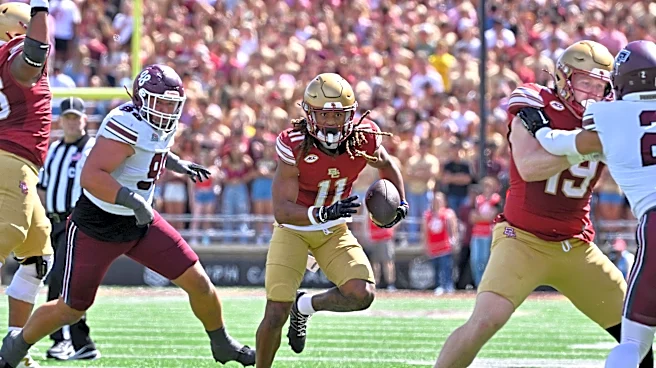
Team captain and multi-year starter, Bond fits the bill for what Nick Caserio and Co. seek in their late-round fliers in the draft. Bond isn’t a burner, nor is he possess a mammoth frame akin to the multiple of the receivers on the roster. What Bond does provide is a complex and advanced ability to run the full NFL route tree.
NFL Route Trees
Below is as simple of a diagram of the standard route trees used in the NFL. College is a fair bit different given the RPO and reliance on screens (read: college QBs are inept). As you’ll see, each type of route requires two of: straight line speed, turning, or acceleration.

Given the NFL’s adoption of two high safeties and match coverage schemes, straight line speed isn’t as devastating as it was in the Will Fuller V era. Now, turning and acceleration are prioritized to find openings in those zone coverages. That’s where Lewis Bond impressed at Boston College and led him to being one of the most productive wide receivers in the nation.
Most sixth round picks lie somewhere between training camp fodder and a roll of the dice. With any luck, they can snag a roster spot and cling onto a special teams role until players above them are either hurt or under-perform. However, Bond does not match that prototype. He’s not a special teamer, nor is he a WR1 type. He is by trade and practice a contributing receiver in an offense built for him to make an impact as the second or third option for Stroud to find.
Entering the 2026 NFL Draft, the Texans receiver room was absent a route running specialist. Someone who could fill voids in the defense and run routes which enable bigger receivers to get open. To rephrase, Bond runs the routes that defenses must respect and defend that allows for other receiving options to get more space. He’s the quick jab to Nico Collin’s upper cut.
The Statistician’s Desk
In 2025, Bond played 60% of snaps from the slot, increasing each year he started at BC. His highest-volume target and reception game, which include Michigan State (11 catches), Georgia Tech (8 catches), and his massive 171-yard performance against Syracuse (8 catches all came in games where his primary position was listed in the slot.
In trips formations, Bond would play all three positions; slot furthest inside, middle of the trio, and furthest outside. This diversity of positioning enabled Bond to diversify his positioning on the field without changing up his routes. It created an endless combination of routes that allowed him to get open throughout Boston College’s offense. To be clear, this isn’t “scheming a player open” as some teams need to do for limited players. This is unlocking a player’s potential through a position-agnostic approach. Any route, anywhere, anytime. That’s a defensive back’s nightmare.
He hauled in 88 receptions on 111 targets for 993 receiving yards and 1 touchdowns. Bond averaged 11.3 yards per reception on the season.
The Film Room
According to PFF, Bond made the majority of his plays in the middle of the field. He was rarely if ever targeted beyond 10 yards down the field. This illustrates both his potential as a pass catcher in short-yardage situations and his limitations to stretch the field at any level.

It doesn’t take an NFL scout to evaluate this chart and conclude that Lewis lacks raw speed. What Bond does bring to the table is a full deck of short and intermediate routes that can complement the pass catching options currently on the roster.
Now, it can be argued that Bond’s slot role will be assumed by Tank Dell and Jaylin Noel. Both returning into an offense that is in dire need of their speed and shiftiness. However, Bond is not of the same mold as either Dell or Noel. Both receivers are more straight line, downfield threats who can win on the boundary. Bond specialized in zone-busting routes, and has a more NFL-specific route tree thanks to playing in Bill O’Brien’s system in Boston College. Bond will find utility in the Texans offense in scheme-specific plays that will allow him to get open in the middle of the field. He’ll be the situational player the Texans can implement to get first downs and draw attention away from their other weapons.
What does success look like for a Day Three rookie in a crowded wide receiver room? First, it’s making the roster. He will be competing directly with veteran Justin Watson for the sixth and final wide receiver spot. Based on my current Rosterology, Bond will just edge out Watson. Then, it’s finding a way onto the field. I don’t expect Bond to make an impact on special teams, instead he will need to rotate in with Noel to create mismatches with linebackers or nickel backs. He can’t expect to repeat his production at Boston College, but a catch or two a game from the sixth round pick could very well open up this offense for a prolific season.