

Where were you when Tim Wakefield’s knuckleball drifted toward Aaron Boone, almost like a butterfly dancing in the wind?
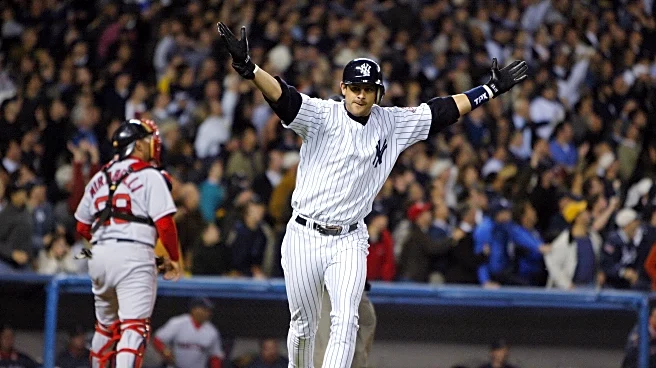
Every Yankees fan remembers that October night in 2003. The stage was set after New York completed its comeback to force extra innings. Wakefield’s pitch floated the way only his knuckleball could. The crack of the bat was followed by a moment of silence, a split second of hope, immediately followed by the chaos only pure joy can produce. When the ball sailed off Boone’s bat and
into the left-field seats, Yankee Stadium erupted. A player who had only been a Yankee for a few months became part of franchise history and the sport’s greatest rivalry forever. Fast-forward 23 years later, and the now-manager of the team celebrates his birthday today.
Aaron John Boone
Born: March 9, 1973 (La Mesa, CA)
Yankees Tenure: 2003 (player); 2018–present (manager)
The stitches of a baseball might actually be the strands that hold Boone’s DNA together. His grandfather Ray Boone was a two-time All-Star infielder. His father, Bob Boone, was a four-time All-Star catcher who played 19 seasons in the major leagues and later managed six seasons with the Royals and Reds. His brother Bret Boone became a three-time All-Star second baseman. The Boone family is one of the rare multi-generation baseball lineages in the sport, and Aaron entered the major leagues with expectations that came with the name.
Aaron Boone’s place in Yankees history as a player comes almost entirely from one moment. But what a moment it was.
When the Yankees acquired Boone from the Cincinnati Reds at the 2003 trade deadline for left-handed pitcher Brandon Claussen and Charlie Manning, the move looked more like a practical roster adjustment than a franchise-altering decision. New York needed help at third base after injuries and inconsistency at the position spelled the end of Robin Ventura’s tenure at the position, and Boone arrived as a solid defender who was enjoying one of his better seasons at the plate.
No one could have predicted how quickly his name would become permanent in Yankees history.
That October, the Yankees met the Boston Red Sox in the 2003 American League Championship Series, one of the most intense rivalries the sport has ever seen. After six exhausting games, the series reached a decisive Game 7 in the Bronx. The game stretched deep into extra innings. In the bottom of the 11th, Boone stepped to the plate to lead off the inning against Wakefield. He hadn’t even started the game, as he was mired in a miserable 5-for-31 slump that postseason and manager Joe Torre instead elected to go with Game 7 starter Pedro Martinez’s nemesis, Enrique Wilson. But Boone entered as a pinch-runner late and now he had his chance.
The first-pitch knuckleball floated toward the plate. Boone swung.
The ball carried into the left-field seats, ending the game instantly and sending the Yankees to the World Series. Few postseason home runs in baseball history have produced a louder reaction. The Yankees’ bench flooded the field as Boone rounded the bases, and the moment immediately joined the short list of iconic plays in franchise history.
Many fans hoped Boone’s home run would become the defining image of that era of the Yankees–Red Sox rivalry. Instead, it became a dramatic chapter in the rivalry’s larger story. The Yankees fell to the Marlins in that year’s World Series, and the following season Boston completed the comeback from a 3–0 deficit to win the 2004 ALCS and then went on to end of the Curse of the Bambino.
Wildly enough, Boone’s Yankees playing career ended almost as quickly as it began. During the following offseason, he suffered a knee injury while playing basketball, which violated the terms of his contract and allowed the Yankees to release him before the 2004 season began.
Boone’s injury triggered one of the most consequential roster moves in Yankees history. Suddenly without a starting third baseman, New York pivoted and acquired Alex Rodriguez from the Texas Rangers in February 2004. Rodriguez moved from shortstop to third base to accommodate Derek Jeter, and the deal reshaped the Yankees roster for the next decade. In a strange twist of baseball history, Boone’s brief Yankees career indirectly opened the door for one of the most famous trades the franchise ever made.
At the time, it seemed like Boone’s place in Yankees history would be limited to that single October swing, a fun memory of days gone by. Years later, his story with the organization took a second chapter.
In December 2017, the Yankees hired Boone out of the ESPN broadcast booth as manager, replacing longtime skipper Joe Girardi. Despite having no previous managerial experience, the former postseason hero suddenly found himself responsible for guiding the next generation of Yankees baseball.

Under Boone over the last eight seasons, the Yankees have posted a 697–497 regular season record and a 25–27 postseason record. The stat Yankees fans care most about, though, is the one with a zero beside it: World Series titles. Entering 2026, Boone is still searching for his first championship in pinstripes as either a player or manager after coming up short in his first nine. They’ve only made it to the Fall Classic once, in 2024, and thanks to Freddie Freeman, Boone’s decision to use a rusty and somewhat-limited Nestor Cortes in extra innings of the opener will linger in fans’ minds for quite some time.
Boone’s tenure has been defined by both success and scrutiny, as managing in the Bronx always brings expectations. However, since it is his birthday, we will allow Boone’s connection to Yankees history for today to rest solely on that swing in October 2003. In a franchise built on moments, legends, and championships, very few players manage to create the moment every kid dreams about in the backyard. Aaron Boone did it.
Happy birthday, Aaron “Bleepin” Boone.
See more of the “Yankees Birthday of the Day” series here.